Hey, friend! Welcome back to another post. Today, I want to show your a series of historic markers from the Heritage Trails that I stumbled upon in Downtown Fort Worth, Texas while I was walking North on Main Street.
Upon further research when I got back home, the Heritage Trails is a series of 22 historical markers in Downtown Fort Worth that details Fort Worth’s rich history. I was able to take photos of eight of them that I immediately saw just walking around. Now, I will have to go back to get the rest of them.
Enjoy what I found on my short walk!
African-American History

“The first African American residents of Fort Worth were slaves who received the delayed news of their emancipation on June 19, 1865. Those who remained in the area began to build a community on the city’s East side. A blacksmith shop operated by John Pratt was the first known African-American business. Mount Gild Baptist Church, 600 Grove Street was organized in 1875.
The community revolved around the Fraternal Bank & Trust Co. and the Masonic Lodge, both built in 1912 by prominent businessman William Madison “Gooseneck Bill” McDonald. Loans from McDonald’s bank enabled residents to purchase homes and start businesses. The community was served by several African-American doctors, including Dr. Riley Ransom, who opened a hospital in 1918.
A mural by artist Paula Blincoe Collins (along the Intermodal Transportation Center Walkway) depicts Fort Worth’s early African-American history.”
Cynthia Ann Parker and Native Americans of North Texas
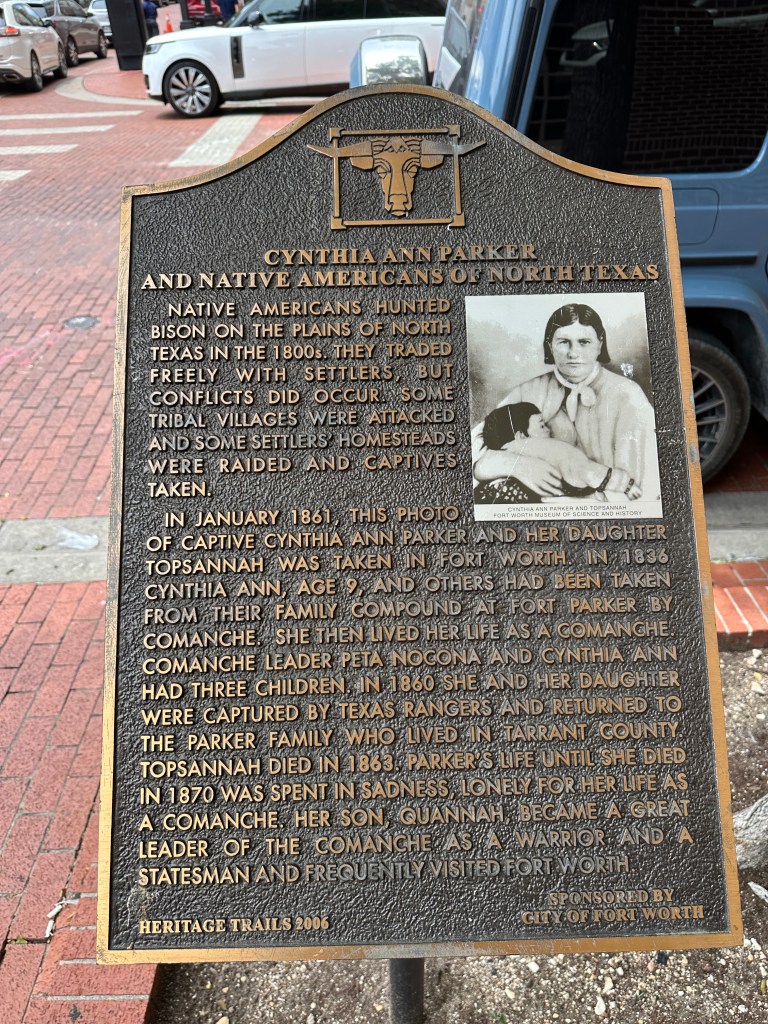
“Native Americans hunted bison on the plains of North Texas in the 1800s. They traded freely with settlers, but conflicts did occur. Some tribal villages were attacked and some settlers’ homesteads were raided and captives taken.
In January 1861, this photo of captive Cynthia Ann Parker and her daughter Topsannah was taken in Fort Worth. In 1836 Cynthia Ann, age 9, and others had been taken from their family compound at Fort Parker by Comanche. She then lived her life as a Comanche. Comanche leader Peta Nocona and Cynthia Ann had three children. In 1860 she and her daughter were captured by Texas Rangers and returned to the Parker family who lived in Tarrant County. Topsannah died in 1863. Parker’s life until she died in 1870 was spent in sadness, lonely for her life as a Comanche. Her son, Quanah, became a great leader of the Comanche as a warrior and a statesman and frequently visited Fort Worth.”
King Candy Co. (1906-1978)

“On this site (810 Main Street) stood the tearoom of King Candy Co. that opened in 1922. This was the public face of King Candy Co., founded in 1906 by John P. King. He built a large manufacturing plant on E. 9th street in 1910 that employed a work force of mostly young women turned out chocolates under the slogan “King’s candy for American Queens.” It was the first chocolate manufacturing plant in the South.
King grew the business over the years, eventually making it one of the big five candymakers in America. They celebrated their 40th anniversary in 1946. Two years later John King died. The company tried to carry on without him but in 1968 the family sold it. In 1978 it closed, bringing the curtain down on a 72-year-old Fort Worth institution.”
Flying Machines
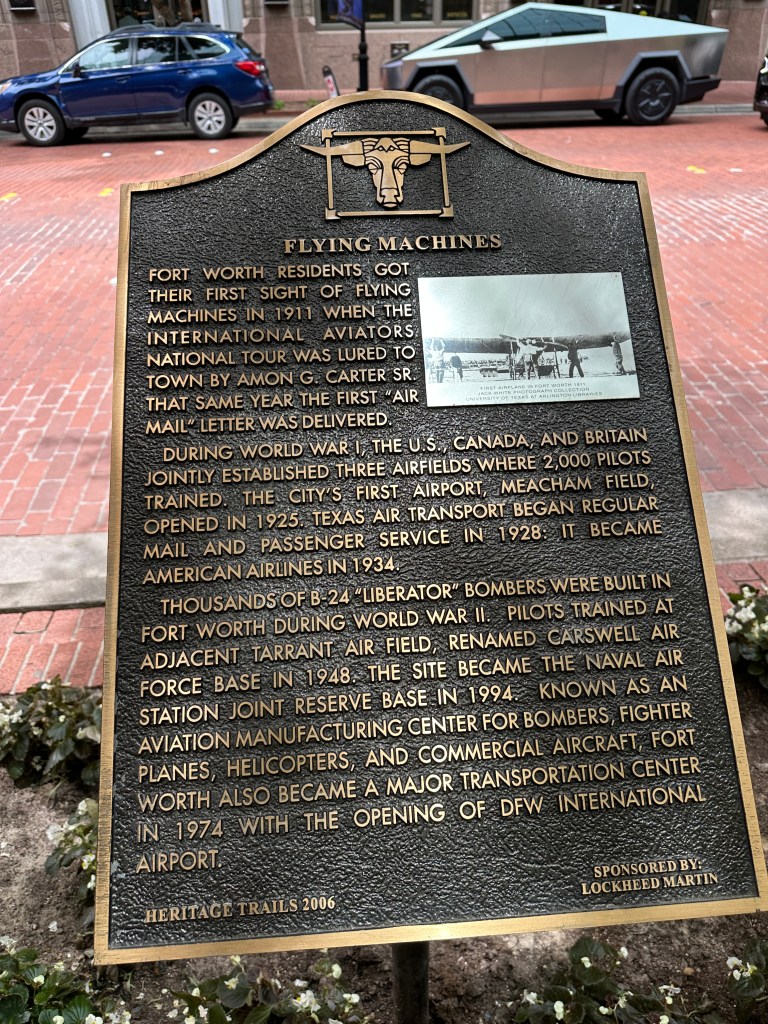
“Fort Worth residents got their first sight of flying machines in 1911 when the International Aviators National Tour was lured to town by Amon G. Carter Sr. that same year the first “Air Mail” letter was delivered.
During World War I, the U.S., Canada, and Britain jointly established three airfields where 2,000 pilots trained. The city’s first airport, Meacham field, opened in 1925. Texas Air Transport began regular mail and passenger service in 1928: it became American Airlines in 1934.
Thousands of b-24 “Liberator” bombers were built in Fort Worth during World War II. Pilots trained at adjacent Tarrant Air Field, renamed Carswell Air Force Base in 1948. The site became the Naval Air Station Joint Reserve Base in 1994. Known as an aviation manufacturing center for bombers, fighter planes, helicopters, and commercial aircraft, Fort Worth also became a major transportation center in 1974 with the opening of DFW International Airport.”
Architectural Diversity
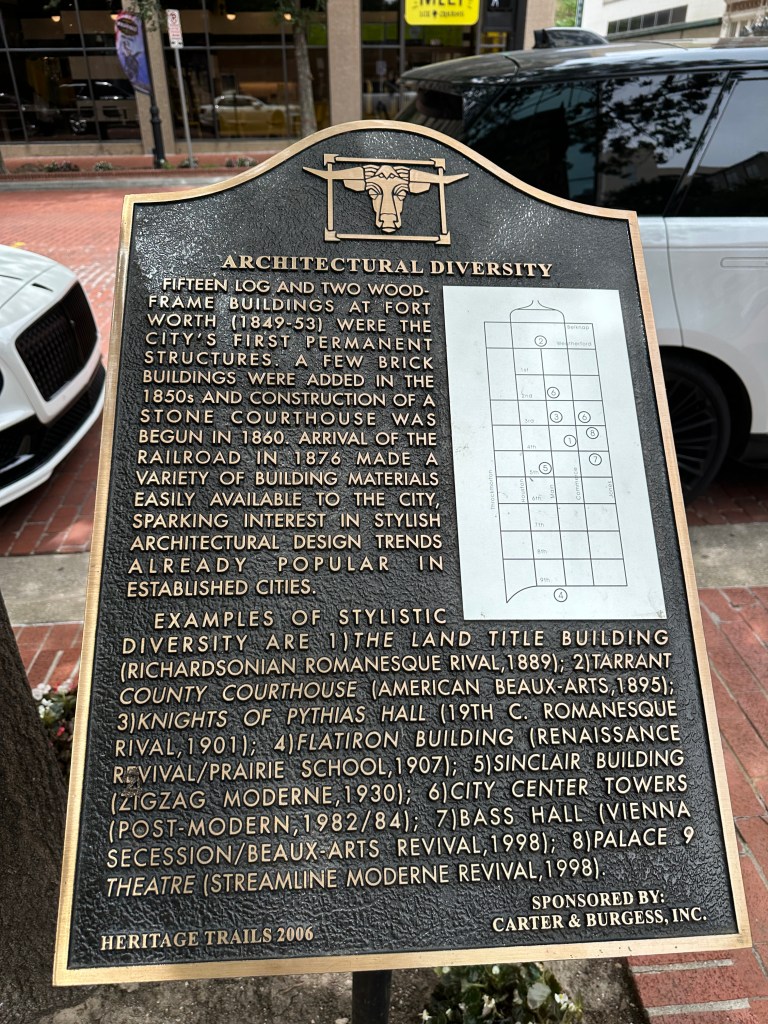
“Fifteen log and two wood-frame buildings at Fort Worth (1849-53) were the city’s first permanent structures. A few brick buildings were added in the 1850s and construction of a stone courthouse was begun in 1860. Arrival of the railroad in 1876 made a variety of building materials easily available to the city, sparking interest in stylish architectural design trends already popular in established cities.
Examples of stylistic diversity are
1) The Land Title Building (Richardson Romanesque Rival, 1889);
2) Tarrant County Courthouse (American Beaux-Arts, 1895);
3) Knights of Pythias Hall (19th C. Romanesque Rival, 1901);
4) Flatiron Building (Renaissance Revival/Prairie School, 1907);
5) Sinclair Building (Zigzag Moderne, 1903);
6) City Center Towers (Post-Modern, 1982-84);
7) Bass Hall (Vienna Secession/Beux-Arts Revival, 1998);
8) Palace 9 Theatre (Streamline Moderne Revival, 1998).”
The Wild Bunch

“When professional photographer John Swartz snapped this photo of five young men in 1910, he had no idea it would end up on a “Wanted” poster. Swartz and his brothers, considered Fort Worth’s premier photographers, were unaware that the dandily-dressed men were notorious outlaws. Pleased with his work, Swartz placed a copy of the photo in his studio window. It wasn’t until a Pinkerton detective recognized one of the men in the photo that Swartz knew he had taken what was to become a legendary portrait of “The Wild Bunch.” The five men were Harry Longbaugh (The Sundance Kid), Ben Kilpatrick, George Lee Roy Parker (Butch Cassidy), Will Carver and Harvey Logan. They had been in Fort Worth for two months, but by the time law enforcement issued the poster on May 15, 1910, the elusive gang had already moved on. Butch Cassidy and the Sundance Kid were never captured.”
Amon G. Carter, Sr. (1879-1955)

“From his arrival in Fort Worth in 1905 until his death, Amon Carter was the city’s most vigorous booster and champion. At his death, it was said that more than half of the city’s workers were employed by businesses Carter helped establish. As the owner and publisher of the Fort Worth Star Telegram, Carter tirelessly promoted Fort Worth and West Texas and was responsible for the paper’s masthead, “Where the West begins.”
Through his national influence, Carter brought World War I and II military bases and manufacturing plants to Fort Worth. In 1922 he established WBAP, Fort Worth’s first radio station with studios in the Blackstone Hotel. In 1948, Carter started Texas’ first TV station, WBAP Channel 5.
The Amon Carter Museum, one of the nation’s premiere art museums, features his collection of Remington and Russell, as well as other American art.”
Opera House & Theaters
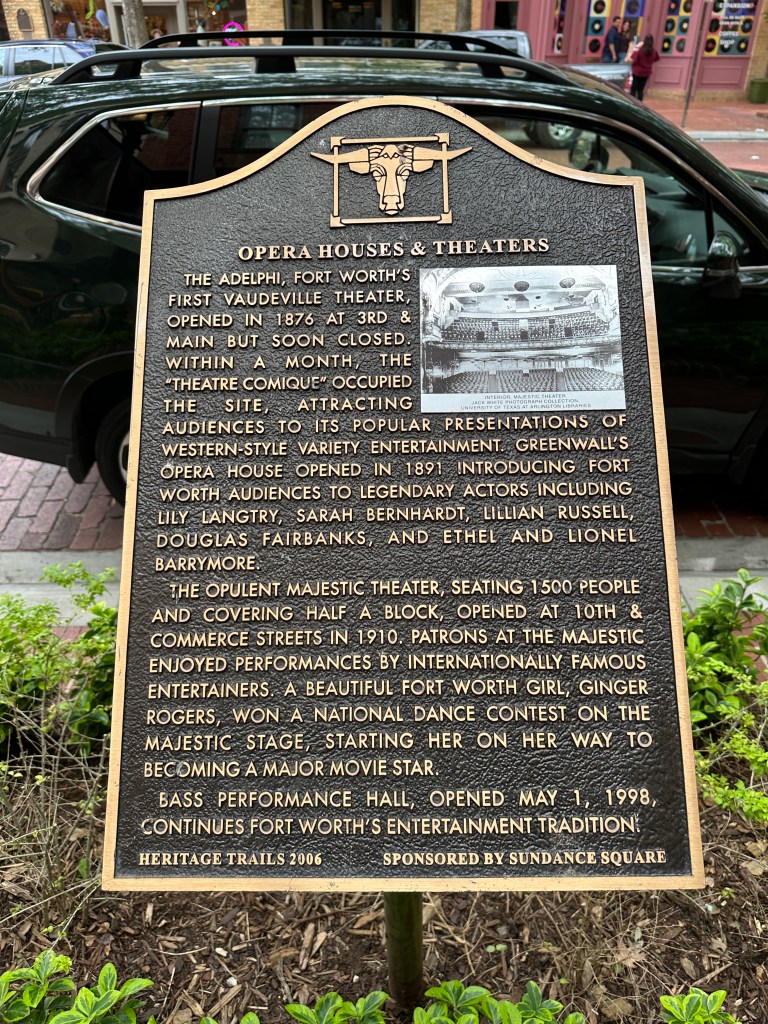
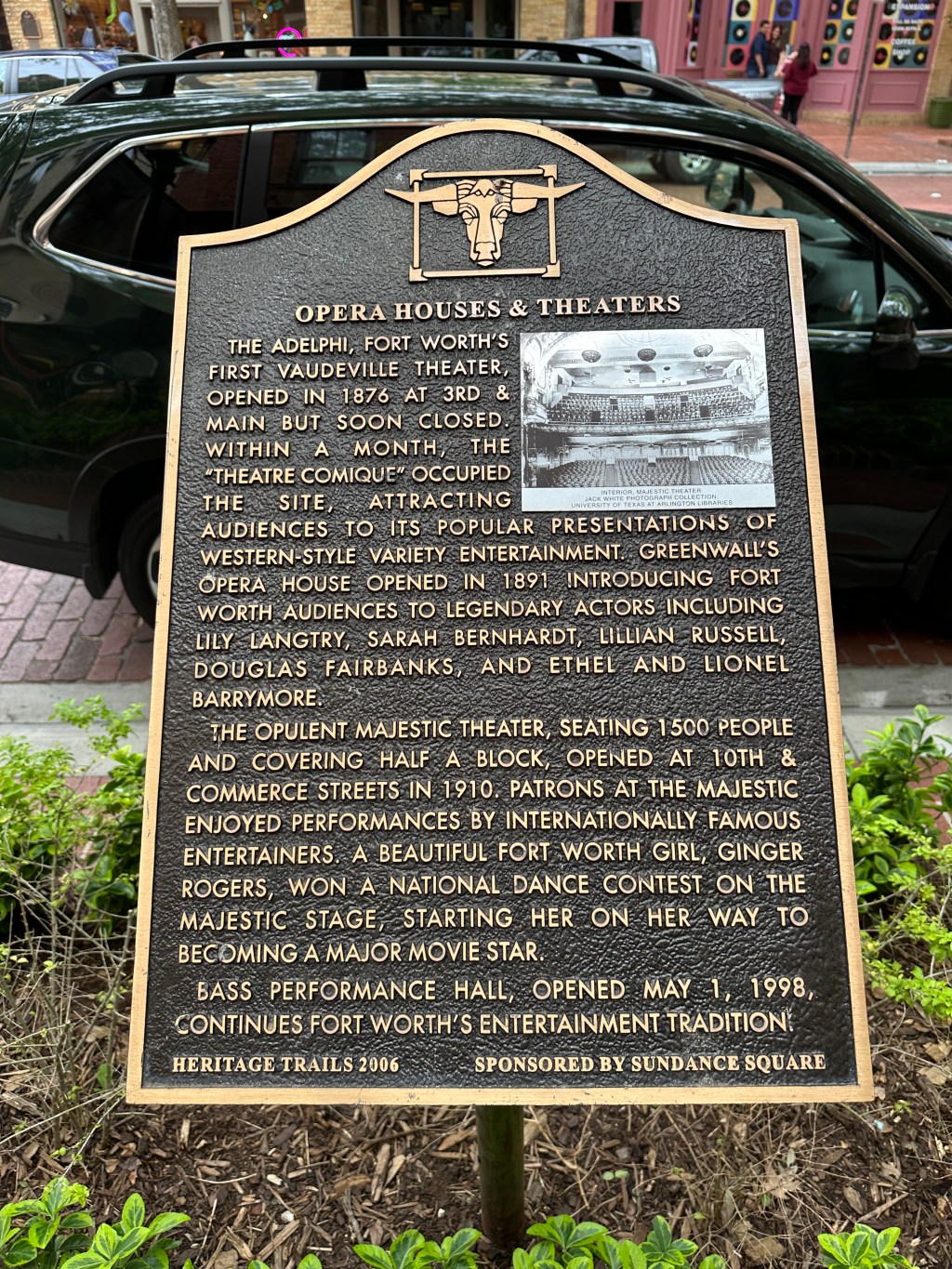
“The Adelphi, Fort Worth’s first Vaudeville Theater opened in 1876 at 3rd & Main but soon closed. Within a month, the “Theatre Comique” occupied the site, attracting audiences to its popular presentations of Western-style variety entertainment. Greenwall’s Opera House opened in 1891 introducing Fort Worth audiences to legendary actors including Lily Langtry, Sarah Bernhardt, Lilian Russell, Douglas Fairbanks, and Ethel and Lionel Barrymore.
The Opulent Majestic Theater, seating 1500 people and covering half a block, opened at 10th & Commerce Streets in 1910. Patrons at the Majestic enjoyed performances by internationally famous entertainers. A beautiful Fort Worth girl, Ginger Rogers, won a national dance contest on the Majestic Stage, starting her on her way to becoming a major movie star.
Bass Performance Hall, opened May 1, 1998, continues Fort Worth’s entertainment tradition.”
Sources
“Heritage Trails” – Website (*There is a downloadable map here with addresses. I wish had known about this set of markers before going down there. This is separate from the Texas Historical Commission Markers in my last post.)
“Heritage Trails” – Downtown Fort Worth Website
 The Active Historian
Leave a comment