
Hey, friend! Welcome back to another post. Today, I want to show you around the Will Rogers Memorial Museum in Claremore, Oklahoma.
‘I never met a museum I didn’t like’ and that’s definitely true about this one! This will be an extra special post because my friends at the museum gave me behind-the-scenes info and helped me work on the butterfly roping trick for over an hour. No… I still haven’t quite figured it out, but I’m getting closer every single day!

Who was Will Rogers?
William Penn Adair Rogers, more commonly known as “Will” Rogers, was born in Indian Territory (what would later become Oklahoma) on November 4, 1879. Rogers was Cherokee. He was the eighth child of Clement Vann Rogers and Mary America Schrimsher Rogers. He was the only son to survive to adulthood and was largely raised by his older sisters.
Clement Vann Rogers was a successful rancher in the Cooweescoowee District and had much financial success. His son Will was raised on the ranch and attended various schools. Will chose to “quit the entire school business for life” when he was 17 years old, dropping out of a military institute. He headed to the great American West, working at several ranches along the way.
Will returned to Oklahoma in 1898 and oversaw the cattle on his father’s ranch, because his father had become involved in the world of banking and tribal politics. Will didn’t stay long though…
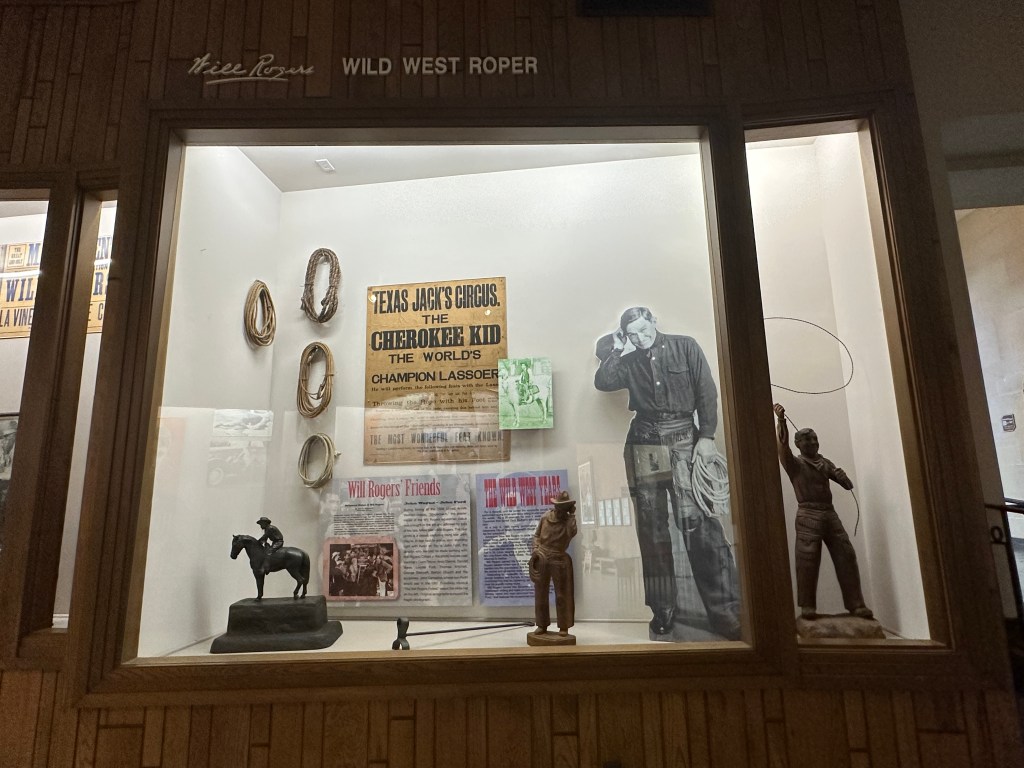
At the dawn of the twentieth century, Will and a friend set out to see more of the world. They hoped to go to South America, but Will actually wound up in South Africa. He didn’t land the cattle working jobs like he wanted… but he did find a job spinning ropes in the Wirth Brothers circus Wild West show. Will was very good at trick roping and had competed in local demonstrations back home. Soon he became known as the “Cherokee Kid.”
Will returned to Oklahoma in 1904 but again didn’t stay very long. He had a desire to be involved in show business and signed on with Zack Mulhall’s Wild West Show, which took him to St. Louis and New York.
Inspired by his run in showbusiness, Will decided to create his own vaudeville act that he toured across the United States and Europe.
In 1908, Will married Betty Blake and they would have four children. The family moved around following Will’s career. First, they lived in New York where there was a sizable entertainment scene with the Ziegfeld Follies. He had some success beginning in 1915. Next, the family moved to Hollywood in 1919 so Will could pursue acting with more ease. Eventually, Rogers would travel between Hollywood and New York. He performed with the Ziegfeld Follies in the filming off-season.
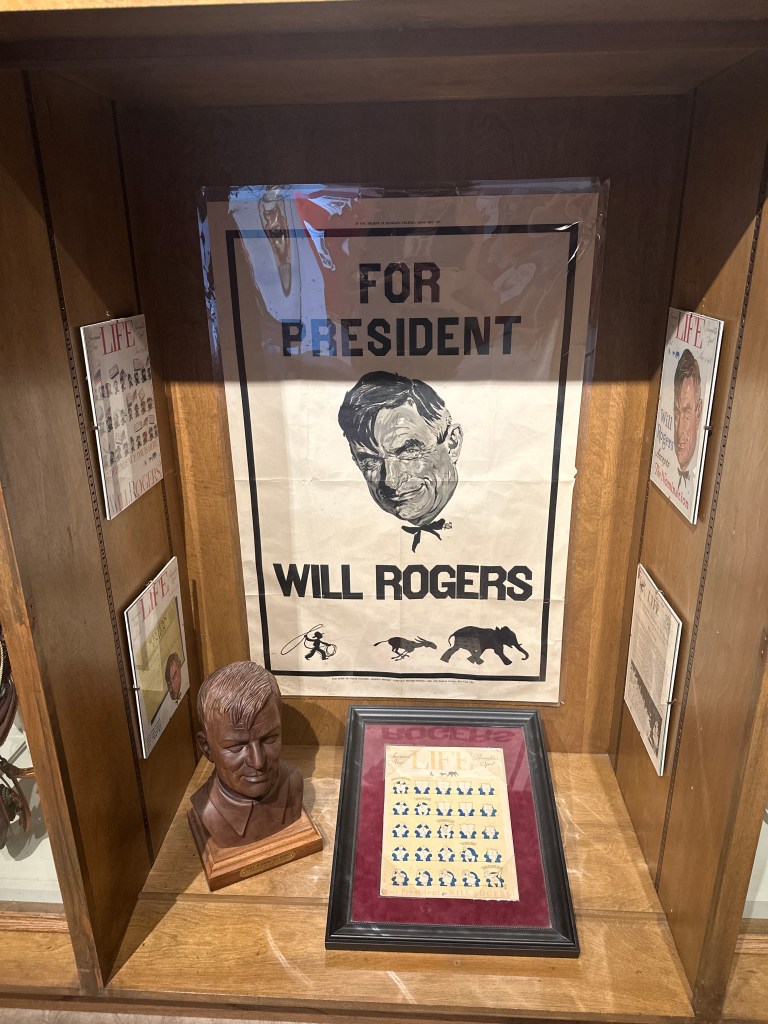
Will was a great writer and speaker because he spoke the language of the common man. He published two books in 1919 with short “Roger-isms.” Additionally, he wrote pieces for a couple of newspapers in New York that were eventually distributed nationwide. Will also appeared as a keynote speaker and as a guest on radio shows throughout the 1920s and 1930s. Will met many notable people during this time from presidents, senators, fellow entertainers and businessmen to name only a few. He also traveled to other countries and met with their dignitaries.
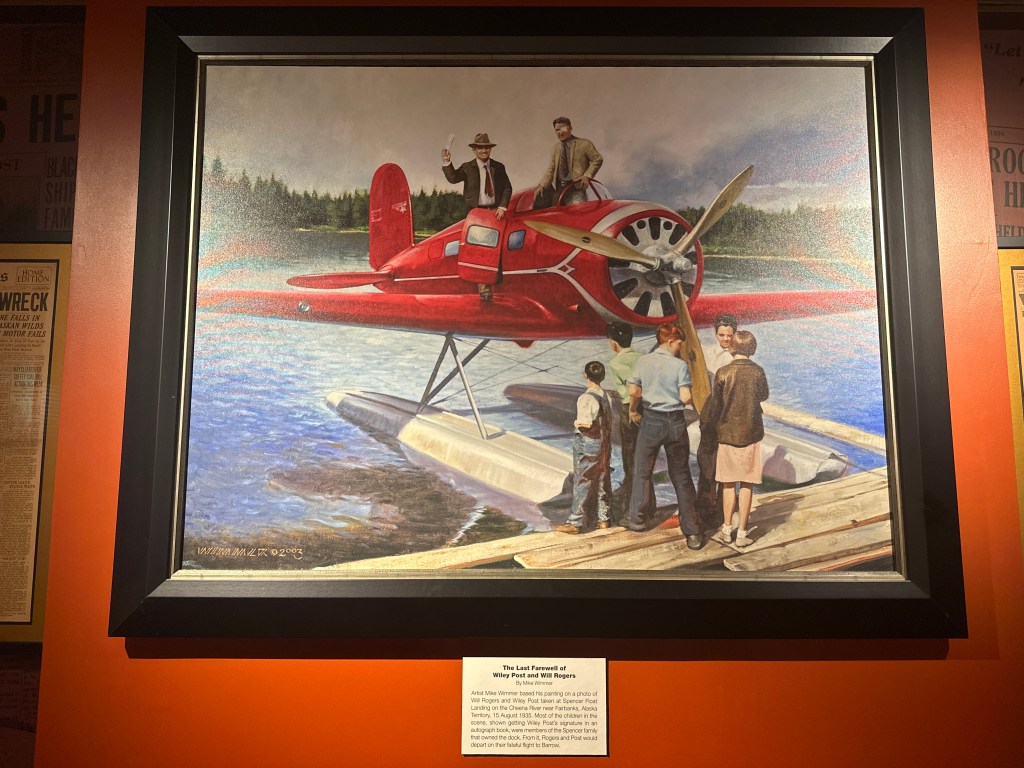
Will Rogers was a man of the people who used humor and common-sense to get his point across. His tragic death in a plane crash on August 15, 1935, rocked the nation and set off a period of national mourning. Will Rogers was an American icon. He was the common man that everyone could relate to, and his death left a hole in several hearts.
You can read more about the life and career of Will Rogers in my blog post, “Breaking Trail Will Rogers.”
Museum History
The Will Rogers Memorial Museum covers the life and legacy of ‘Oklahoma’s Favorite Son,’ Will Rogers. He accomplished much throughout his career and was loved by many.
Will Rogers had purchased the land the museum stands on in 1911 with the intention of building a home to retire to. Tragically, Will Rogers was killed in a place crash alongside Wiley Post in 1935.
In 1938, ground was broken for a museum to honor Will Roger’s life and legacy on April 21. The museum opened a few months later on November 4, 1938 – what would have been Will Roger’s 59th birthday. Many people helped donate funds to make this museum a reality including the Oklahoma Legislature and thousands of individual donors. Governor E.W. Marland said, “This will for all time be the outstanding museum of the State [Oklahoma].”
The Will Rogers Memorial Museum contains 12 galleries, a movie theater, library, and children’s museum in addition to the collection.
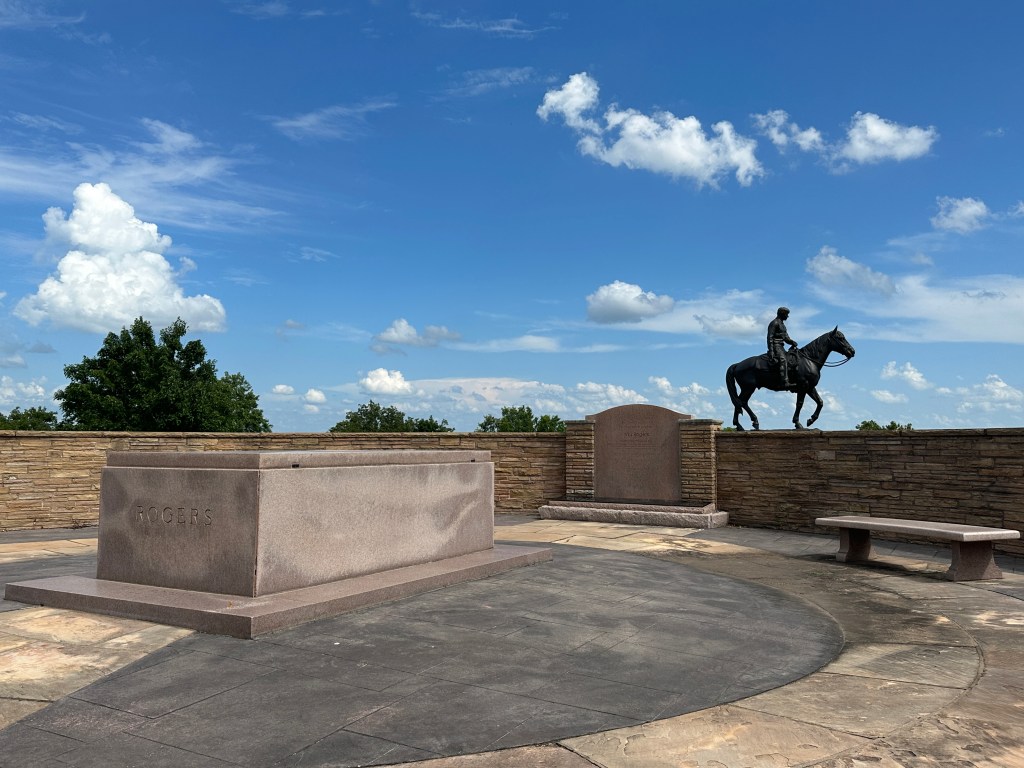
Outside of the museum, there is a beautiful garden and tomb. Will Rogers, Betty Blake Rogers, William Vann (Will Jr.) Rogers, Mary Rogers Brooks, Fred Stone Rogers, and James Blake (Jim) Rogers are all buried on the museum grounds.
Photos Inside the Museum
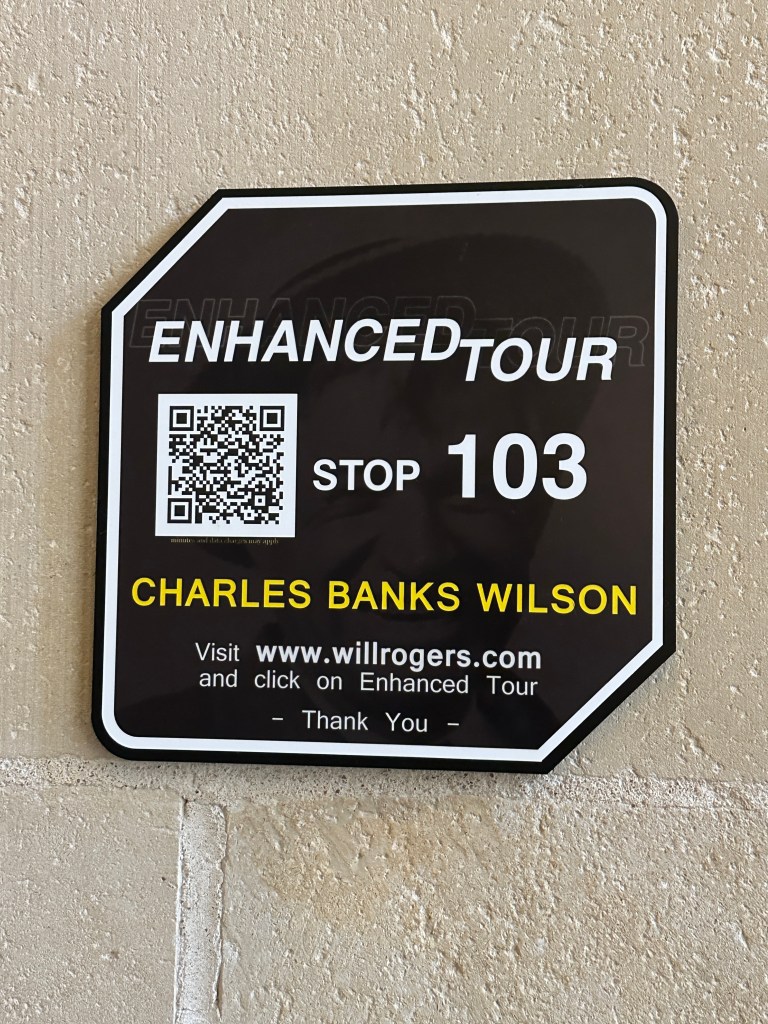
The museum has a QR path you can scan to learn more about certain pieces and exhibitions throughout the museum. I didn’t take pictures of all of the QR codes, but if you scan the one in the photo you will be taken to a website that has all of the narrated tour.
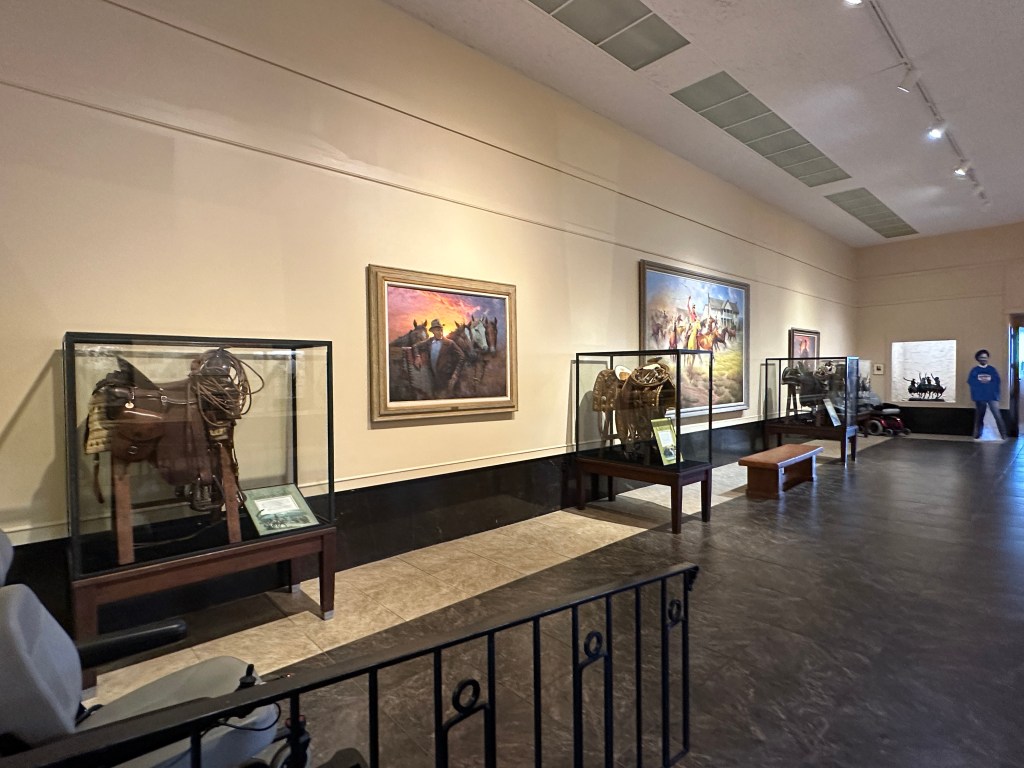
The opening gallery showcases a few saddles in the Will Rogers collection. There were so many saddles spaced throughout the museum from countries around the world. It was so interesting seeing the different ways cultures construct saddles.

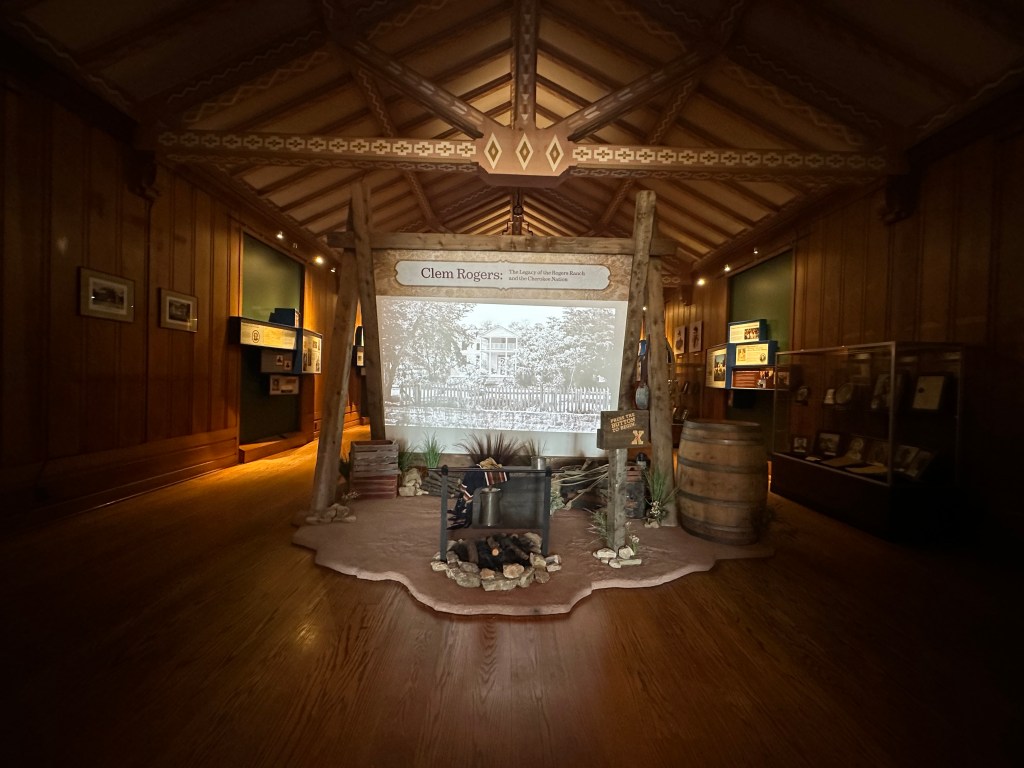
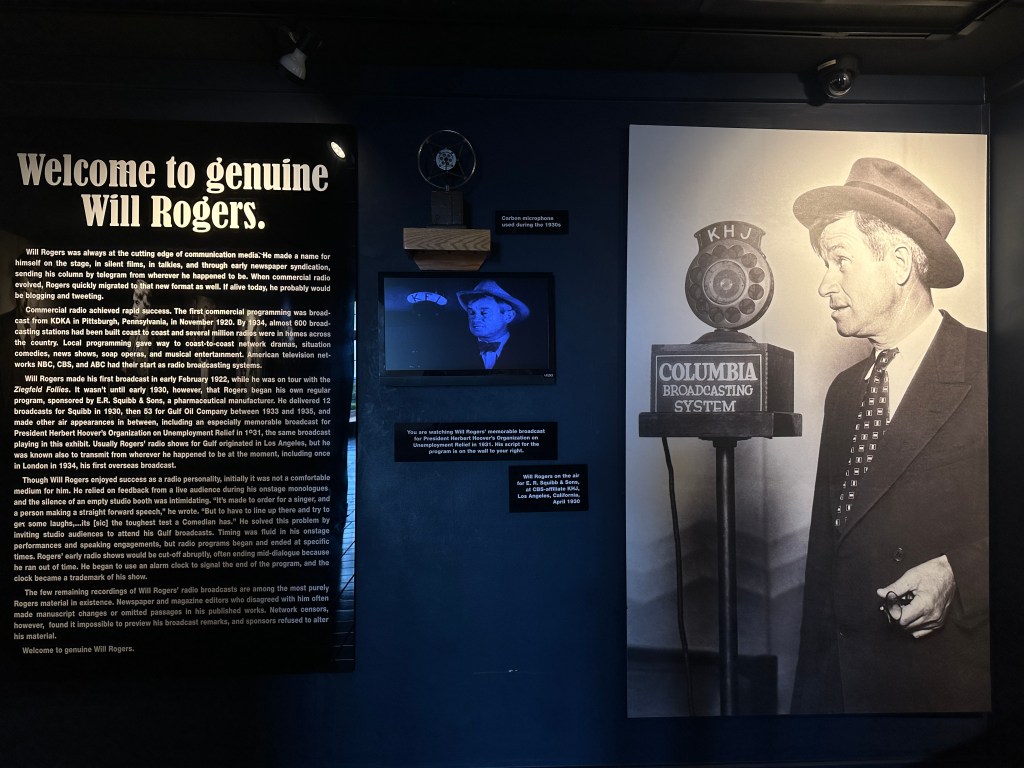
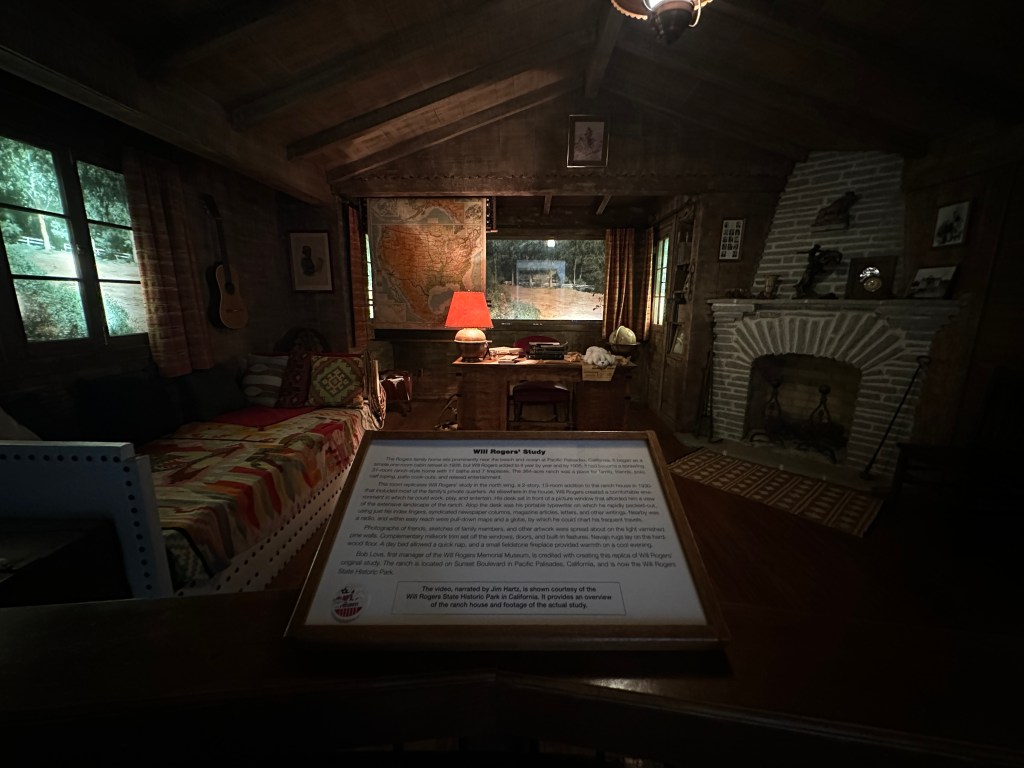
This section of the museum covered the various stages of Will Roger’s career.


The mural of Will Rogers and his horses was one of my favorite pieces. It’s HUGE!




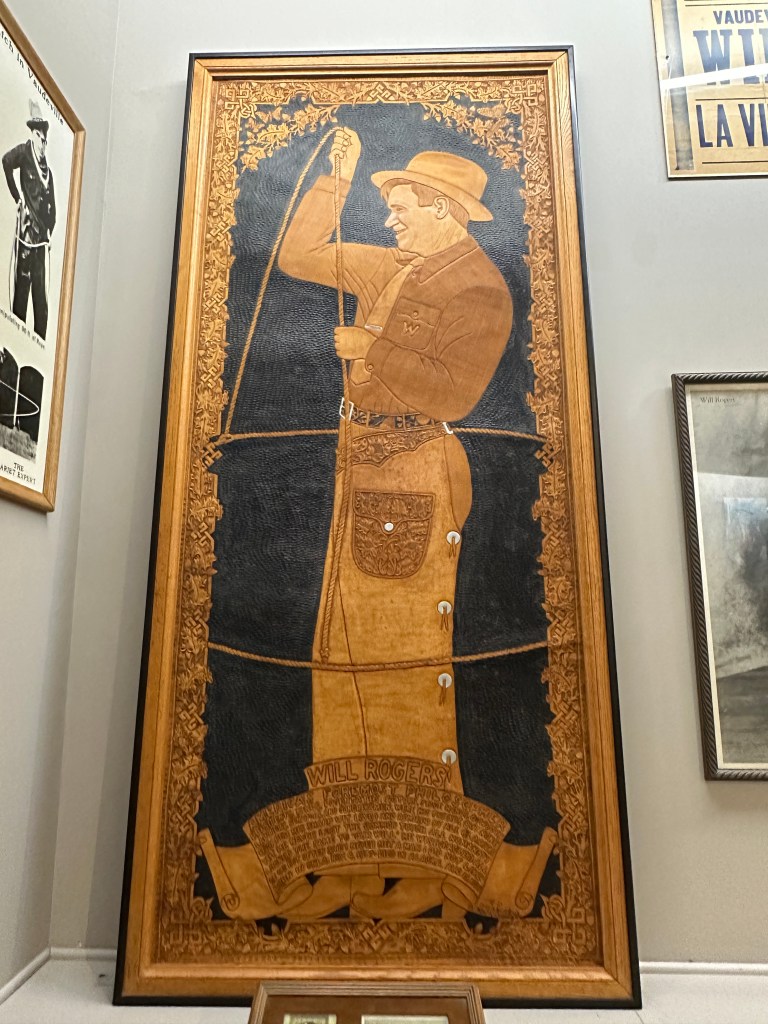
The massive leather work image of Will Rogers was so impressive in my opinion. I recently enrolled in a leather working class and have a newfound respect for artists who craft with leather. The detail is amazing on this piece! I also love seeing family brands when I visit museums.

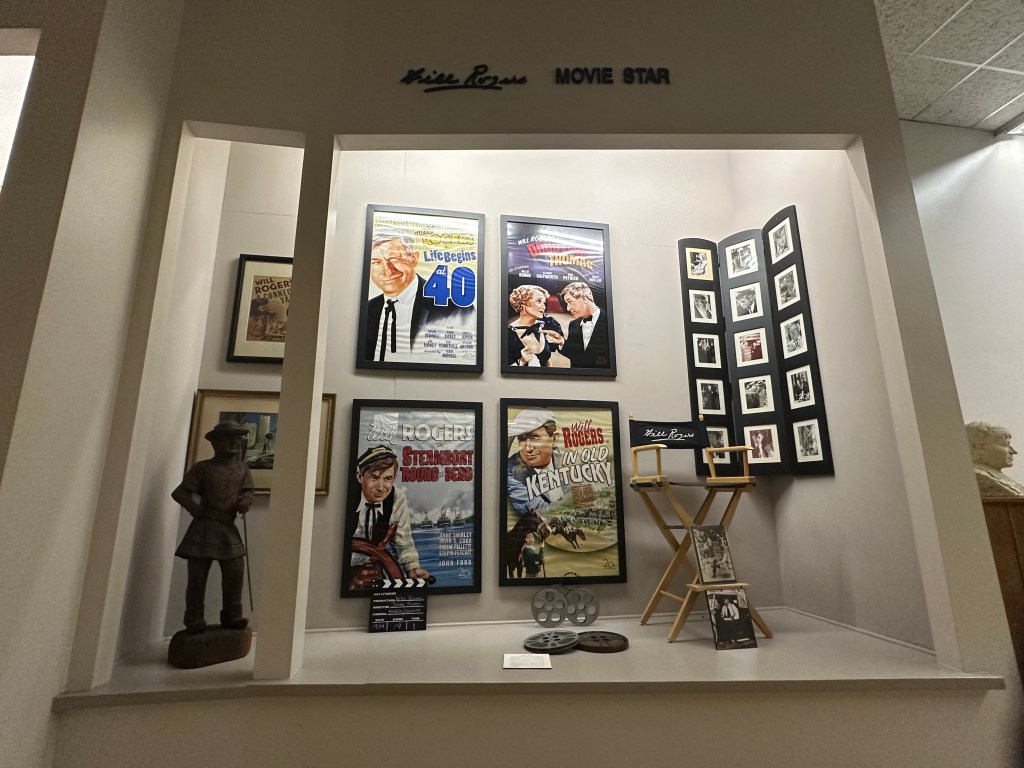
This room had several movie posters of films that Will Rogers appeared in.

Will Rogers had many famous friends and was loved by so many people. Here are just a handful of photos that were framed on the wall. From left to right the photos include: Lucille Mulhall, Shirley Temple, Eleanor Roosevelt and Amon Carter.


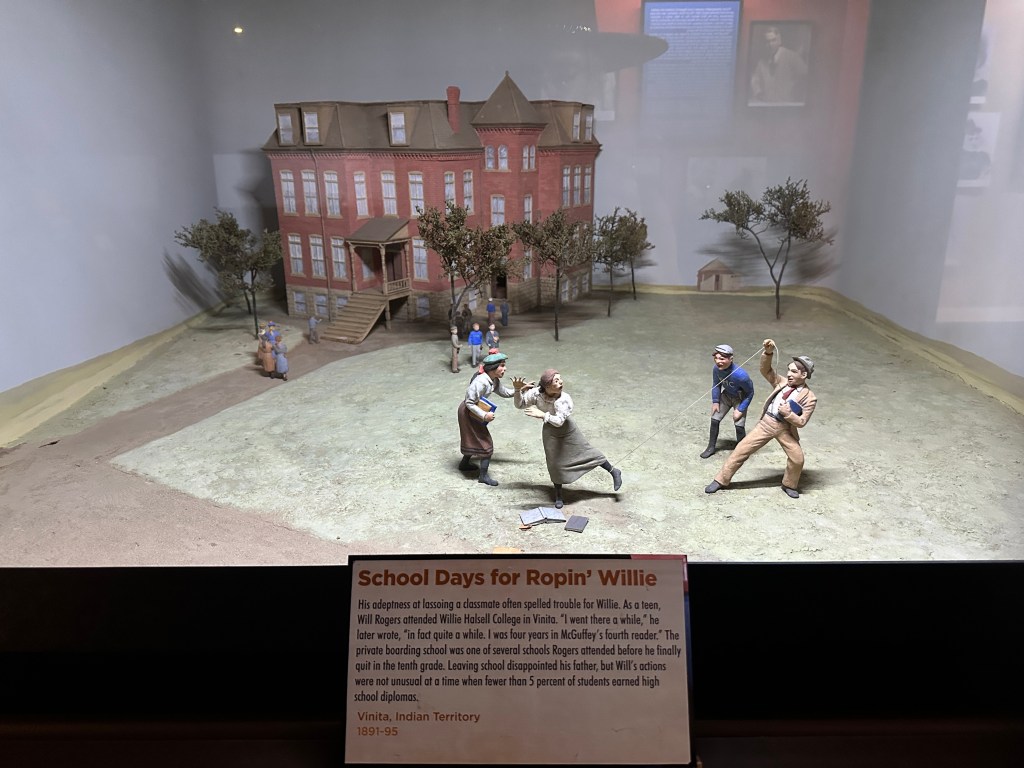
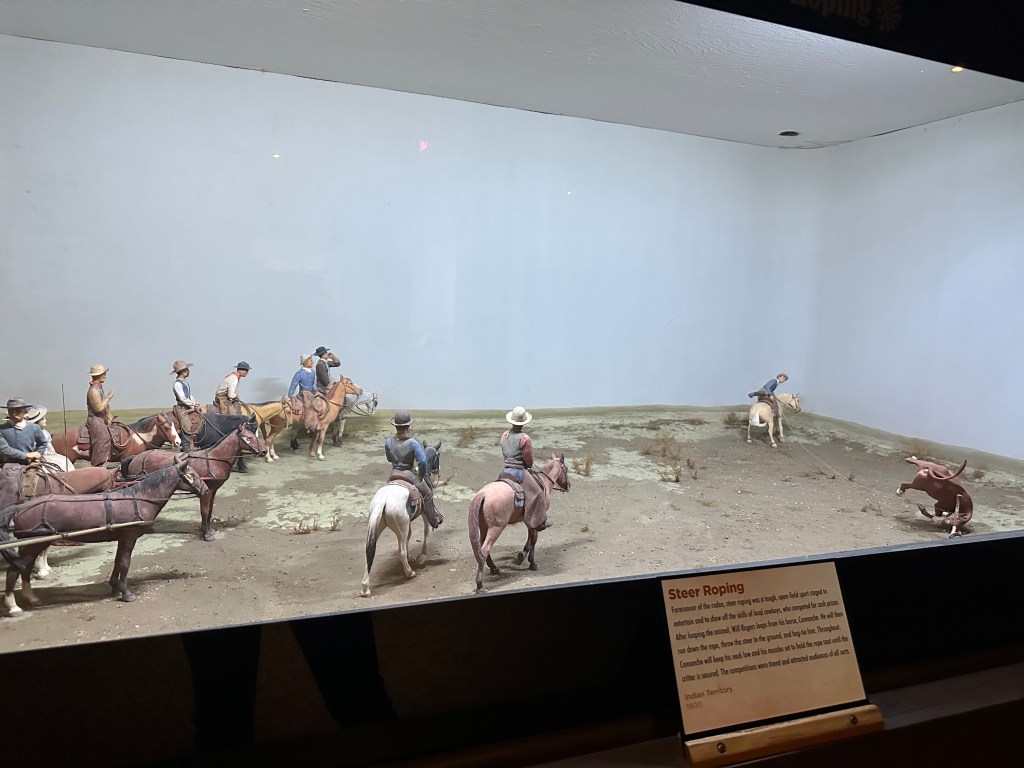
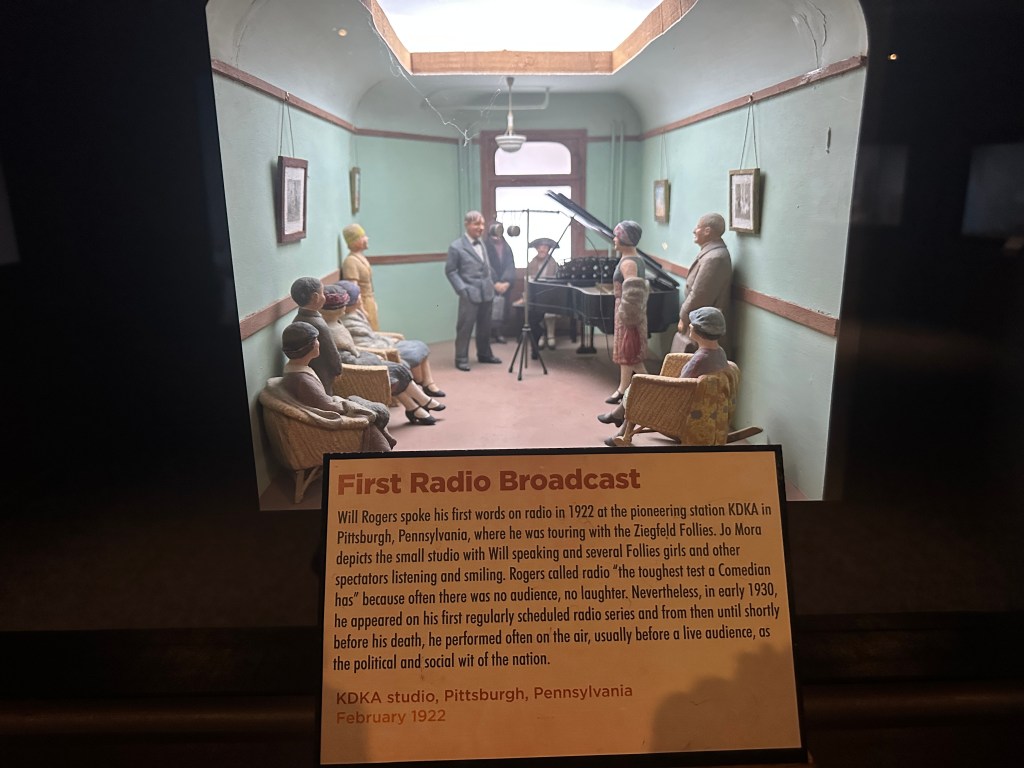
There is a gallery inside the museum that contains dioramas of key points in Will Rogers’ life. Artist Jo Mora created the miniature figures to be ‘done to scale… one-inch to a foot.’ The first nine dioramas were installed by the artist in 1941. They contained over 200 figures. He built four more dioramas from 1945-1947. He passed away before they could be installed so his son, Jo Mora Jr. installed the remaining four at the museum.
Each diorama scene tells a story and is fascinating. They have been moved around the museum from time to time, but have been in their current gallery in chronological order since 2008.






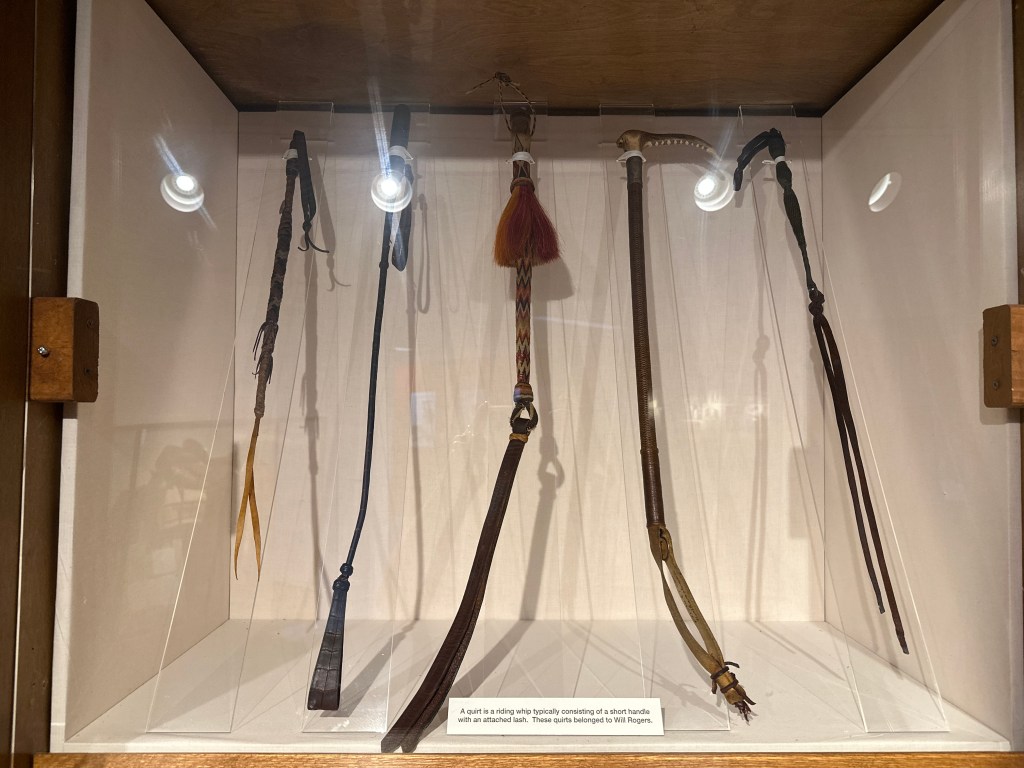
I loved seeing Will Rogers’ ropes, Teddy’s stage shoes, and the quirts. It’s so cool to see pieces that were actually used in his acts.


This typewriter is in the final gallery and it’s a somber gallery. It talks about the plane crash that tragically killed Will Rogers and Wiley Post.

Rogers’ epitaph said, “I joked about every prominent man of my time, but I never met a man I didn’t like.”
Concluding Thoughts
The Will Rogers Memorial Museum has been on my list of places to visit for several years now. I was so excited to finally be able to visit in person.
After learning how to trick rope at the end of March, I knew I needed to see this museum sooner rather than later. I was happy to be twenty minutes away for a conference this summer and had time to visit before driving home.
I want to say a huge ‘thank you’ to the staff at the Will Rogers Memorial Museum for their kindness. I have interacted with this museum on social media for months and met Buckaroo Bart at The Chisholm’s Chuck Wagon Gathering. They were all so kind – showing me more trick rope tips, telling me things about the pieces on exhibition in the galleries, and sharing their knowledge about Will Rogers’ life.
Thank you to Rachel, Dirk, Manny, Woody, Sherri, and Bart for your kindness – it won’t be forgotten.
I highly recommend visiting the Will Rogers Memorial Museum in Claremore, Oklahoma whenever you get the chance!
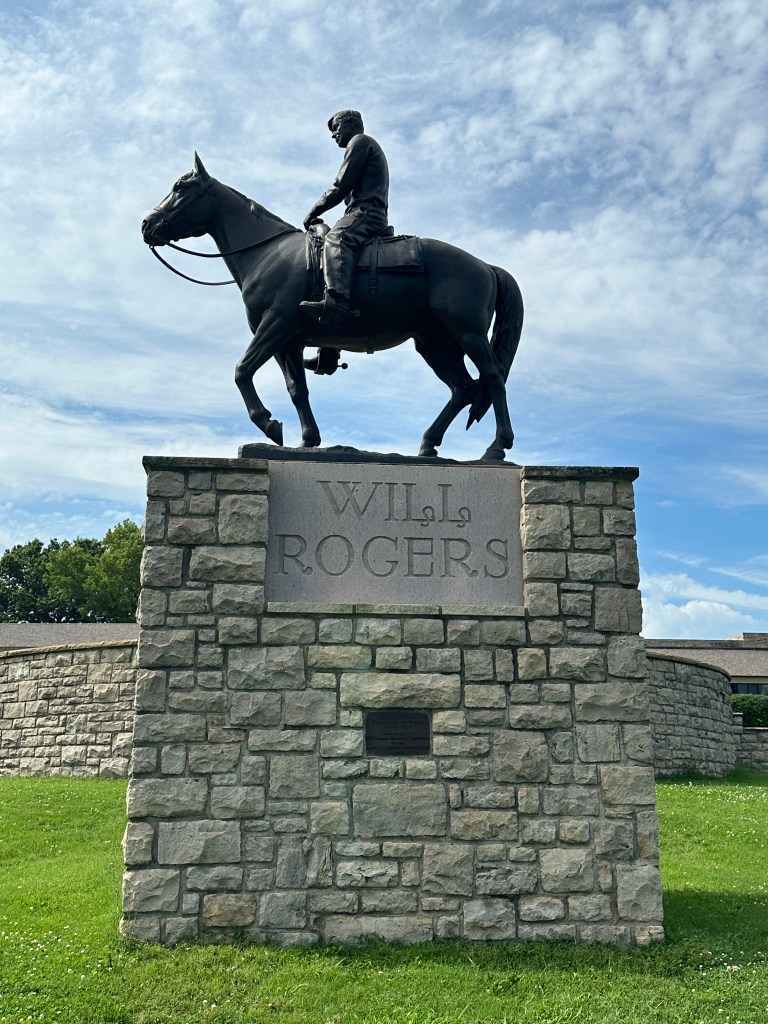
Visit
1720 W Will Rogers Blvd,
Claremore, OK 74017
Sources
Will Rogers Memorial Museum – Website
Enhanced Tour – Will Rogers Memorial Museum
Betty Rogers. Will Rogers (Norman: University of Oklahoma Press, 1941).
Douglas Watson, “Rogers, William Penn Adair,” The Encyclopedia of Oklahoma History and Culture, Oklahoma Historical Society.
“Will Rogers For Speakers: Volume One: General Quotes.” Will Rogers Memorial Museum.
 The Active Historian
Leave a comment