
Hey, Friend! Welcome back to another post. Today, I want to show you the historic markers at the University of Oklahoma’s Health Sciences Campus in Oklahoma City. I enjoyed walking around the campus and learning about the history of healthcare education in Oklahoma. In this blog post, you will find photos and transcriptions of the signs. I hope you learn something new. Let’s get started!
OU Health Sciences Center
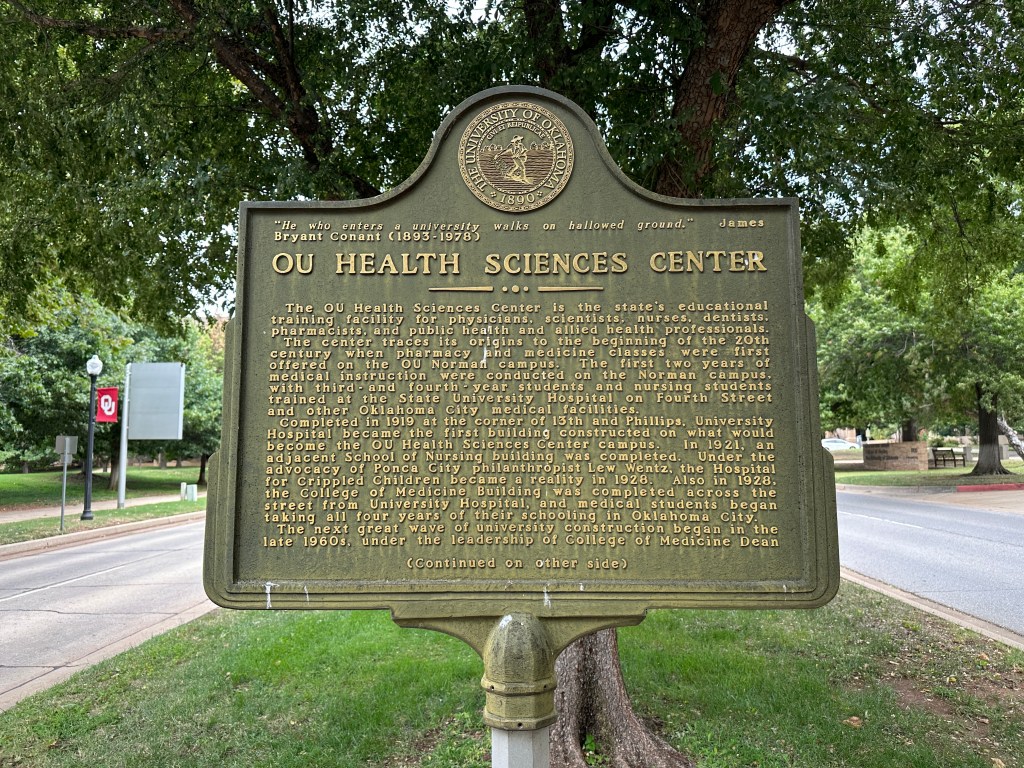
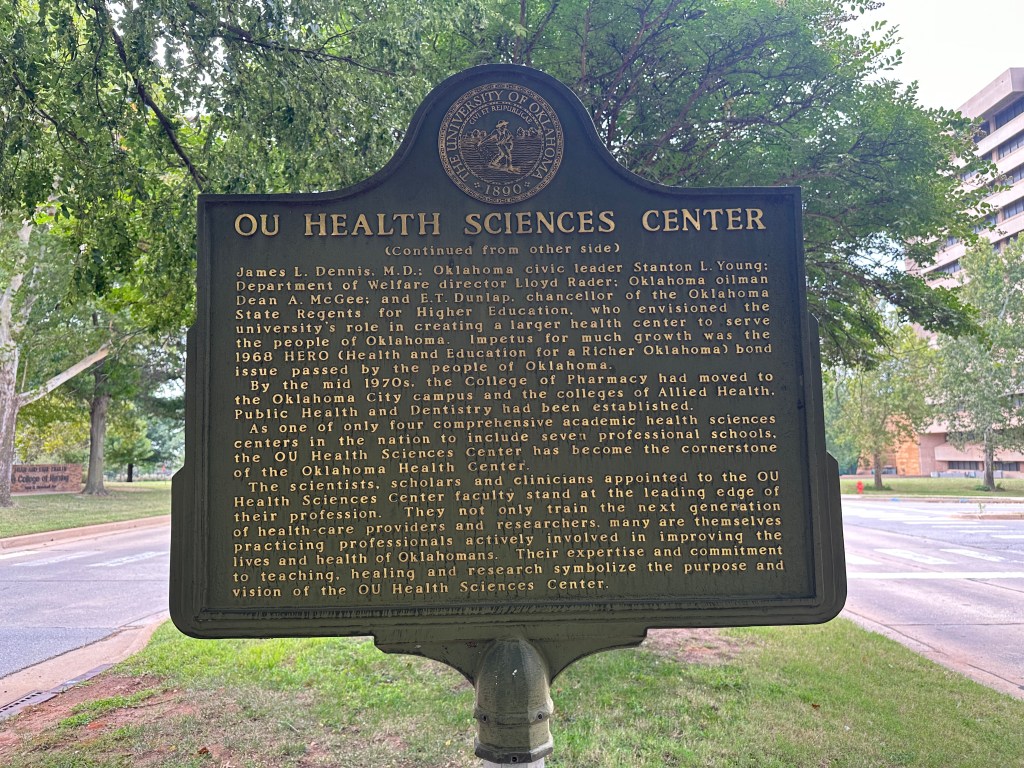
Location: 1100 N Stonewall Ave, Oklahoma City OK 73117
“The OU Health Sciences Center is the state’s educational training facility for physicians, scientists, nurses, dentists, pharmacists, and public health and allied health professionals.
The center traces its origins to the beginning of the 20th century when pharmacy and medicine classes were first offered on the OU Norman campus. The first two years of medical instruction were conducted on the Norman campus, with third-and-fourth-year students and nursing students trained at the State University Hospital on Fourth Street and other Oklahoma City medical facilities.
Completed in 1919 at the corner of 13th and Phillips, University Hospital became the first building constructed on what would become the OU Health Sciences Center campus. In 1921, an adjacent School of Nursing Building was completed. Under the advocacy of Ponca City philanthropist Lew Wentz, the Hospital for Crippled Children became a reality in 1921. Also in 1928, the College of Medicine Building was completed across the street from University Hospital, and medical students began taking all four years of their schooling in Oklahoma City.
The next great wave of university construction began in the late 1960s, under the leadership of College of Medicine Dean James L. Dennis, M.D.; Oklahoma civic leader Stanton L. Young; Department of Welfare director Lloyd Rader; Oklahoma oilman Dean A. McGee; and E.T. Dunlap, chancellor of the Oklahoma State Regents for Higher Education, who envisioned the university’s role in creating a larger health center to serve the people of Oklahoma. Impetus for much growth was the 1968 HERO (Health and Education for a Richer Oklahoma) bond issue passed by the people of Oklahoma.
By the mid 1970s, the College of Pharmacy had moved to the Oklahoma City campus and the colleges of Allied Health, Public Health and Dentistry had been established.
As one of only four comprehensive academic health sciences centers in the nation to include seven professional schools, the OU Health Sciences Center has become the cornerstone of the Oklahoma Health Center.
The scientists, scholars and clinicians appointed to the OU Health Sciences Center faculty stand at the leading edge of their profession. They not only train the next generation of health-care providers and researchers, many are themselves practicing professionals actively involved in improving the lives and health of Oklahomans. Their expertise and commitment to teaching, healing and research symbolize the purpose and vision of the OU Health Sciences Center.”
OU College of Allied Health


Location: 801 NE 13th St, Oklahoma City OK 73104
“In 1967, the Oklahoma State Regents for Higher Education approved the establishment of an academic home for allied health educational programs. Some programs, including a long-standing physical therapy program were already in existence at University Hospital, and the need for additional baccalaureate – and graduate-level allied health programs was well recognized.
The School of Health Related Professions was activated in 1970 with the appointment of Philip E. Smith, D.Sc., as dean. Dr. Smith, who had been an associate dean in both the College of Medicine and the Graduate College, worked closely with OU President Paul F. Sharp in shaping allied health programs on the Oklahoma City campus.
In response to funding issues, allied health and public health programs were combined in 1973 into what later became the College of Health. In 1978, the college moved into the historic College of Health Building, which was erected in 1928 to house the College of Medicine.
In 1981, to better serve rapidly developing programs and diverging needs, Allied Health and Public Health once again became separate colleges, and in 1982 Dr. Lee Holder was named dean of the College of Allied Health. Holder presided over a period of increasing faculty research and scholarly activity and tremendous growth in enrollment in the college’s professional programs.
The College of Allied Health has evolved to include educational programs in nutritional sciences; the rehabilitation sciences of physical therapy, occupational therapy and radiation therapy; the medical imaging sciences of radiography, nuclear medicine and diagnostic medical sonography; and the communication sciences of audiology, and speech and language pathology. The college also is home to the Department of Medical Library Science, whose faculty members staff the Robert M. Bird Health Sciences Library.
Allied health students receive clinical training at the college’s Oklahoma Assistive Technology Center and the Keys Speech Hearing Clinic and at clinical affiliates across the state.
The college offers master’s degree programs in occupational therapy and physical therapy on the OU Health Sciences Center Tulsa campus.”
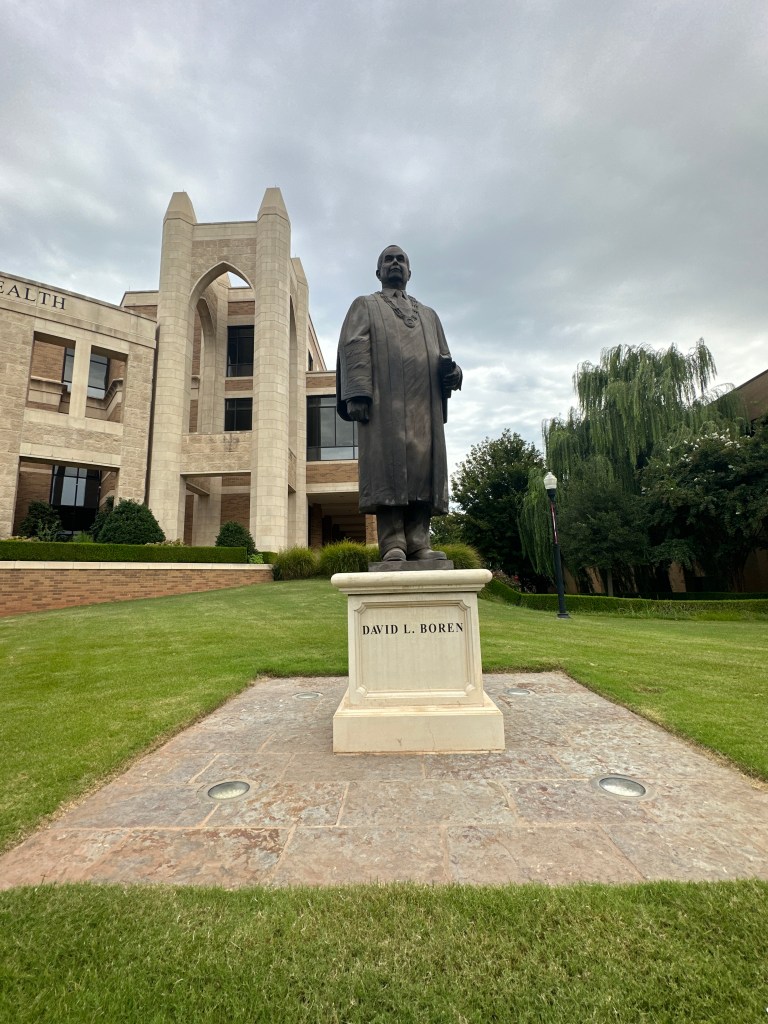
David L. Boren Statue


OU College of Nursing
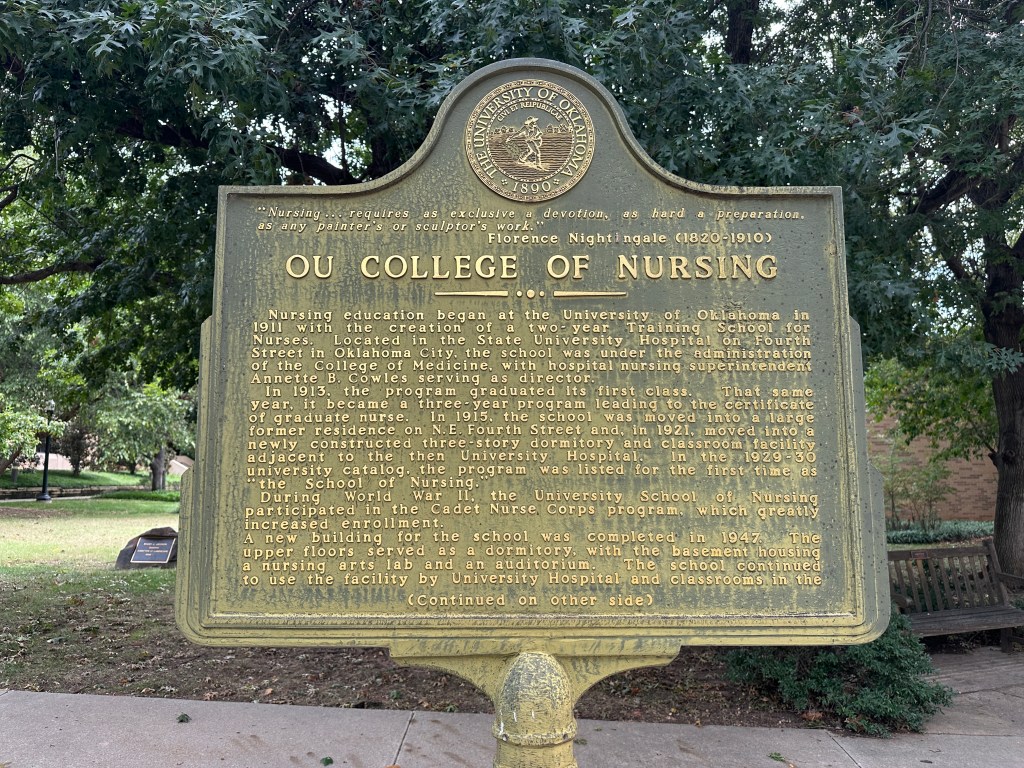

Location: 1106 N Stonewall Ave, Oklahoma City OK 73117
“Nursing education began at the University of Oklahoma in 1911 with the creation of a two-year Training School for Nurses. Located in the State University Hospital on Fourth Street in Oklahoma City, the school was under the administration of the College of Medicine, with hospital nursing superintendent Annette B. Cowles serving as director.
In 1913, the program graduated its first class. That same year, it became a three-year program leading to the certificate of graduate nurse. In 1915, the school was moved into a large former residence on N.E. Fourth Street and, in 1921, moved into a newly constructed three-story dormitory and classroom facility adjacent to the then University Hospital. In the 1929-30 university catalog, the program was listed for the first time as “the School of Nursing.”
During World War II, the University School of Nursing participated in the Cadet Nurse Corps program, which greatly increased enrollment.
A new building for the school was completed in 1947. The upper floors served as a dormitory, with the basement housing a nursing arts lab and an auditorium. The school continued to use the facility by University Hospital and classrooms in the College of Medicine, which was then located in the present-day College of Health Building on 13th Street. For almost three decades, Olive Allen served as housemother to nursing students, enforcing curfews and overseeing decorum.
Nursing remained a part of the College of Medicine until 1951, when it was transferred to the College of Arts and Sciences and became a baccalaureate program. The first two African American students were accepted into the school that year and, under the explicit edict of OU President George L. Cross, took up residence in the nurses’ dormitory “without discrimination.”
In 1955, the first baccalaureate degrees in nursing were awarded, and a graduate program was implemented in 1973.
The decade of the 1970s saw tremendous growth in students and faculty at a time when the college was without a permanent facility. The building that had housed the program since 1947 was demolished in 1970 to make way for the Basic Sciences Education Building. First the college was housed in two former residences on 14th Street and a church on Kelley Avenue, then it shared an interim facility on 12th Street.
The present building was completed in time for the 1977-78 academic year. By this time, the College of Nursing had grown to 335 undergraduates and master’s students, including both men and women. According to Gloria Smith, Ph.D., who served as dean from 1973 to 1984, the long-anticipated building changed the image of the college, bringing recognition that it was “a resource for all of nursing in Oklahoma.”
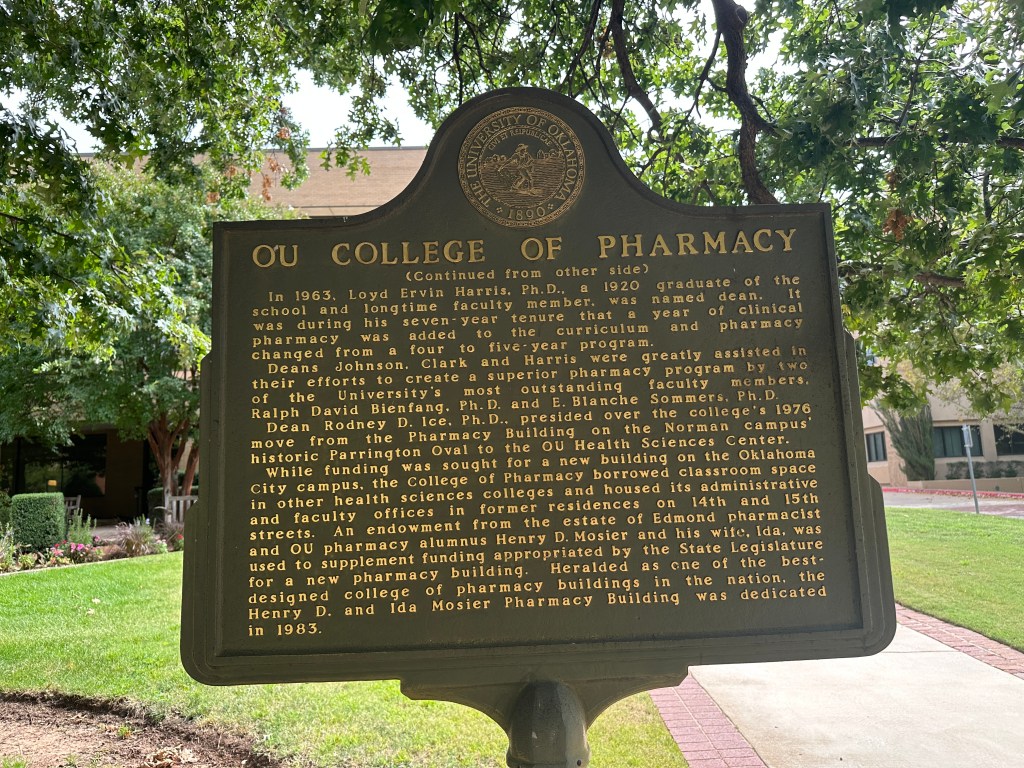
OU College of Pharmacy

Location: 1110 N Stonewall Ave, Oklahoma City OK 73117
“One of the first four degree-granting programs established at the University of Oklahoma, the Pharmaceutical Department was created in 1893 to provide Oklahoma Territory with much needed pharmacists.
In 1896, the first diplomas conferred by the new University went to pharmacy students Lemuel L. Dorrance of Lexington and Marshall A. Tucker of Norman. Eighty-six of the University’s first 200 graduates were from pharmacy.
Edwin C. “Daddy” DeBarr, one of the University’s four original faculty members, was the founding director of the departments of pharmacy, chemistry and electrical engineering. When pharmacy was elevated to a school in 1899, DeBarr was named dean and served in that position until 1904 and again in 1911 and 1912.
In 1919, the School of Pharmacy was placed under the able leadership of D.B.R. Johnson, who guided the school for 30 years and holds the distinction of being the longest-serving dean in the history of the University. Johnson worked tirelessly to improve the stature of pharmacy Paid Advertisementwithin the University and across the state.
Succeeding Johnson in 1949 was Ralph William Clark, Ph.D., who served as dean until 1962 and presided over the 1950 reorganization of the school into a college.
In 1963, Loyd Ervin Harris, Ph.D., a 1920 graduate of the school and longtime faculty member, was named dean. It was during his seven-year tenure that a year of clinical pharmacy was added to the curriculum and pharmacy changed from a four to five-year program.
Deans Johnson, Clark and Harris were greatly assisted in their efforts to create a superior pharmacy program by two of the University’s most outstanding faculty members, Ralph David Bienfang, Ph.D. and E. Blanche Sommers, Ph.D.
Dean Rodney D. Ice, Ph.D., presided over the college’s 1976 move from the Pharmacy Building on the Norman campus’ historic Parrington Oval to the OU Health Sciences Center.
While funding was sought for a new building on the Oklahoma City campus, the College of Pharmacy borrowed classroom space in other health sciences colleges and housed its administrative and faculty offices in former residences on 14th and 15th streets. An endowment from the estate of Edmond pharmacist and OU pharmacy alumnus Henry D. Mosier and his wife, Ida, was used to supplement funding appropriated by the State Legislature for a new pharmacy building. Heralded as one of the best-designed college of pharmacy buildings in the nation, the Henry D. and Ida Mosier Pharmacy Building was dedicated in 1983.”
OU College of Public Health


Location: 801 NE 13th St, Oklahoma City OK 73104
“The college traces its origins to a school of public health that existed on the Norman campus from 1949 to 1953. With the termination of that program, a Department of Preventative Medicine and Public Health, chaired by William Schottstaedt, M.D., was established in the College of Medicine.
As the field of public health evolved, the need for a program dedicated exclusively to training public health practitioners was recognized. In 1965, the Oklahoma State Regents for Higher Education recommended the establishment of a school of public health, with the Department of Preventative Medicine and Public Health given responsibility for its organization.
In 1967, the School of Health was launched, with Dr. Schottstaedt as dean and former family residences on 15th Street housing the new school. Very quickly, the new school began accepting students and submitting grants. By 1969, it had received full accreditation.
A total of 122 students were enrolled when the school was officially renamed the College of Health in 1972.
In response to funding issues, the College of Health was merged with the College of Allied Health in 1973. Enrollment in the consolidated college’s public health division continued to grow throughout the 1970s, and successful research programs were established.
In 1981, Public Health and Allied Health once again became separate colleges, with the College of Public Health encompassing the departments of Biostatistics and Epidemiology, Health Administration and Policy, Health Promotion Sciences, and Occupational and Environmental Health. The college has earned national recognition for research of public health issues affecting Native Americans.
The College of Health Building has served the colleges of Allied Health and Public Health since 1978. The building was erected in 1928 to house the College of Medicine.”
OU College of Dentistry


Location: 1201 North Stonewall Avenue, Oklahoma City OK 73117
“In 1965, the Oklahoma State Legislature authorized the development of a dental school at the University of Oklahoma. The following year, a committee created by the Oklahoma Dental Association began working with the Oklahoma State Regents for Higher Education, the Legislature and OU administrators, to make preliminary plans and search for a dean.
In March of 1969, William E. Brown, D.D.S., a dental educator from the University of Michigan, was hired as dean, a position he held until 1987. Dr. Brown arrived in Oklahoma City in July and began the formidable task of writing grants, hiring a faculty, planning a curriculum and designing interim and permanent facilities for the new college. Instrumental in establishing the basic sciences program for the college were College of Medicine Dean James L. Dennis, M.D., and his successor Robert M. Bird M.D.
Under the direction of Sharon Barton, the bachelor’s degree program in dental hygiene welcomed its first class of 16 students in 1971. The program’s first home wasin a former residence at the corner of 14th Street and Lindsay Avenue.
The 24 students of the first OU dentistry class began their studies in 1972 on the third floor of the Basic Sciences Education Building, with clinical facilities on the first floor of the Interim Building at the corner of Stonewall Avenue and 13th Street.
(Continued on other side)
(Continued from other side)
Breaking with the long-established dental education practice of offering two years of basic science education and two of clinical training, Dean Brown developed a curriculum that would expose students to clinical dentistry from the first weeks of their first year. Begun in 1973, the College of Dentistry Building was completed in 1976. The project was funded by at a cost of $10.3 million. The project was funded by the U.S. Department of Health, Education and Welfare and funding from the Health and Education for a Richer Oklahoma (HERO) bond issue passed by the people of Oklahoma in 1968. The 112,000-square-foot facility included 180 general practice operatories for student use and additional operatories for oral diagnosis, radiography, oral surgery, pediatric dentistry, graduate programs, and residencies. The innovative structure is considered one of the nation’s finest dental facilities for undergraduate, graduate and auxiliary education.
The primary mission of the college continues to be the education of highly competent dental professionals. A significant part of the educational program involves the clinical treatment of patients in student clinics, where a wide range of dental services is provided under the supervision of clinical faculty members. These faculty members not only train the next generation of general practice and specialized dentists, they also are actively involved in treating patients.”
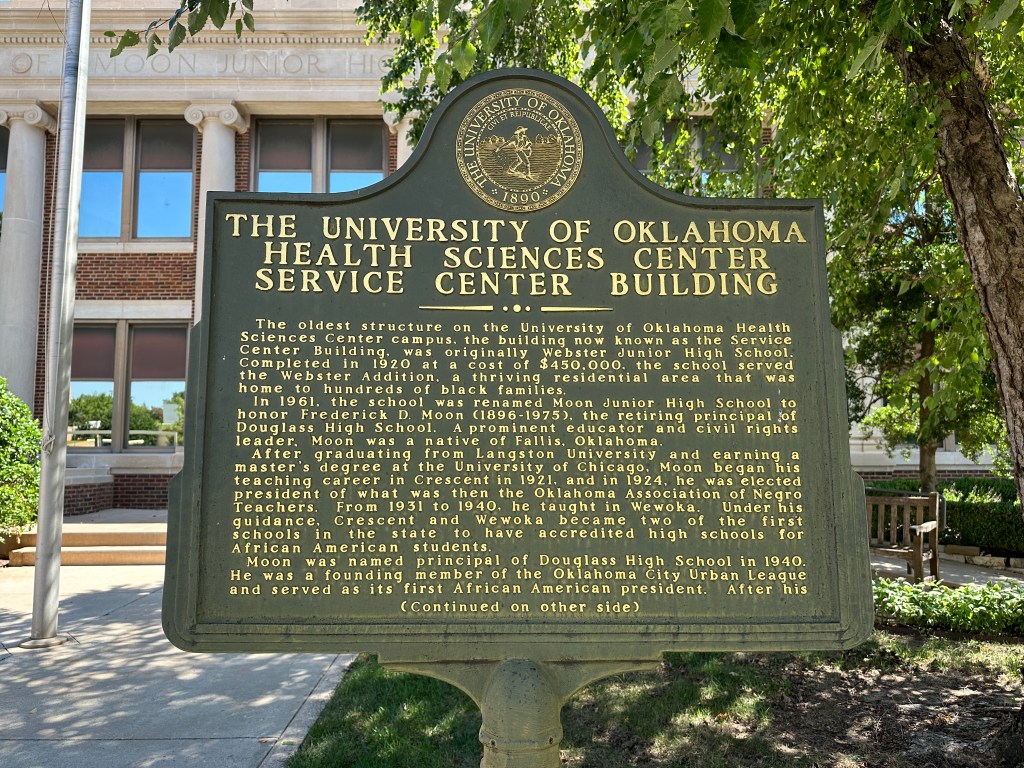
The University of Oklahoma Health Sciences Center Service Center Building

Location: 1100 N Lindsay Ave, Oklahoma City OK 73104
“The oldest structure on the University of Oklahoma Health Sciences Center campus, the building now known as the Service Center Building, was originally Webster Junior High School. Completed in 1920 at a cost of $450,000, the school served the Webster Addition, a thriving residential area hat was home to hundreds of black families.
In 1961, the school was renamed Moon Junior High School to honor Frederick D. Moon (1896-1975), the retiring principal of Douglass High School. A prominent educator and civil rights leader, Moon was a native of Fallis, Oklahoma.
After graduating from Langston University and earning a master’s degree at the University of Chicago, Moon began his teaching career in Crescent in 1921, and in 1924, he was elected president of what was then the Oklahoma Association of Negro Teachers. From 1931 to 1940, he taught in Wewoka. Under his guidance, Crescent and Wewoka became two of the first schools in the state to have accredited high schools for African American students.
Moon was named principal of Douglass High School in 1940. He was a founding member of the Oklahoma City Urban League and served as its first African American president. After his retirement from the Oklahoma City Public Schools, he became the first of his race elected to the Oklahoma City Board of Education and the first to serve as president of that organization.
Moon Junior High School and much of the Webster neighborhood was located in the John F. Kennedy Urban Renewal Area. Much of the area was cleared in the early 1970s to accommodate building managed to escape the wrecking ball. It was decommissioned by the Oklahoma City Public Schools in 1974 and acquired, along with a city block of land, by the OU Health Sciences Center under a five-year lease-purchase arrangement totaling $175,000.
Renovation of the structure preserved its broad hallways and vintage junior high character. Also preserved was the site of Payne Boomer Camp, located on the east side of the building. Occupied from 1884 to 1889, the camp was one of five established by David L. Payne, the leader of the “Boomer” movement, which sought to hasten the opening of the Unassigned Lands. Now a small park, the site is commemorated with a historic marker.
The Service Center Building houses the OU Health Sciences Center administrative support offices.”
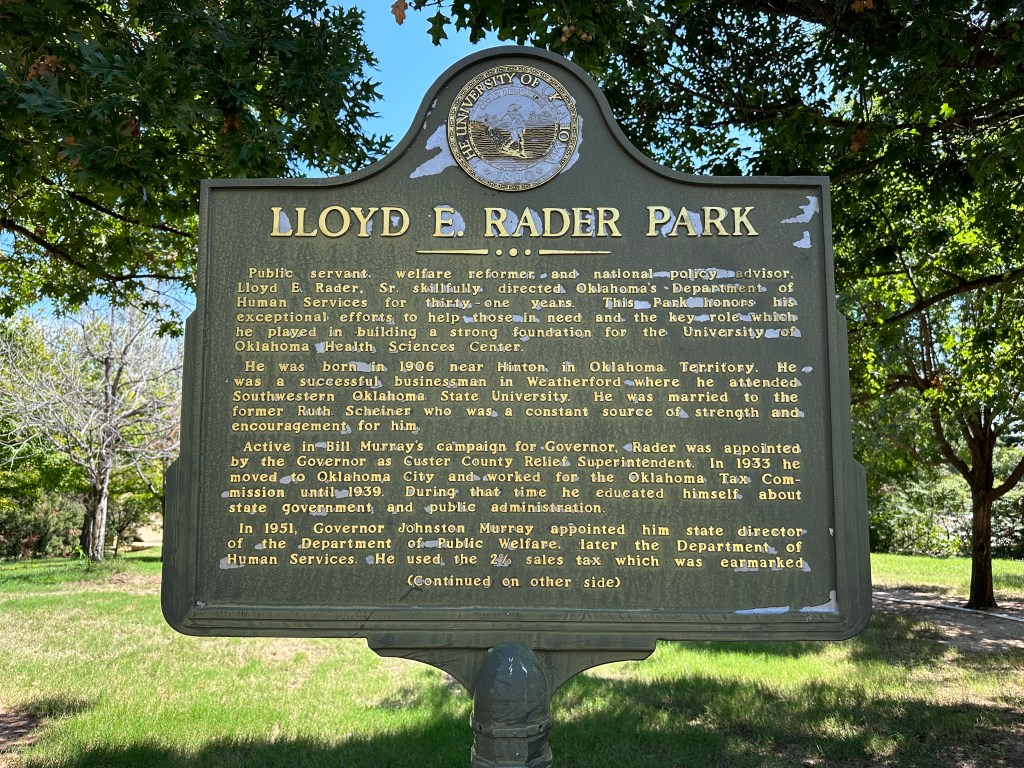
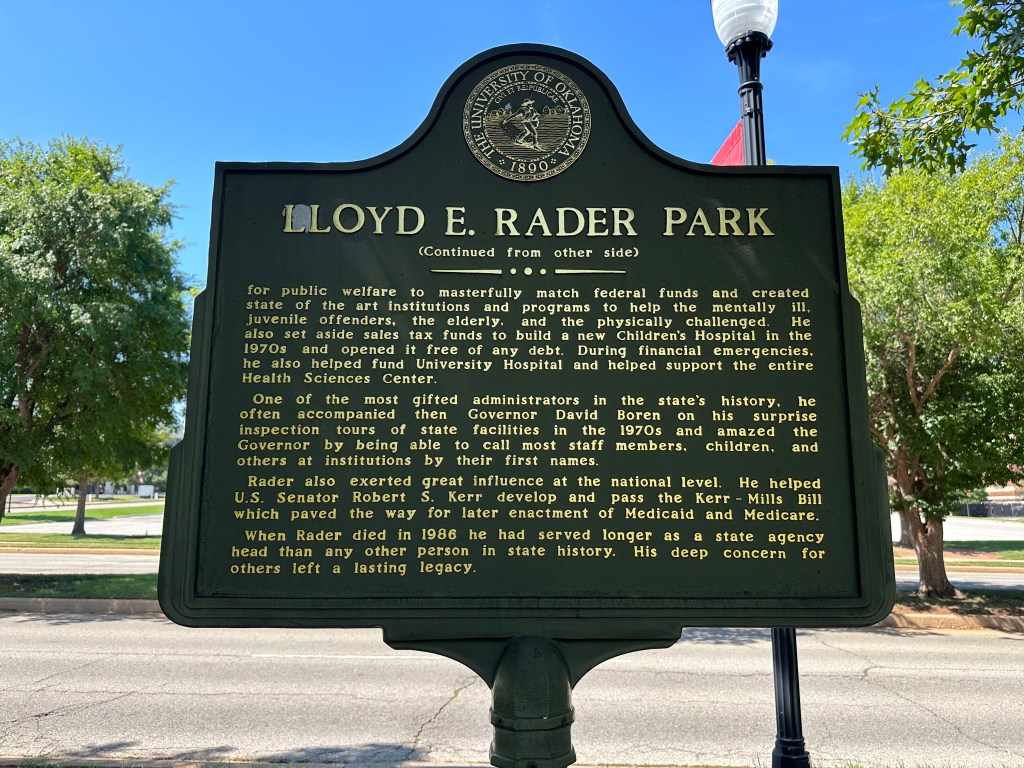
Lloyd E. Rader Park
Location: 825 NE 10th St, Oklahoma City OK 73104
“Public servant, welfare reformer and national policy advisor, Lloyd E. Rader, Sr. skillfully directed Oklahoma’s Department of Human Services for thirty-one years. This park honors his exceptional efforts to help those in need and the key role which he played in building a strong foundation for the University of Oklahoma Health Sciences Center.
He was born in 1906 near Hinton in Oklahoma Territory. He was a successful businessman in Weatherford where he attended Southwestern Oklahoma State University. He was married to the former Ruth Scheiner who was a constant source of strength and encouragement for him.
Active in Bill Murray’s campaign for Governor, Rader was appointed by the Governor as Custer County Relief Superintendent. In 1933 he moved to Oklahoma City and worked for the Oklahoma Tax Commission until 1939. During that time he educated himself about state government and public administration.
In 1951, Governor Johnston Murray appointed him state director of the Department of Public Welfare, later the Department of Human Services. He used the 2% sales tax which was earmarked for public welfare to masterfully match federal funds and created state of the art institutions and programs to help the mentally ill, juvenile offenders, the elderly, and the physically challenged. He also set aside sales tax funds to build a new Children’s Hospital in the 1970s and opened it free of any debt. During financial emergencies he also helped fund University Hospital and helped support the entire Health Sciences Center.
One of the most gifted administrators in the state’s history, he often accompanied then Governor David Boren on his surprise inspection tours of state facilities in the 1970s and amazed the Governor by being able to call most staff members, children, and others at institutions by their first names.
Rader also exerted great influences at the national level. He helped U.S. Senator Robert S. Kerr develop and pass the Kerr-Mills Bill which paved the way for later enactment of Medicaid and Medicare.
When Rader died in 1986 he had served longer as a state agency head than any other person in state history. His deep concern for others left a lasting legacy.”
University of Oklahoma Health Sciences Center and Oklahoma Heritage Association
*I haven’t been able to figure out where this marker is to take a picture. When I drove by, I didn’t see it. Here is the text according to the HMDB.
Location: 800 NE 10th St, Oklahoma City OK 73104
“The Oklahoma Cancer Center is named for Peggy and Charles Stephenson, whose roots in Oklahoma go back more than 170 years. Through their generosity, they have helped the University of Oklahoma impact the future by providing landmark gifts for the Stephenson Research and Technology Center and the Stephenson Life Sciences Research Center, which assisted in transforming an empty field on the Norman campus into OU’s burgeoning research campus.
Charles Stephenson, a 1959 OU petroleum engineering graduate, retired as chairman of the board, president and CEO of Vintage Petroleum Inc., which was sold in 2006 to Occidental. Peggy Stephenson is executive director of the Stephenson Family Foundation, which supports many community programs. In philanthropy, parenting, and life, they are longtime partners, having grown up in the southeastern Oklahoma community of Antlers. Both are recipients of honorary degrees of Doctor of Humane Letters from OU. Their gift for the Cancer Center is the largest in the history of the OU Health Sciences Center and it helped create a partnership which is the largest public-private biosciences initiative in Oklahoma history. Creation of the Cancer Center will help to meet the state’s goal of bringing world-class research and cancer care to all the people of Oklahoma. New research findings will be used to enhance patient care.
A major focal point of the facility is the “healing garden,” a beautiful outdoor space 30 feet, below street level with flowers, fountains, a water wall and picnic tables. Families and friends waiting for patients will be able to wait in the garden, the café and game rooms. The leadership of the Center has worked to utilize best practices form around the country to create patient-centered medical services. Exam rooms have a non-institutional feeling with warm colors and original works of art on the walls.
Nourishing hot food is available in the café. Original works of art, beautiful surroundings – including rocking chairs – enhance waiting areas. Recreation rooms for those of all ages and a quiet meditation room are provided. A variety of special amenities are also provided to patients. The high standard of medical treatment and the comfortable and healing environment at the Peggy and Charles Stephenson Oklahoma Cancer Center make the Center a model for others to follow.”
The Robert M. Bird Library and OU Graduate College
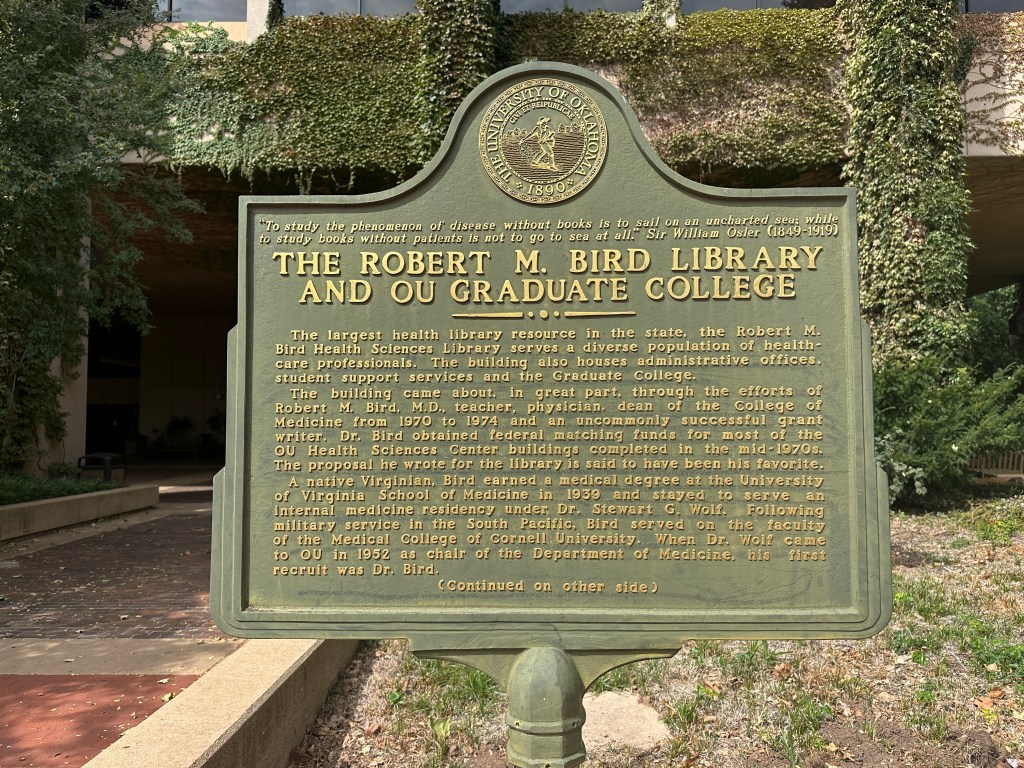
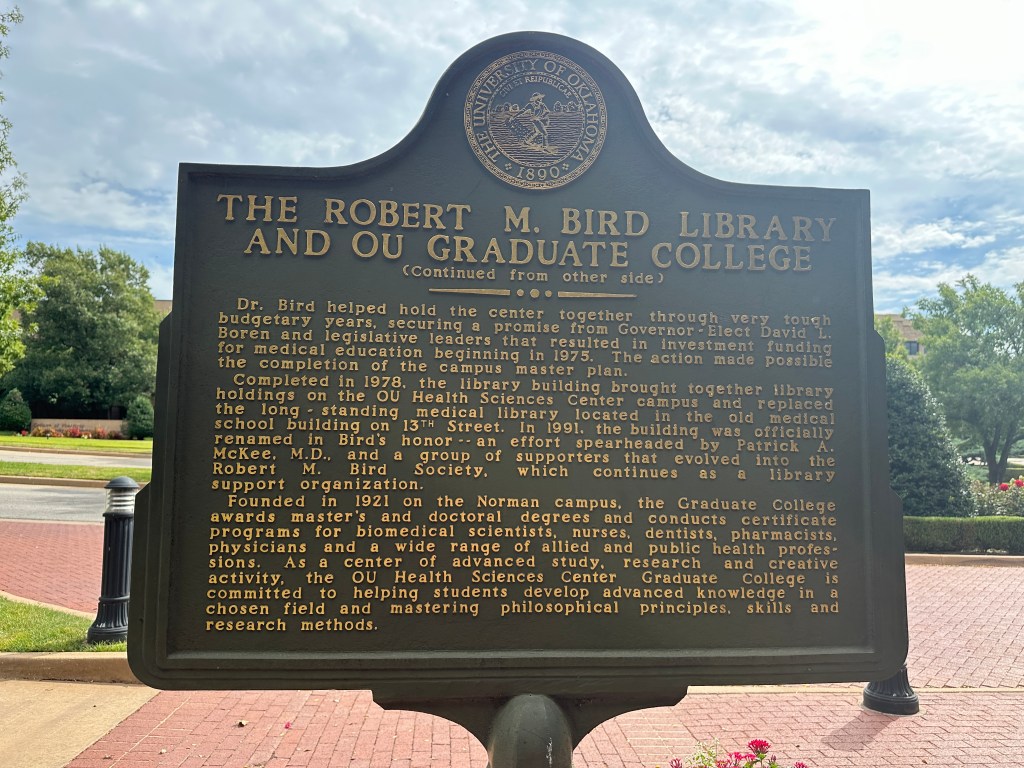
Location: 1105 North Stonewall Avenue, Oklahoma City OK 73104
“The largest health library resource in the state, the Robert M. Bird Health Sciences Library serves a diverse population of health-care professionals. The building also houses administrative offices, student support services and the Graduate College.
The building came about, in great part, through the efforts of Robert M. Bird, M.D., teacher, physician, dean of the College of Medicine from 1970 to 1974 and an uncommonly successful grant writer, Dr. Bird obtained federal matching funds for most of the OU Health Sciences Center buildings completed in the mid-1970s. The proposal he wrote for the library is said to have been his favorite.
A native Virginian, Bird earned a medical degree at the University of Virginia School of Medicine in 1939 and stayed to serve an internal medicine residency under Dr. Stewart G. Wolf. Following military service in the South Pacific, Bird served on the faculty of the Medical College of Cornell University. When Dr. Wolf came to OU in 1952 as chair of the Department of Medicine, his first recruit was Dr. Bird.
Dr. Bird helped hold the center together through very tough budgetary years, securing a promise from Governor-Elect David L. Boren and legislative leaders that resulted in investment funding for medical education beginning in 1975. The action made possible the completion of the campus master plan.
Completed in 1978, the library building brought together library holdings on the OU Health Sciences Center campus and replaced the long-standing medical library located in the old medical school building on 13th Street. In 1991, the building was officially renamed in Bird’s honor — an effort spearheaded by Patrick A. McKee, M.D., and a group of supporters that evolved into the Robert M. Bird Society, which continues as a library support organization.
Founded in 1921 on the Norman campus, the Graduate College awards master’s and doctoral degrees and conducts certificate programs for biomedical scientists, nurses, dentists, pharmacists, physicians and a wide range of allied and public health professions. As a center of advanced study, research and creative activity, the OU Health Sciences Center Graduate College is committed to helping students develop advanced knowledge in a chosen field and mastering philosophical principles, skills and research methods.”

Stanton L. Young Walk
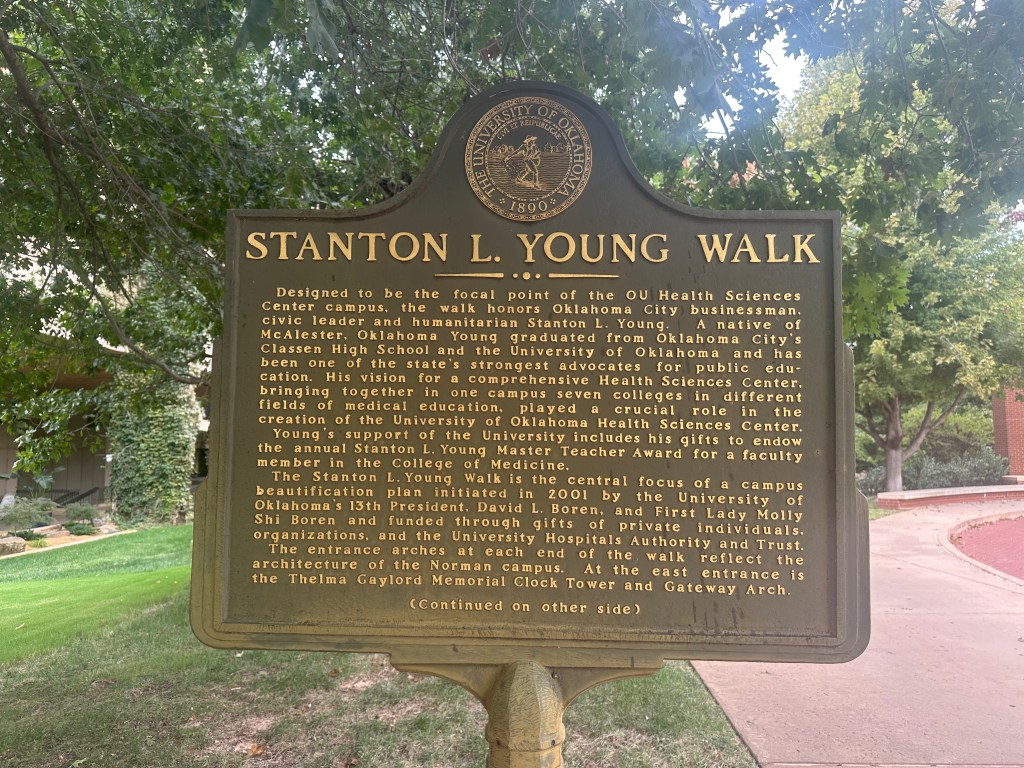
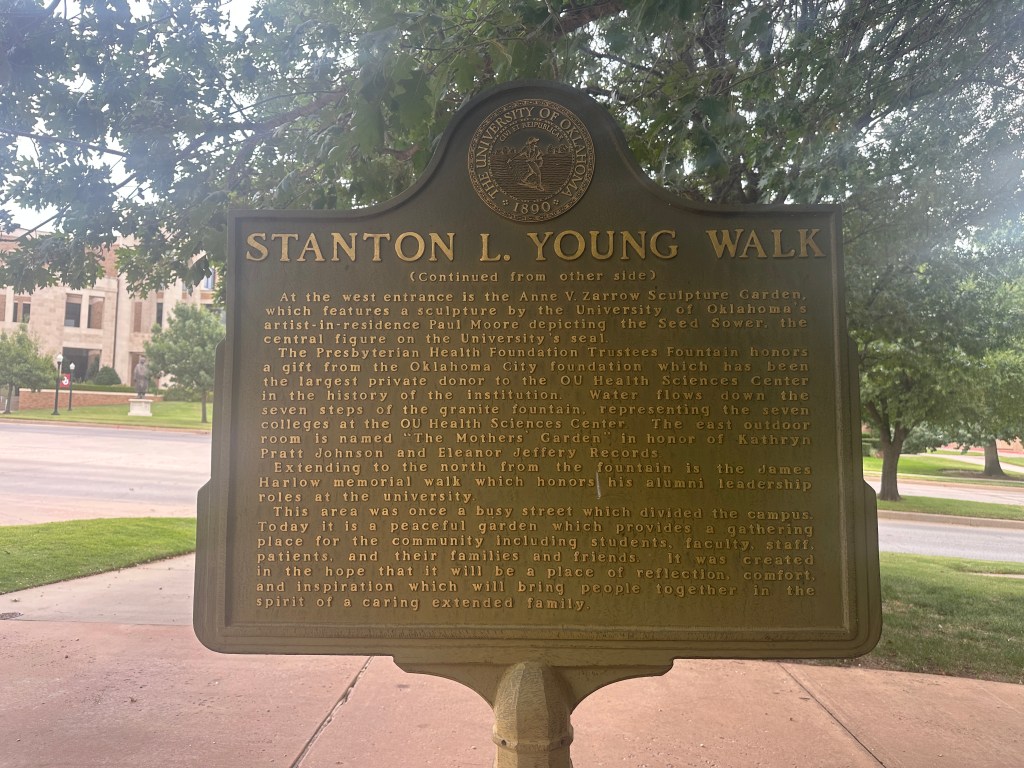
Location: 1000 Stanton L Young Blvd, Oklahoma City OK 73104
“Designed to be focal point of the OU Health Sciences Center campus, the walk honors Oklahoma City businessman, civic leader and humanitarian Stanton L. Young. A native of McAlester, Oklahoma Young graduated from Oklahoma City’s Classen High School and the University of Oklahoma and has been one of the state’s strongest advocates for public education. His vision for a comprehensive Health Sciences Center, bringing together in one campus seven colleges in different fields of medical education, played a crucial role in the creation of the University of Oklahoma Health Sciences Center.
Young’s support of the University includes his gifts to endow the annual Stanton L. Young Master Teacher Award for a faculty member in the College of Medicine.
The Stanton L. Young is the central focus of a campus beautification plan initiated in 2001 by the University of Oklahoma’s 13th President, David L. Boren, and First Lady Molly Shi Boren and funded through gifts of private individuals, organizations, and the University Hospitals Authority and Trust.
The entrance arches at each end of the walk reflect the architecture of the Norman campus. At the east entrance is the Thelma Gaylord Memorial Clock Tower and Gateway Arch.
At the west entrance is the Anne V. Zarrow Sculpture Garden, which features a sculpture by the University of Oklahoma’s artist-in-residence Paul Moore depicting the Seed Sower, the central figure on the University’s seal.
The Presbyterian Health Foundation Trustees Fountain honors a gift from the Oklahoma City foundation which has been the largest private donor to the OU Health Sciences Center in the history of the institution. Water flows down the seven steps of the granite fountain, representing the seven colleges at the OU Health Sciences Center. The east outdoor room is named “The Mothers’ Garden” in honor of Kathryn Pratt Johnson and Eleanor Jeffery Records.
Extending to the north from the fountain is the James Harlow memorial walk which honors his alumni leadership roles at the university.
This area was once a busy street which divided the campus. Today it is a peaceful garden which provides a gathering place for the community including students, faculty, staff, patients, and their families and friends. It was created in the hope that it will be a place of reflection, comfort, and inspiration which will bring people together in the spirit of a caring extended family.”
David L. Loren Student Union


Location: 1106 N Stonewall Ave, Oklahoma City, OK 73117
“Before assuming the presidency of the University of Oklahoma in November 1994, U.S. Senator David L. Boren met with OU Health Sciences Center students and faculty members. He determined that one of the top priorities for the first year of his administration would be to accelerate the construction of the long-awaited student center on the Oklahoma City campus.
Boren believed that such a facility was “essential to building the spirit of family and community” on the Oklahoma City campus. Some sort of student center has been part of the Campus Master Plan since the late 1970s but had never been funded.
The OU Health Sciences Center Student Association had approved an increase in student fees to help support the project, and through Boren’s efforts. Section 13 revenue bonds were secured for the first time in the University’s history. These funds were pooled with student fees to finance the building. Construction began on August 1, 1995, just eight months into Boren’s administration.
(Continued on other side)
On September 4, 1996, Boren and HSC Student Association President David Kendrick presided over dedication ceremonies for the $4.3 million structure, which included offices for student government, a fitness facility, food court, meeting and study rooms, and computer stations. Kendrick had actively championed the facility on behalf of Health Sciences Center students.
In 2000, the OU Board of Regents approved plans to add a third floor to the building to house Financial Aid and Student Support Services. Funding for the addition was provided largely by student fees earmarked for that purpose. Student support for the addition was led by Robert J. Herman, HSC Student Association president at the time the project was being considered.
In 2004, in honor of the tenth anniversary of his presidency and recognizing his strong support for students, the OU Board of Regents named the building the David L. Boren Student Union.”
Payne Boomer Campsite
*Historic marker has been removed, but here was the text according to HMDB.
“In April 1884 on the Cedar Springs site, David L. Payne established the Central Boomer Camp among those established from the Deep Fork Creek to the North Canadian. For five years he had led those who sought the opening of the unassigned lands. Their efforts hastened the land opening of 1889.”
University of Oklahoma Health Sciences Center and Oklahoma Heritage Association, 1976.
 The Active Historian
Leave a comment