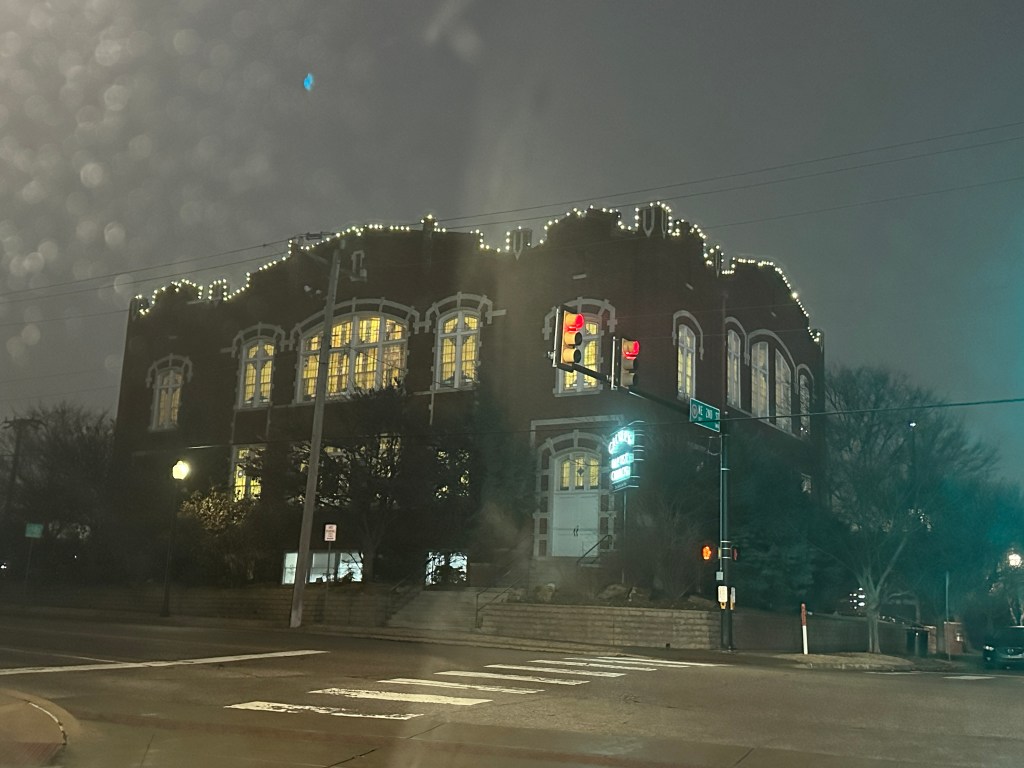
Hey, friend! Welcome back to another post. Today, I want to show you some historic markers and buildings in the Deep Deuce District in Oklahoma City. If you’re familiar with Oklahoma City, the Deep Deuce District in just north of Bricktown. Let’s go look around!
History of Deep Deuce
The Deep Deuce District has roots dating back to the late-nineteenth and early-twentieth centuries. This was the business and cultural district of the African American community. There were newspapers, clothing shops, barbershops, doctor’s offices, and more. In the evenings, the nightclubs, restaurants, and dance halls were home to famous musicians and singers.
The area came to be known by a few different names, “Deep Deuce,” “Deep Two,” and “Deep Second.”
The jazz music scene was vibrant in Deep Deuce. Legends of jazz and blues grew their talent and launched their careers here including Jimmy Rushing and Charlie Christian. Jimmy Rushing was a singer and pianist who played with the jazz band, Oklahoma City Blue Devils, in the 1920s. From 1935-1948, Rushing was a featured vocalist for Count Basie’s orchestra. Charlie Christian was deeply involved in jazz and swing. Christian’s electric jazz guitar skills have arguably made him a legend.
Ralph Ellison was an author who was born in Oklahoma City in 1914. Ellison lived in Deep Deuce until the early 1930s when he moved to Alabama. One of his more prominent novels was the “Invisible Man” (1952).
From the 1920s to the 1950s, Deep Deuce was the hub for African American culture in Oklahoma City. Several people left the district as more choices for housing and schooling opened up in the 1960s.
At the turn of the twenty-first century, there was interest in redeveloping the Deep Deuce District. Apartment complexes and restaurants were built along the streets.
Calvary Baptist Church
The Cavalry Baptist Church was built in 1921 and was a centerpiece of the community. Russell Benton Bingham was the architect of the building. It is three stories tall and made of red brick. The twin towers are capped by brick parapets. Several famous people have walked through the doors of this building including Martin Luther King, Jr. and Ralph Ellison.
Cavalry Baptist Church was significant to the Civil Rights Movement in Oklahoma City because the sit-ins were planned here.
Cavalry Baptist Church was added to the National Register of Historic Places in 1978.
The building was slightly damaged in the 1995 bombing of the Alfred P. Murray Federal Building. The building was repaired and is still in use today.
(NR 78002244) – 300 North Walnut Avenue

The Lyons Mansion
The Lyons Mansion is a historic home located in Oklahoma City. There is a sign in the photo which I have transcribed below.

“The mansion is currently undergoing preservation efforts while planning for its long-term use is underway. Restoration is in the future, but in the meantime please excuse the temporary support structures.
The Lyons Mansion was built in 1926 for S.D. Lyons, owner of East India Goods and Manufacturing Company. In addition to the home, this site houses the buildings where Lyons would manufacture and sell his products. Here, Lyons made specialty hair tonics, soaps, and perfumes which he shipped across the U.S. and internationally.
Today, the mansion is a standing reminder of the historical success of the Black residents of Deep Deuce during the 1920’s through 1970’s. The Oklahoma City Urban Renewal Authority purchased the property in 2019 with help from a $75,000 grant from the National Trust for Historic Preservation’s African American Cultural Heritage Action Fund to secure its future.”
Historic Markers in the Sidewalk
While looking at the Lyon House, I walked down the sidewalk a little ways to take a picture of the house from a different angle and looked down in the sidewalk. I saw a name and a bunch of words. Immediately, I started reading and realized it was a historic marker with information. As a historian who looks for these kind of markers, I looked up and scanned the rest of the sidewalk and saw another one across the street and had to go read it too. So, I proceeded to walk and drive around the district finding several more plaques. Keep reading below to learn some cool stories about people from Oklahoma City!

Dr. Frederick Douglass Moon (May 4, 1986 – May 4, 1996)
“An educator and the Black person elected to the City Board of Education, he was known as the “Dean” of Black education in Oklahoma. He was a graduate of Langston University and founded its Alumni Association. He served as principal of Douglas High School in Oklahoma City from 1940-1961 and was responsible for obtaining North Central Association accreditation for the Douglass High Schools in Crescent, Wewoka and Oklahoma City.”

Dr. Jefferson Davis (J.D.) Randolph (October 12, 1862 – July 15, 1939)
“The first Black teacher in Oklahoma City, he opened the first two room Black schoolhouse at the corner of California and Harvey in 1891. The school moved to 400 W California, where he served as principal. This school later became Douglas High School. He owned Randolph’s Drug Store at 331 NE Second Street, which housed the most popular soda fountain and ice cream parlor in the state and was a congregating place for all, including the many talented musicians and dancers.”
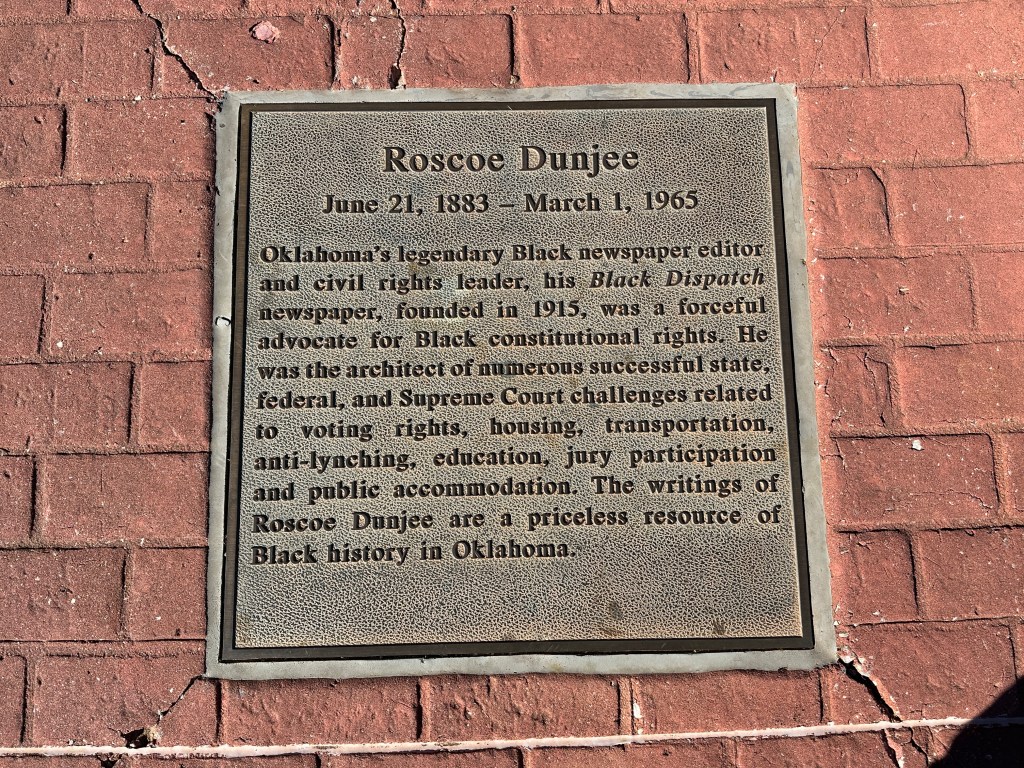
Roscoe Dunjee (June 21, 1883 – March 1, 1965)
“Oklahoma’s legendary Black newspaper editor and civil rights leader, his Black Dispatch newspaper, founded in 1915, was a forceful advocate for Black constitutional rights. He was the architect for numerous successful state, federal, and Supreme Court challenges related to voting rights, housing, transportation, anti-lynching, education, jury participation and public accommodation. The writings of Roscoe Dunjee are a priceless resource of Black history in Oklahoma.”

Dr. William Lewis Haywood (1883 – May 1971)
Founder of the first Oklahoma City hospital for Blacks, “the Utopia.” He served as medical examiner for Oklahoma County, rose to the position of Chief of Staff of the South Ward of University Hospital as was the founder of the Medical, Dental and Pharmaceutical Society as well as the American Woodmen Insurance Company. He was an active member of Avery Chapel A.M.E. for 61 years. The Haywood Building at 331-1/2 NE 2nd Street is on the National Register of Historic Places.”
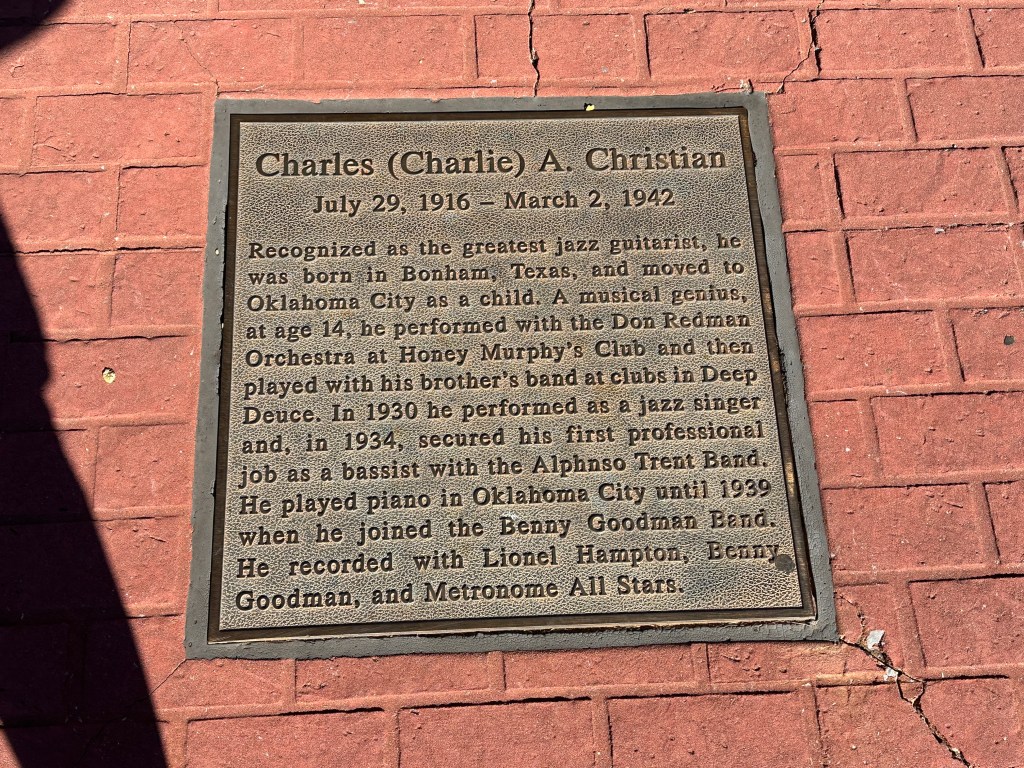
Charles (Charlie) A. Christian (July 29, 1916 – March 2, 1942)
“Recognized as the greatest jazz guitarist, he was born in Bonham, Texas, and moved to Oklahoma City as a child. A musical genius, at age 14, he performed with the Don Rodman Orchestra at Honey Murphy’s Club and then played with his brother’s band at clubs in Deep Deuce. in 1930 he performed as a jazz singer and, in 1934, secured his first professional job as a bassist with the Alphonso Trent Band. He played piano in Oklahoma City until 1939 when he joined the Benny Goodman Band. He recorded with Lionel Hampton, Benny Goodman, and Metronome All Stars.”

James (Jimmy) Andrew Rushing “Mr. Five by Five” (August 26, 1903 – June 8, 1972)
“World’s leading male blues vocalist for ten consecutive years, he was born into a musically talented family in Deep Deuce and began his professional career in 1927. A mature tenor, with a high-pitched, penetrating voice that could be heard for blocks, he was the best known of the “blues shouters,” but closed from blues to jazz. He sang with Count Basie, Benny Goodman, Walter Page, and Buck Clayton. He formed his own band, toured the United States and Europe, and appeared in movies. His best-known recordings are “Going to Chicago” and “Every Day I Have the Blues” with the Basie orchestra. He is among Blacks honored with a Black History Series Stamp.”

James “Doughbelly” Brooks
“James Brooks was the last resident to leave Deep Deuce, his home for almost a half-century. Born on March 12, 1920, Brooks was called L.W. (for LoneWolf) by his mother because of her Cherokee and Choctaw heritage. He was nicknamed “Doughbelly” when a classmate saw Brooks eating cookie dough at nearby Page Elementary. Brooks later ran a shoeshine business on 2nd Street and sold the Black Dispatch and Black Chronicles newspapers. But it was as a fun and talented vaudeville dancer that “Doughbelly” became a ;legend during the prosperous days of Deep Deuce.”

Russel M. Perry
“Russel M. Perry’s formative years were in Deep Deuce where he later became the editor of the Black Dispatch newspaper. His early lessons and his talents propelled him to build a business empire that includes the Black Chronicle and 11 radio stations. Perry’s distinguished public service spans federal, state and municipal levels. He was an advisor to the Federal Reserve Bank of Kansas City, a Secretary of Commerce for Renewal Authority. Perry was inducted into the state’s Afro-American Hall of Fame and the OKC Schools Wall of Fame.”
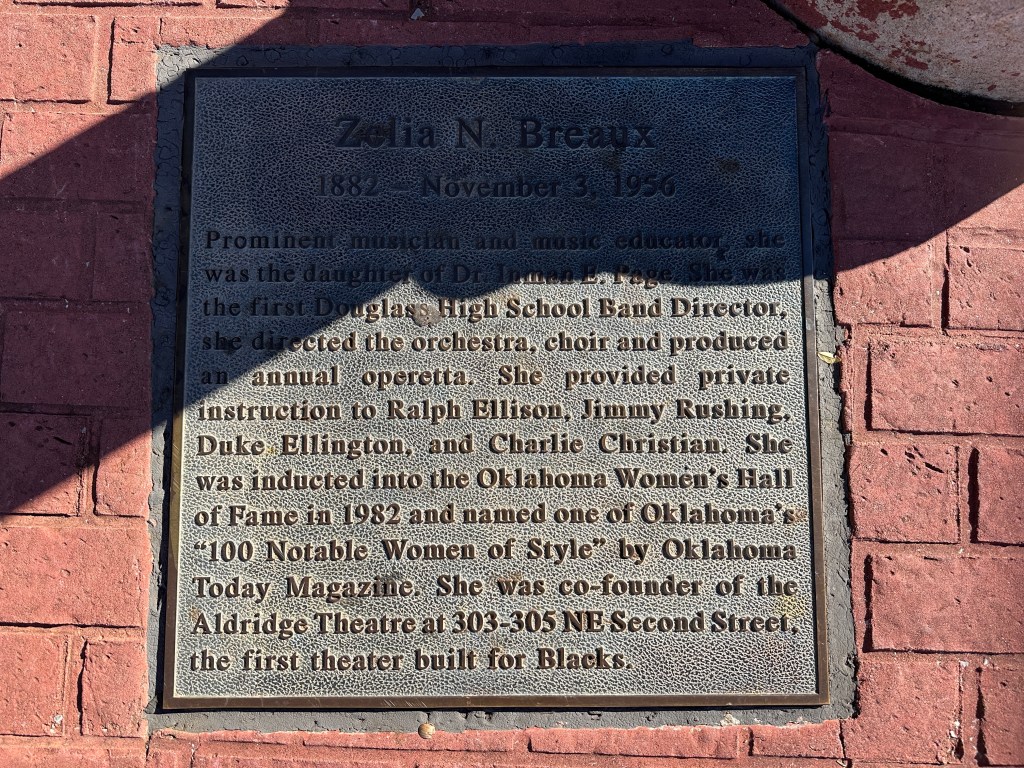
Zelia N. Breaux (1882 – November 3, 1956)
“Prominent musician and music educator, she was the daughter of Dr. Inman E. Page. She was the first Douglas High School Band Director, she directed the orchestra, choir and produced an annual operetta. She provided private instruction to Ralph Ellison, Jimmy Rushing, Duke Ellington, and Charlie Christian. She was inducted into the Oklahoma Women’s Hall of Fame in 1982 and named one of Oklahoma’s “100 Notable Women of Style” by Oklahoma Today Magazine. She was co-founder of the Aldridge Theatre at 303-305 NE Second Street, the first theater built for Blacks.”
Concluding Thoughts
I learned a lot about the Deep Deuce District while researching this blog. I am so happy my dad showed me the Lyons Mansion and that we stumbled across the historic markers in the sidewalk. I hope you’ll visit the Deep Deuce District next time you’re in Oklahoma City.
Happy traveling! I’ll talk to ya soon 🙂
Sources
“Oklahoma’s National Register Handbook.” State Historic Preservation Office. Oklahoma Historical Society. November 8, 2024.
Websites
“History” – Deep Deuce
“Deep Deuce” – Travel Oklahoma
“Deep Deuce” – Visit OKC
“African American History & Culture in Oklahoma” – Travel Oklahoma
“Cavalry Baptist Church” – Metropolitan Library System website
“Oklahoma: Calvary Baptist Church” – National Park Service
Anita G. Arnold. “Second Street.” – The Encyclopedia of Oklahoma History and Culture. Oklahoma Historical Society.
Newspapers & Media Stories
“Re-evaluating Deep Deuce.” The Journal Record (Oklahoma City, Oklahoma), March 1, 2001.
“Looking back at the history of Oklahoma City’s Deep Deuce District and one man who helped build it,” KFOR News 4. March 2, 2015.
Ian Jayne. “Deep Deuce continues building an identity while keeping an eye on its historic past.” Oklahoma Gazette (Oklahoma City, Oklahoma), March 20, 2017.
Claire Donnelly. “How Curious: Where Were Oklahoma’s Green Book Listings?” KGOU. March 18, 2019.
 The Active Historian
Leave a comment