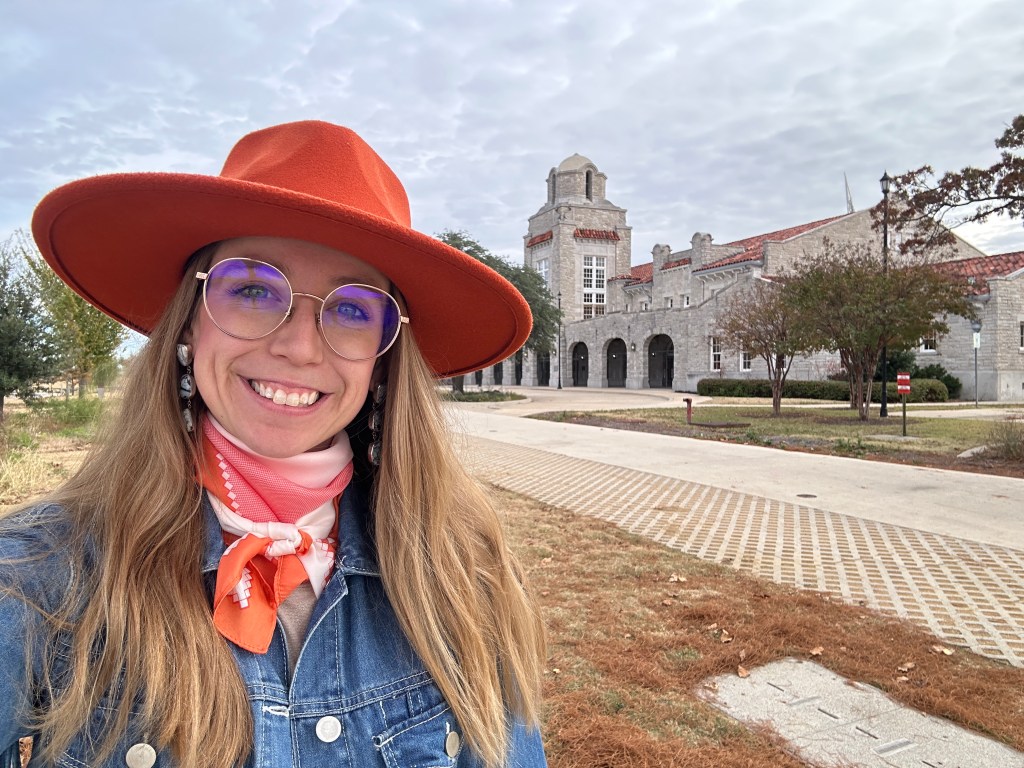
Hey, friend! Welcome back to another post. Today, I want to show you the historic Union Station in Oklahoma City. This building is listed on the National Register of Historic Places and now sits in Scissortail Park.
First, I will take you through the history of the building from construction to completion. Then I will show you current photos of the building today in 2025. This building has been preserved well and looks great for being nearly 100 years old.
Let’s get started!

Building the Union Station in OKC
Plans for the Union Station began to take shape in Oklahoma City as early as 1928. The initial railroad delegation which visited OKC in 1930 was comprised of J.E. Hutchison (Frisco Vice President), L.C. Fritch (Rock Island Vice President), W.H. Peterson (Rock Island Chief Engineer), and other engineering staff members.
After the January 1930 meeting, Hutchison believed construction of the new Union Station on the north side of OKC could begin in March or April. The railroad delegation returned to St. Louis to begin drawing plans.
“We are anxious to begin our station building.”
– J.E. Hutchison
The first round of proposed plans for Union Station were completed by mid-February, but they didn’t have a set budget for the estimated cost. The new site of the Union Station would be on the north side of the Frisco right of way between Hudson and Harvey.
W.A. Wallace (Resident Engineer) stated the shipment of rails for the new right of way would begin in February so the project could be potentially be completed during the summer. Meanwhile, Col. F.G. Jonah (Chief Engineer for the Frisco) was a little more realistic on the construction timeline stating it would be “quite a while” before plans for the Frisco-Rock Island Union Station would be completed. By early March, the proposed completion date for Union Station in OKC was December 4, 1930.
Several lots needed to be acquired for the new Union Station in OKC – some were purchased and the others were acquired through condemnation suits according to railroad attorneys.
I.C. Stephens of St. Louis was chosen as the architect for the Union Station in OKC. The building was to be 360 feet long and 222 feet wide shaped like a “horizontal T.”
The interior was to have stone walls and be one story with high ceilings. The building was ‘technically’ two stories tall with a single level with “a large lobby, two waiting rooms, cafe, smoking and rest rooms, newsstand, large ticket office, and other essentials…” (“Union Station Construction Due In Month.” The Oklahoma News, March 7, 1930.
Harlow’s Weekly described the Union Station architecture and building floor plan as follows:
“… It is to be of Bedford Stone, and of modified Spanish architecture, with a large tower rising in the center front. It has large waiting rooms and lobby, and the floor arrangements are regarded as unusually well planned. Persons going to the trains will not cross any tracks. The street entrance is at ground level, and approaches are such that no traffic congestion is expected. Exits are provided on both sides of the building. A large wing on Harvey avenue side will house the express business, and a similar one on Hudson Avenue side will handle mail and baggage. A parking place for cabs is provided and a parkway on Choctaw avenue, in the front of the building is to be landscaped. The station proper including tracks and train shed, will cost $1,300,000.”
“Union Station For Capital,” Harlow’s Weekly, March 15, 1930.
The newspaper image below shows what the proposed plan for the Union Station in OKC was to look like.

On April 15, 1930, plans for the Union Station were submitted to the Oklahoma Corporation Commission for approval by the Rock Island and Frisco Railroads alongside OKC officials.
Plans surrounding the viaducts went back and forth and stymied up the construction process for the Union Station. Due to pushback from unhappy residents, the two railroads were forced to complete a new survey to determine whether viaducts or underpasses would be better for traffic flow around the railroad tracks. The Corporation Commission thus postponed the hearing on the viaduct plans until May 14 so the survey could be completed. The survey appears to have been completed early and the Corporation Commission wound up voting on the OKC Union Station plan on May 7, 1930. The plans were approved and the Corporation Commission stipulated the Union Station must still be completed by December 4 deadline.
On May 12, Frisco Chief Engineer Col. F.G. Jonah stated the Frisco and Rock Island Railroads were receiving bids for the Union Station project. Tankersley Construction Co. was the successful bidder. Dan and Earl Tankersley successfully bid $500,000 for the station building alone. This did not include the platforms, underpasses, or safety systems as these would be separate bids. Construction on the OKC Union Station building was set to begin in early July.

Meanwhile beginning on June 14, workers began laying rails for the main line for the Rock Island Railroad in front of the future OKC Union Station site. These rails were heavy and weighed 120 pounds each!
Tankersely wanted to hire around 300 men from the OKC area for the project. His ideal plan included having two to three shifts of men working on the building 24 hours a day.
Excavation began on the Union Station site in mid-July. Fifty men with machines were hired immediately to expedite the process so construction of the building could begin to meet the December 4 deadline. As soon as the excavation was completed, more men were employed to work on the building. The foundation work began at the beginning of August.
Other men hired to construct the building included carpenters, stone masons, and the plastering crews.
By mid-September, the outer walls of the Union Station were starting to take shape.
“Wall construction will be done first on the west wing, which is to house mail and baggage… concrete sub-basement and footing work is nearly completed.”
“Union Station Walls To Be Started Soon.” The Oklahoma News, September 4, 1930.
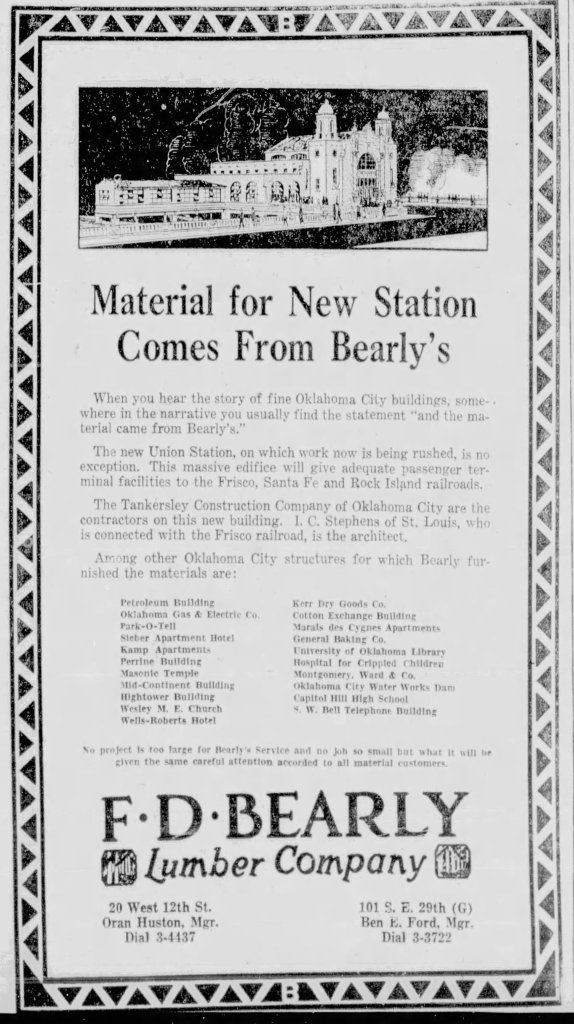
F.D. Bearly Lumber Company supplied a majority of the materials that were used to build the OKC Union Station. You can see their newspaper ad below.
Temporary station quarters were arranged for beginning in November as the removal of the Rock Island Railroad tracks took place in the Business District. The new OKC Union Station would eventually house the permanent quarters.
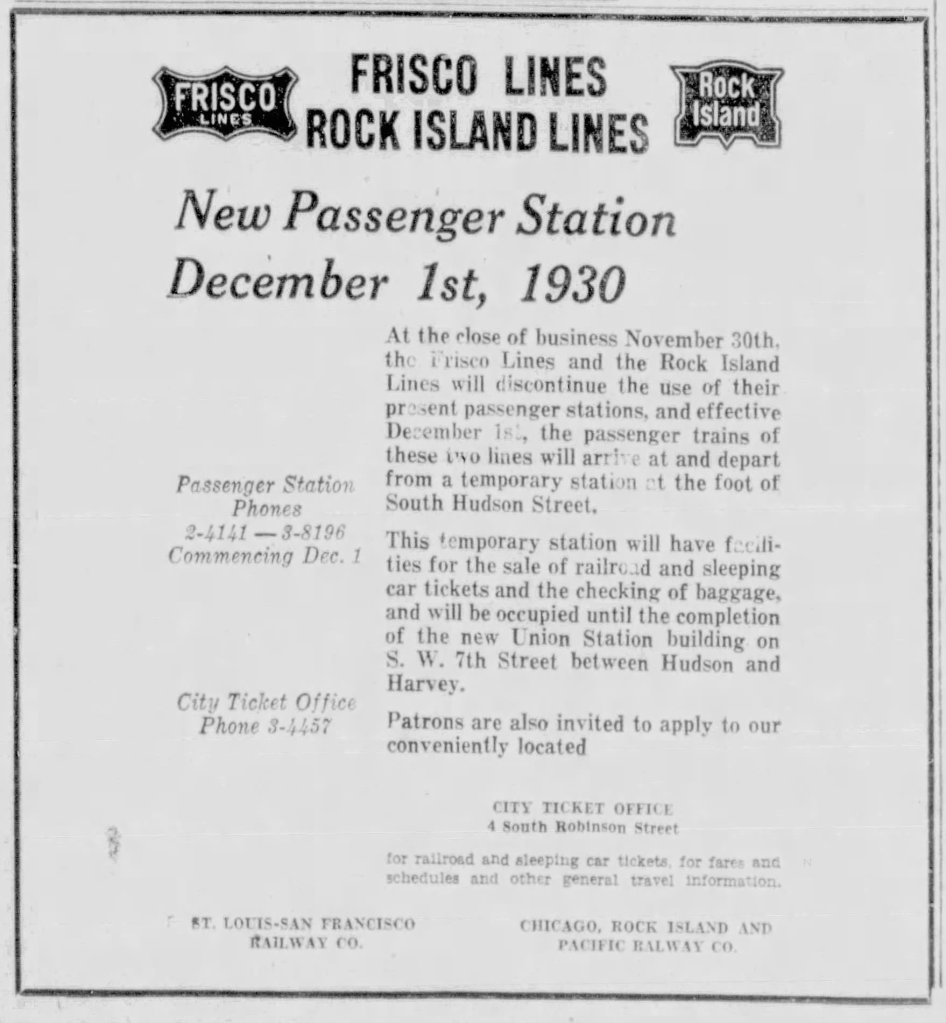
The OKC Union Station was not completed by the December 4 deadline due to a multitude of factors. The Oklahoma News reported on January 2, 1931, that the new projected completion date would be March 1931. The public would supposedly have access to the station in April 1931. More delays led to the Union Station being set to open in July 1931.
In the photo below, the workmen are putting the finishing touches on the Union Station in Oklahoma City.


Opening Day – July 15, 1931
The July 1931 opening date looked feasible and the OKC Chamber of Commerce was asked to sponsor and plan a grand celebration.
The Union Station was dedicated and officially opened on Wednesday, July 15, 1931, in Oklahoma City with over 2,000 people in attendance.

“We will stage one of the most spectacular celebrations ever held to commemorate a local civic project. Completion of the [Union] station will mark a new era in the city’s development.”
– John A. Brown, OKC Chamber President
Col. F.G. Jones (Frisco Chief Engineer) presented a huge guilded key to the Union Station to OKC Mayor Clarence J. Blinn. Mayor Blinn then gave the key to three-year-old, Mary Jo Poole, granddaughter of the Rock Island engineer. She unlocked the entrance to the subway which led from the station to the tracks. This ceremonial unlocking officially opened the Union Station for business.

Two local high school bands played music as the engines pulled into the station. The first engine to arrive at Union Station was a Frisco Meteor fast train between Oklahoma City and St. Louis. A replica “No. 9” engine pulled up next to it and they arrived together. The “No. 9” engine was significant because it was the first Frisco engine to arrive in OKC several 33 years earlier.

C.C. Mills was the conductor on the first Frisco engine to arrive in OKC in 1898 and he was given the opportunity to do it again for the opening ceremony of the OKC Union Station. This was special moment because the new station was built on the site of the original station he first pulled into so many years earlier. He is pictured below in 1898 and 1931. In 1931, he was still working for Frisco in the safety department.
The Firemen’s Band also marched and played music from Grand to Hudson Avenue.
The official ceremony was held on the platform and it was presided over by Dan W. Hogan, President of the City National Bank.
Lieutenant Governor Robert Burns represented the state because Governor W.H. Murray was not able to attend the ceremony. Lt. Governor Burns rode on the “No. 9” engine into the ceremony.
C.T. Miller, Vice President and General Solicitor for Frisco, spoke about the development of the Union Station project and their locations from the 1890s to the 1930s.
Other members who rounded out the speaker’s platform included: Councilmen J.E. Taylor, A.H. Jacoby, C.T. Lockwood, City Engineer L.M. Bush, Carl Magee, editor of The News, J.F. Owens, president of the Oklahoma Gas & Electric Co.; Stanley Draper, secretary of the chamber of commerce; Ben Franklin, local Frisco attorney and other railroad officials and city business men.
After the ceremony, railroad officials, city guests, and other dignitaries went to the OKC Chamber of Commerce for a luncheon. Later that afternoon, a reception for the railroad officials was held at the Oklahoma City Golf and Country Club by Dr. G.A. Nichols.
OKC Union Station Over the Years
The OKC Union Station was active from 1931 to 1967 as the central hub for Rock Island and Frisco lines in OKC. These trains carried both freight and passengers across the Midwest.
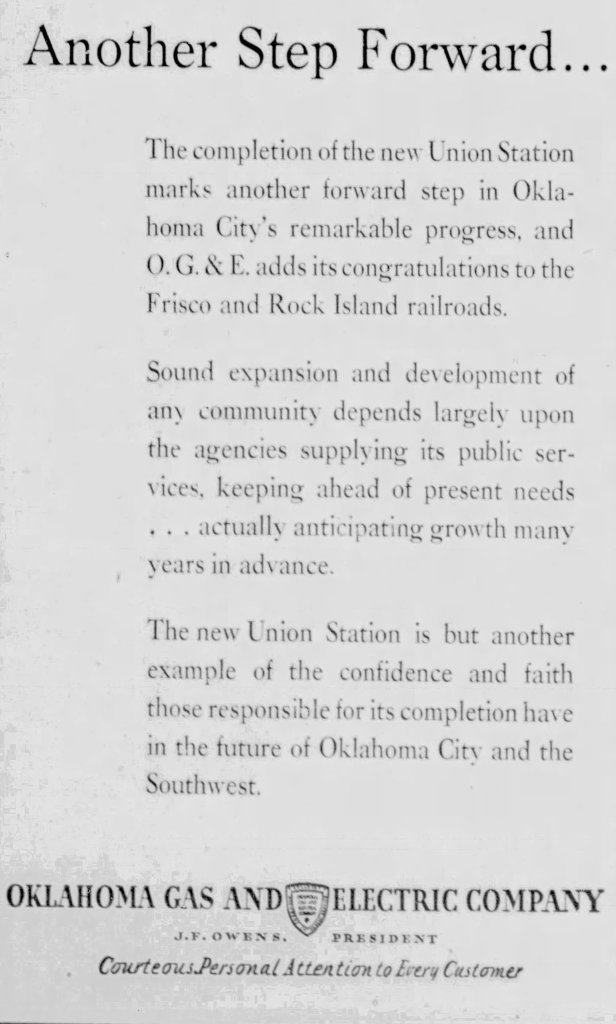
In 1977, the Thurman Magbee Family purchased the building in an effort to preserve the historic structure. The Union Station was added to the National Register of Historic Places two years later in 1979. By 1981, the Thurman Magbee Family had finished their restorations to the historic building.
In 1986, the building was left vacant due to an economic downturn.
In November 1989, the OKC Union Station was purchased by the Central Oklahoma Transportation and Parking Authority (COPTA) to act as a center for inter-Oklahoma City transit planning.
Today, the OKC Union Station building is being renovated using MAPS 3 funds. Oklahoma City officials planned to use $17 million to renovate the exterior and transform the interior spaces into office spaces and an event center. Renderings for the space can be found on the OKC Talk website cited in the “secondary sources” section of this post.
Current Photos
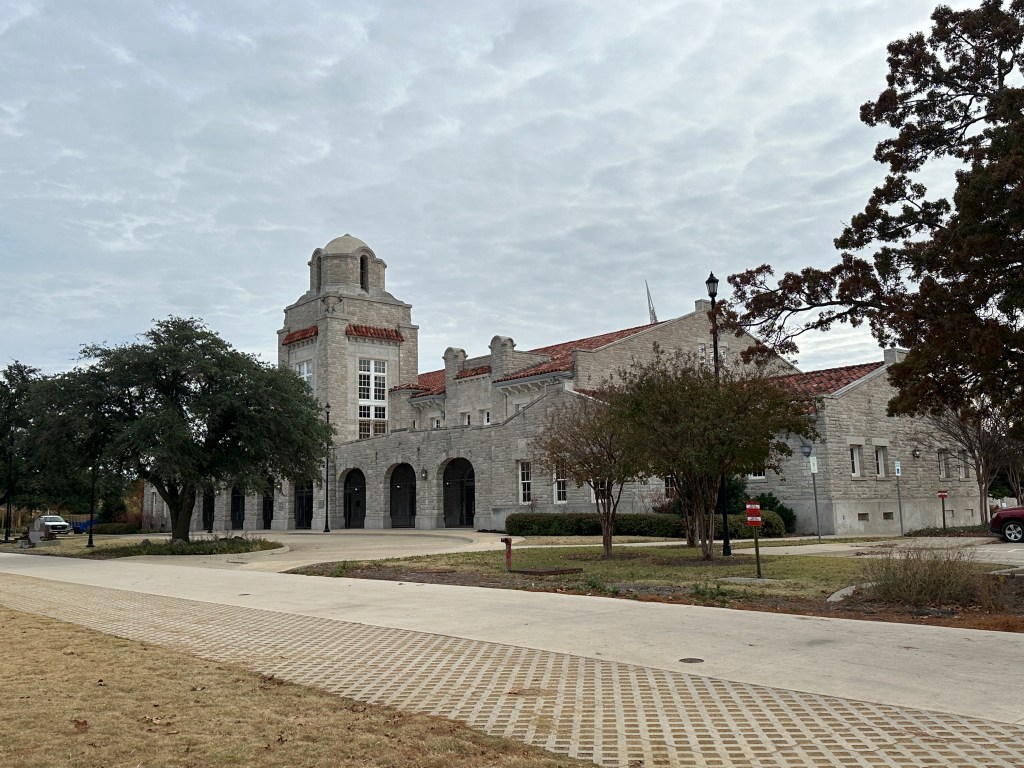
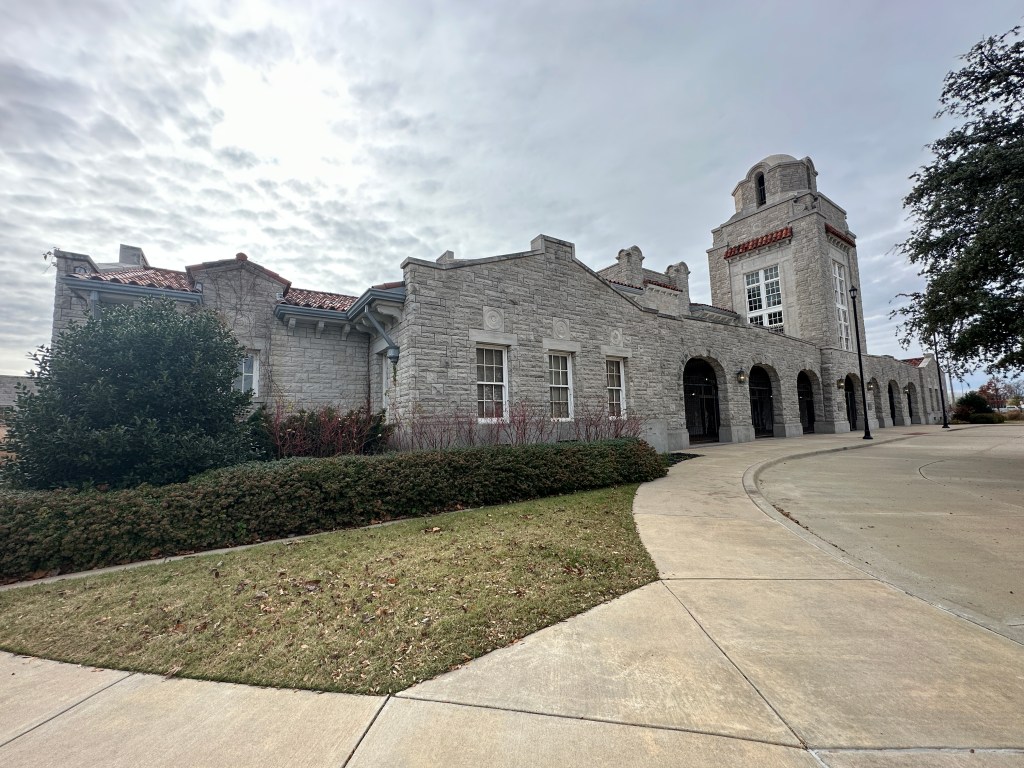
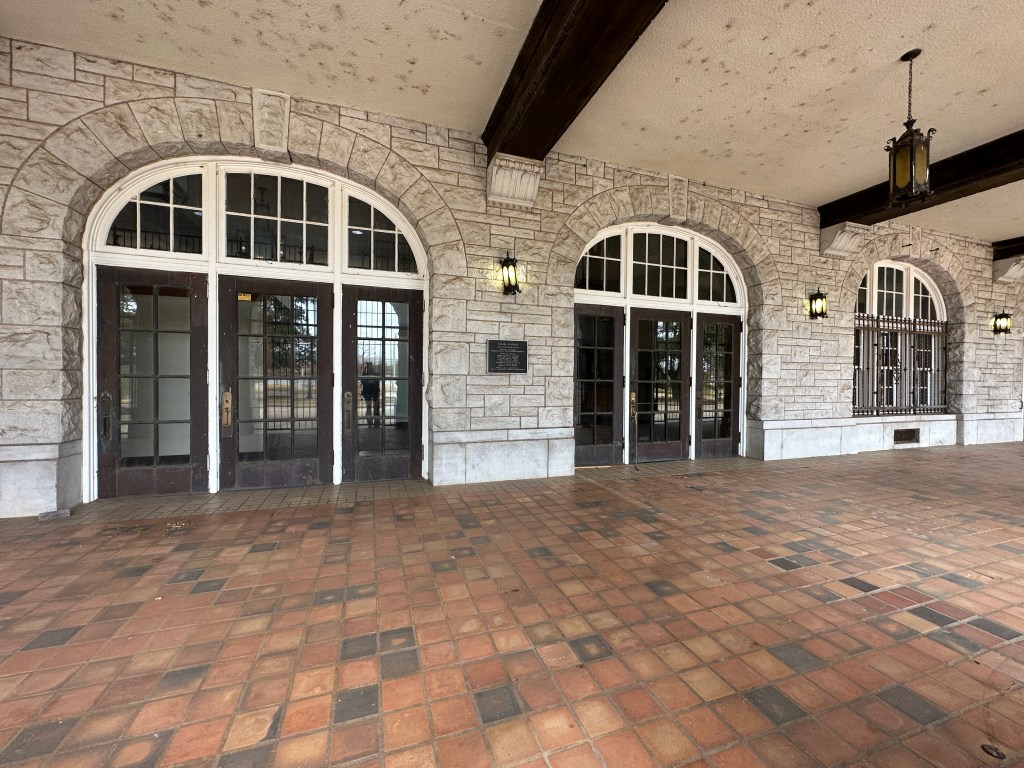
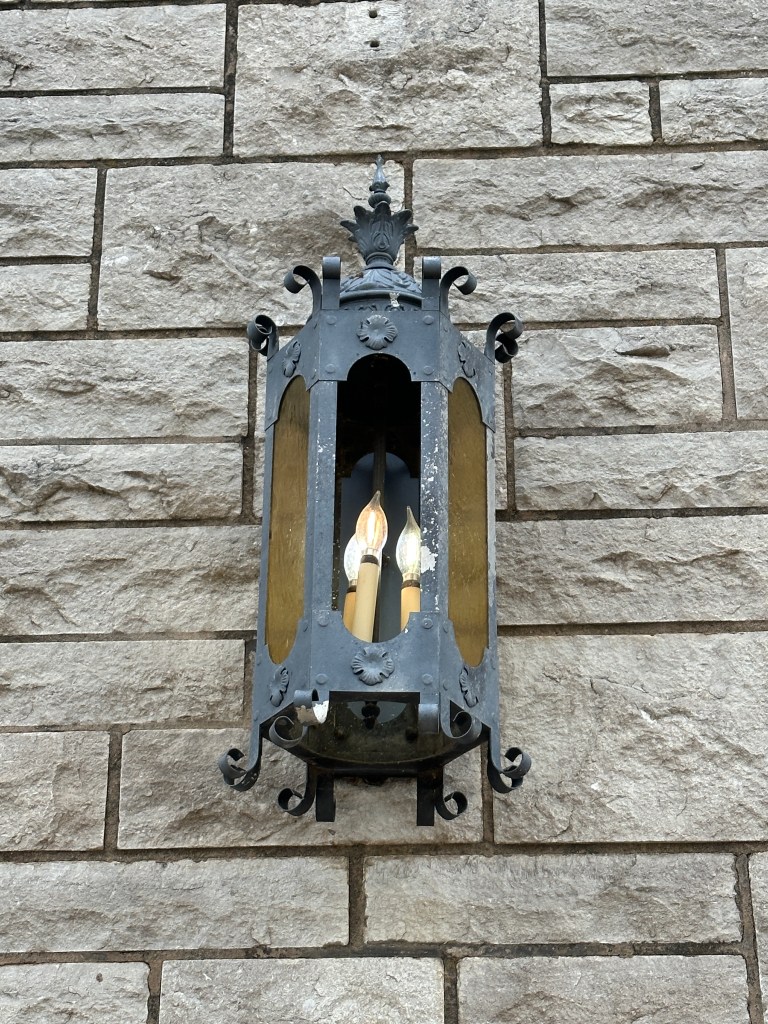
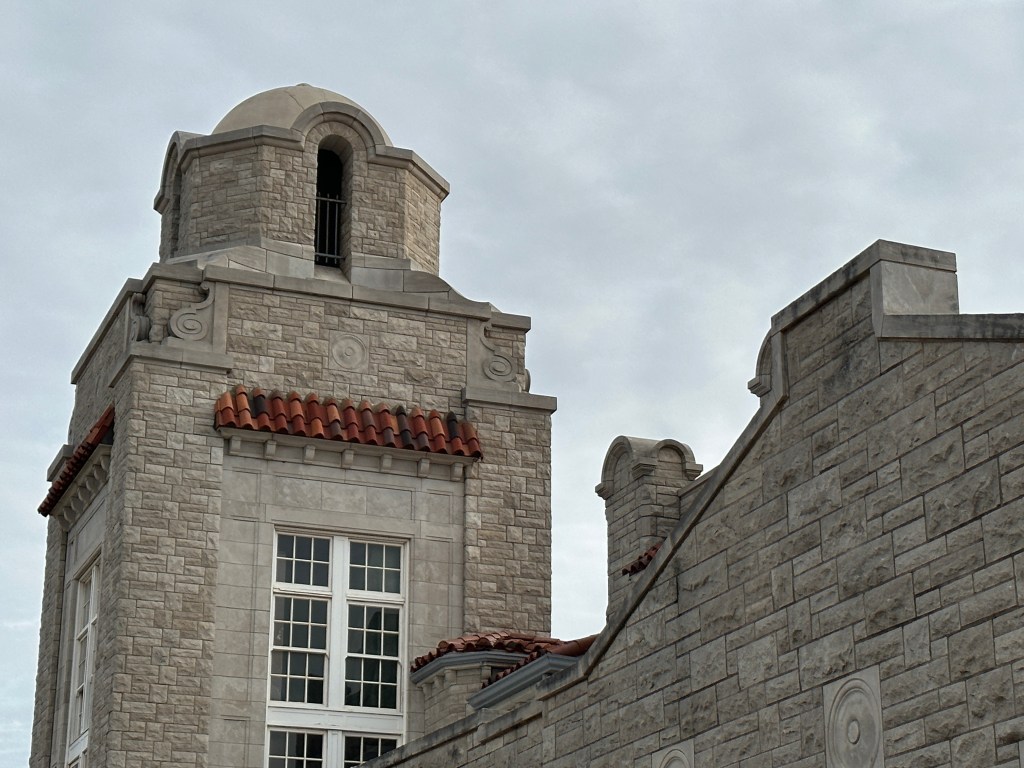
The OKC Union Station building is currently closed to the public and the front had locked gates so I couldn’t go inside. I enjoyed walking around the outside of the building and seeing the small architecture details.
I loved how the building had “Union Station” carved into the top and thought it was cool to see that detail was included in the original plans when I was researching this post further.
“The exterior will be built of Bedford stone, with six archways at the main entrance. A tower is in the center. “Union Station” will be engraved across the front.
“Union Station Construction Due In Month.” The Oklahoma News (Oklahoma City, Oklahoma), March 7, 1930.
I hope I get to see the interior of this building one day once it is renovated.
Enjoy these exterior photos!



Historic Markers Transcribed
There were three signs posted on the exterior of the building and they are transcribed below!

Union Station
“The Union Station was vacated in 1986 as a result of economic changes within the community. The facility was purchased by the Central Oklahoma Transportation and Parking Authority (COPTA) in November, 1989, in preparation for the future transportation needs of the Oklahoma City urban area. The Station became the center for transportation, planning and operations involving local and inter-city bus services, as well as future transit programs. The purchase was made possible with the financial assistance from the U.S. Urban Mass Transportation Administration and the Liberty National Bank and Trust Company of Oklahoma City.”
Dedicated to the citizens of Greater Oklahoma City on March 29, 1990
Ronald J. Norick, Mayor
Harold Stansberry, Chairman, COTRA
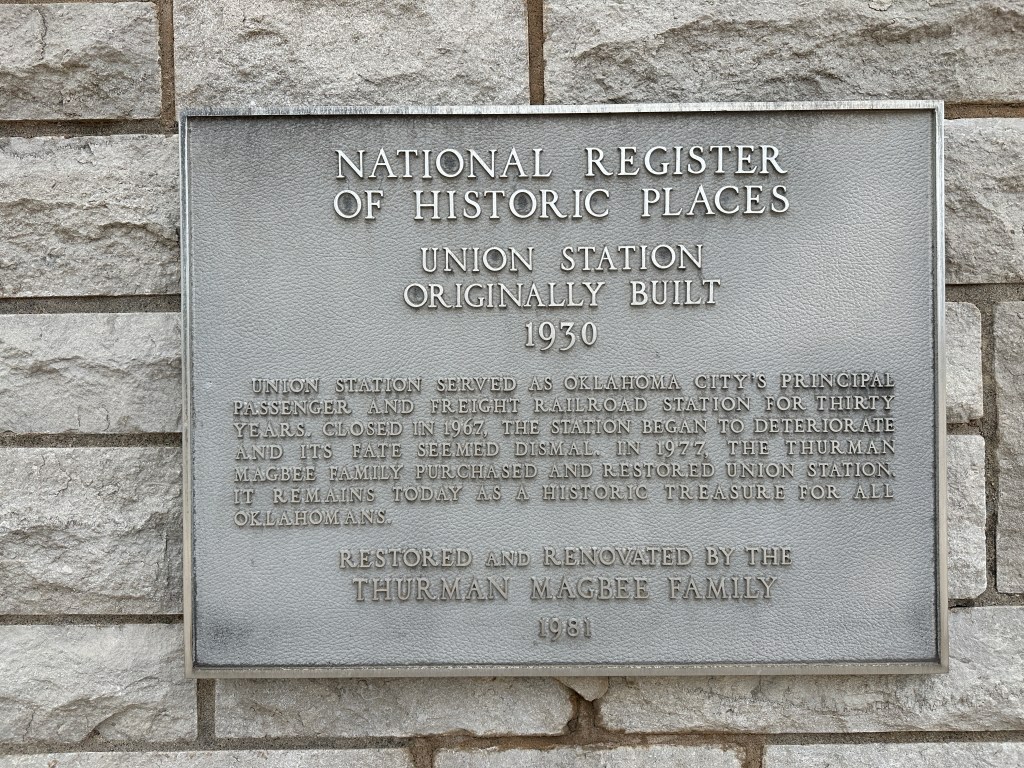
National Register of Historic Places
Union Station – Originally Built 1930
“Union Station served as Oklahoma City’s principal passenger and freight railroad station for thirty years. Closed in 1967, the Station began to deteriorate and its fate seemed dismal. In 1977, the Thurman Magbee Family purchased and restored Union Station. It remains today as a historic treasure for all Oklahomans.”
Restored and Renovated by the Thurman Magbee Family – 1981

Union Station
Dedicated March 20, 1990
Central Oklahoma Transportation and Parking Authority
Board of Trustees
Harold Stansberry, Chairman
Odell Smith, Vice Chairman
E. Chris Kauffman, Trustee
Clark H. Boyles Jr., Trustee
James D. Crosby, Trustee
Mayor Ronald J. Norick, Trustee
Paula A. Hearn, Trustee
Ronald K. Mason, Trustee
Steven C. Klika, Administrator
Terry L. Armentrout, Assistant Administrator
Concluding Thoughts
I enjoyed walking around and looking at the exterior of the Union Station in Oklahoma City. I’m thankful this building was saved and will be used for office spaces and event spaces in the future. I can’t wait to see the renovated interior.
I hope you’ll find some building on the National Register of Historic Places in your area and will go check them out!
Happy Traveling! I’ll talk to ya soon 🙂
Visit
300 SW 7th Street
Oklahoma City, OK 73109
TRAVEL TIP: This building is located in the south end of the Scissortail Park in Oklahoma City.
Sources
Primary Sources
Newspapers
“Railway Heads To Settle Row.” The Oklahoma News (Oklahoma City, Oklahoma), January 7, 1930.
“Union Station To Begin Soon.” The Oklahoma News (Oklahoma City, Oklahoma), January 11, 1930.
“Depot Plans Rushed.” The Oklahoma News (Oklahoma City, Oklahoma), January 28, 1930.
“Union Station Plans Ready Next Week.” The Oklahoma News (Oklahoma City, Oklahoma), February 10, 1930.
“Union Station Progress.” Harlow’s Weekly (Oklahoma City, Oklahoma), February 15, 1930.
“Progress on Station Projects.” Harlow’s Weekly (Oklahoma City, Oklahoma), March 1, 1930.
“Union Station To Begin Soon.” The Oklahoma News (Oklahoma City, Oklahoma), March 4, 1930.
“This Is How The New Oklahoma City Station Will Look.” The Oklahoma News (Oklahoma City, Oklahoma), March 6, 1930.
“Union Station Construction Due In Month.” The Oklahoma News (Oklahoma City, Oklahoma), March 7, 1930.
“Union Station For Capital,” Harlow’s Weekly (Oklahoma City, Oklahoma), March 15, 1930.
“Depot Viaduct Foes To Meet.” The Oklahoma News (Oklahoma City, Oklahoma), April 11, 1930.
“Viaduct Plan Action Delayed.” The Oklahoma News (Oklahoma City, Oklahoma), April 15, 1930.
“Union Station Plans Delayed.” The Oklahoma News (Oklahoma City, Oklahoma), April 30, 1930.
“Station Work To Begin Soon.” The Oklahoma News (Oklahoma City, Oklahoma), May 8, 1930.
“Depot Bids Are Due.” The Oklahoma News (Oklahoma City, Oklahoma), May 12, 1930.
“Laying Of Tracks Start.” The Oklahoma News (Oklahoma City, Oklahoma), June 14, 1930.
“Union Station Begins July 1.” The Oklahoma News (Oklahoma City, Oklahoma), June 20, 1930.
“Start Work on Station Next Week.” The Oklahoma News (Oklahoma City, Oklahoma), June 28, 1930.
“We Are Proud to Have Been Trusted.” The Oklahoma News (Oklahoma City, Oklahoma), September 23, 1930.
“Approve Plans For Underpass.” The Oklahoma News (Oklahoma City, Oklahoma), July 12, 1930.
“Receive Subway Bids.” “We Are Proud to Have Been Trusted.” The Oklahoma News (Oklahoma City, Oklahoma), July 14, 1930.
“Start Union Depot.” The Oklahoma News (Oklahoma City, Oklahoma), July 18, 1930.
“Work Is Pushed On New Union Station.” The Oklahoma News (Oklahoma City, Oklahoma), July 23, 1930.
“Start Work On Union Station Foundation.” The Oklahoma News (Oklahoma City, Oklahoma), August 5, 1930.
“Rock Island May Build Temporary Depot Here.” The Oklahoma News (Oklahoma City, Oklahoma), August 14, 1930.
“Union Station Walls To Be Started Soon.” The Oklahoma News (Oklahoma City, Oklahoma), September 4, 1930.
“Utilities Are Making Improvements.” Harlow’s Weekly (Oklahoma City, Oklahoma), November 15, 1930.
“Material for New Station Comes From Bearly’s.” The Oklahoma News (Oklahoma City, Oklahoma), November 17, 1930.
“Frico Lines | Rock Island Lines.” The Oklahoma News (Oklahoma City, Oklahoma), November 25, 1930.
“Rail Stretch Will Be Paved.” The Oklahoma News (Oklahoma City, Oklahoma), December 1, 1930.
“R.I. Landmark Has Vanished.” Oklahoma Live Stock News (Oklahoma City, Oklahoma), December 1, 1930.
“Work Rushed On Depot.” The Oklahoma News (Oklahoma City, Oklahoma), January 2, 1931.
“News Shorts.” The Oklahoma Courier (Oklahoma City, Oklahoma), January 10, 1931.
The Oklahoma Banker (Oklahoma City, Oklahoma), May 1, 1931. [Page 13]
“Union Station To Be Completed By July.” The Oklahoma News (Oklahoma City, Oklahoma), May 5, 1931.
“Union Station to Open July 9.” The Oklahoma News (Oklahoma City, Oklahoma), June 5, 1931.
“Station Opens Soon.” The Oklahoma News (Oklahoma City, Oklahoma), June 15, 1931.
“Murray To Be Casey Jones In Union Pageant.” The Oklahoma News (Oklahoma City, Oklahoma), July 11, 1931.
“News Shorts.” The Oklahoma Courier (Oklahoma City, Oklahoma), July 11, 1931.
“Depot Opening Plan Complete.” The Oklahoma News (Oklahoma City, Oklahoma), July 13, 1931.
“Uncle Charley to Bring ‘Iron Horse’ to Town Again.” The Oklahoma News (Oklahoma City, Oklahoma), July 14, 1931.
“Union Station Is Dedicated.” The Oklahoma News (Oklahoma City, Oklahoma), July 15, 1931.
Ad Blocks, The Oklahoma News (Oklahoma City, Oklahoma), July 15, 1931.
“Going Down to Depot to See Train Come In.” The Oklahoma News (Oklahoma City, Oklahoma), July 15, 1931.
“New Frisco-Rock Island Station Has Gala Opening With High Road Officials Present.” The Black Dispatch (Oklahoma City, Oklahoma), July 16, 1931.
Secondary Sources
Historic Markers.
“Union Station Celebrates Anniversary.” July 15, 2020. scissortailpark.org.
“Renovation of Union Station set to go forward.” OKC Talk. October 17, 2023.
 The Active Historian
Leave a comment