
Hey, Friend! Welcome back to another post. Today, I want to show you some of the historic markers I have found in Tulsa, Oklahoma. This is not a comprehensive list and I will continue to add to it as I find more. Let’s get started!

The 1921 Tulsa Massacre
“On May 31 to June 1, 1921, a white mob attacked the prosperous Black neighborhood of Greenwood in Tulsa, resulting in the deaths of at least 36 Black Tulsa’s, the destruction of 36 city blocks, and the displacement of over 10,000 Black people. On May 31, Dick Rowland, a 19-year-old Black teenager, was jailed after being accused of assaulting a white woman. Although the charges were dropped, the local Tulsa Tribune newspaper published an inflammatory story that mobilized a white mob to lynch Rowland. In response, members of the Black community stationed themselves at the courthouse to protect him. Reports indicate that local authorities provided firearms and ammunition to the mob of thousands of white people who began firing at the Black men trying to protect Rowland. When the men retreated towards Greenwood, the mob, joined by city-appointed deputies, pursued them and began terrorizing the entire community, deliberately shooting Black residents, burning homes and buildings. When the Oklahoma National Guard was called to intervene, they ignored the mob’s rampage and instead arrested hundreds of Black survivors. Public officials failed to keep records of Black people who were wounded or killed. While the estimated number of deaths is at least 36, witness accounts report more than 300 Black people were killed. No one was held accountable for Greenwood’s devastation. Its only surviving foundation now sits under Vernon AME Church.”

Lynching in America
“Thousands of Black people were the victims of racial terror lynching in the United States between 1877 and 1950. During this era, racial terror lynching of African Americans emerged as a stunning form of violent resistance to emancipation and equal rights for African Americans, intended to intimidate Black people and enforce racial hierarchy and segregation. Although racial terror lynching was most prevalent in the South, it was used to uphold white supremacy and enforce decades of political, social, and economic exploitation, as Black people moved and built communities outside the South, as well. Racial terror lynching became the most public and notorious form of subordination directed at Black people and was frequently tolerated or even supported by law enforcement and elected officials, illustrating the failure of the criminal justice system to afford Black people equal justice under law. White mobs were usually permitted to engage in brutal violence with impunity. It was also common during this era for a Lynch mobs focus to expand beyond a specific person accused of an offense and to target any or all Black people unfortunate enough to be in the mob’s path. In most cases, the communities devastated by this violence never received any resources to repair the harm. The names of many lynching victims were not recorded or remain unknown, but over 76 racial terror lynchings have been documented in Oklahoma.”

The Greenwood District
“Founded in 1906, Tulsa’s Greenwood District was one of many Black communities created to welcome African Americans seeking freedom and opportunity in Oklahoma after suffering generations of slavery elsewhere. In 1889, O.W. Gurley, a wealthy Black man from Arkansas, purchased over 40 acres of land and sold it to Black people relocating to the area. Following Reconstruction and the ratification of the 13th, 14th, and 15th Amendments, state legislatures enacted racially discriminatory statutes and ordinances known as “Jim Crow” laws. This codified system of racial apartheid restricted the economic and civil rights of African Americans and affected almost every aspect of daily life, mandating segregation of schools, parks, restaurants, and other private and public institutions. Legally barred from white businesses, Black people spent their money in Greenwood creating a self-sustained economy. By 1920, Greenwood boasted dozens of Black-owned businesses and an educational system for Black students. J.B. Stafford built and operated a luxury hotel that became the largest Black-owned hotel in the country. Simon Berry ran transportation services including a charted plane service. John and Loula Williams owned a theater in addition to several other businesses. A.J. Smitherman founded the Tulsa Star, a key resource in documenting the community’s events. Dr. A.C. Jackson, a prominent Black surgeon, treated both Black and white patients.”
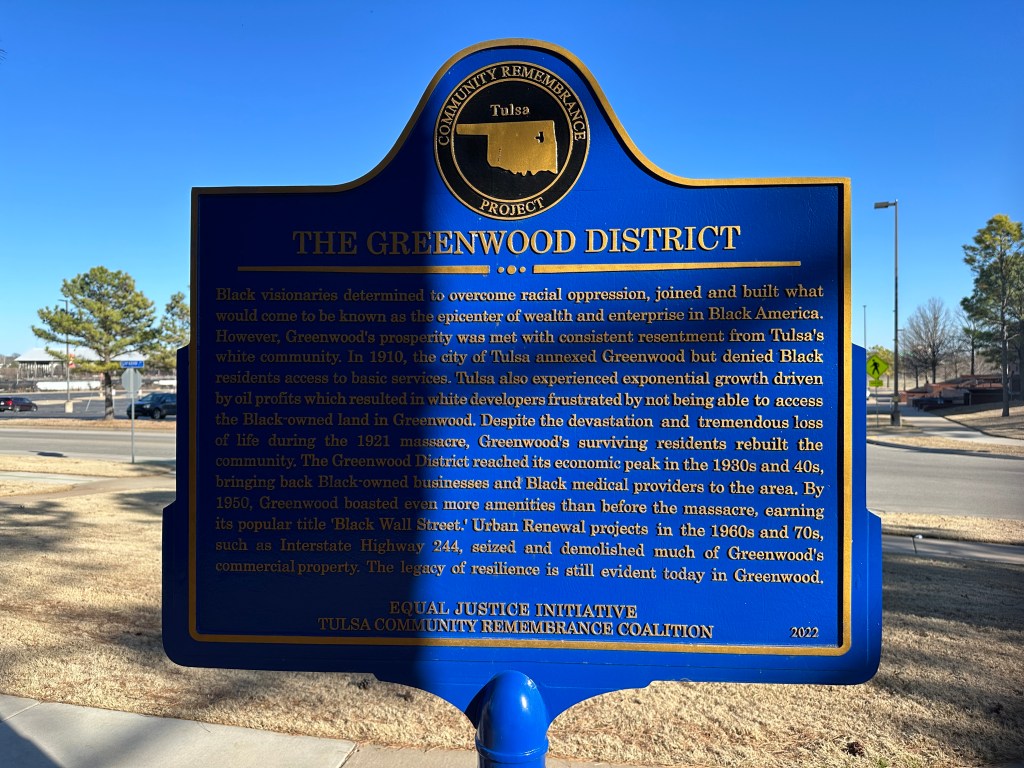
“Black visionaries determined to overcome racial oppression, joined and built what would come to be known as the epicenter of wealth and enterprise in Black America. However, Greenwood’s prosperity was met with consistent resentment from Tulsa’s white community. In 1910, the city of Tulsa annexed Greenwood but denied Black residents access to basic services. Tulsa also experienced exponential growth driven by oil profits which resulted in white developers frustrated by not being able to access the Black-owned land in Greenwood. Despite the devastation and tremendous loss of life during the 1921 massacre, Greenwood’s surviving residents rebuilt the community. The Greenwood District reached its economic peak in the 1930s and 40s, bringing Black-owned businesses and Black medical providers to the area. By 1950, Greenwood boasted even more amenities than before the massacre, earning its popular title ‘Black Wall Street.’ Urban Renewal projects in the 1960s and 70s, such as Interstate Highway 244, seized and demolished much of Greenwood’s commercial property. The legacy of resilience is still evident today in Greenwood.”

1921 Black Wall Street Memorial
“After statehood, Tulsa’s Black community, through resourcefulness, spirit, and self-sufficiency, developed a vibrant showcase of African-American culture around the intersection of Greenwood Avenue and Archer Street. Hundreds of prosperous black businesses lined the streets and brought unheralded wealth to the community, earning the name, “The Black Wall Street of America.” Archer Street, the line of segregation between the black and white worlds, was the ironic symbol of opportunity and oppression. While segregation created a vital economic center for Blacks, it also defined their place in the nation, the state, and the city.
The Greenwood area suffered the most devastating single incident of racial violence in the 20th century on June 1, 1921 following a distorted, false claim of assault. In 24 hours, as many as 300 black citizens died, and 36 square blocks, 23 churches, and more than 2,000 businesses and homes went up in flames. A thick, gray pall hung over Tulsa’s northern horizon for days as a result of the massive fires. With hands raised before the guns of soldiers, an estimated 6,000 Black men, women and children trudged past Greenwood and Archer Streets to temporary internment camps.
Fire and hatred had destroyed their community, but not their enterprising spirit. Tulsa’s Black citizens rebuilt this famed business avenue more enterprising than before. The tragic incident of 1921 became the new beginning. This Black Wall Street Memorial is dedicated to the entrepreneurs, the pioneers, and to Greenwood Avenue’s renaissance. It marks the past, the present and the future. The eternal flame symbolizes not mourning, but the resilience of a people. The fountain sanctifies those pioneering souls who refused to relinquish their dream. The Black Wall Street Memorial reaches for the unity of all God’s people.”
State Representative Don Ross
Greenwood Cultural Center
A founder
1996
 The Active Historian
Leave a comment