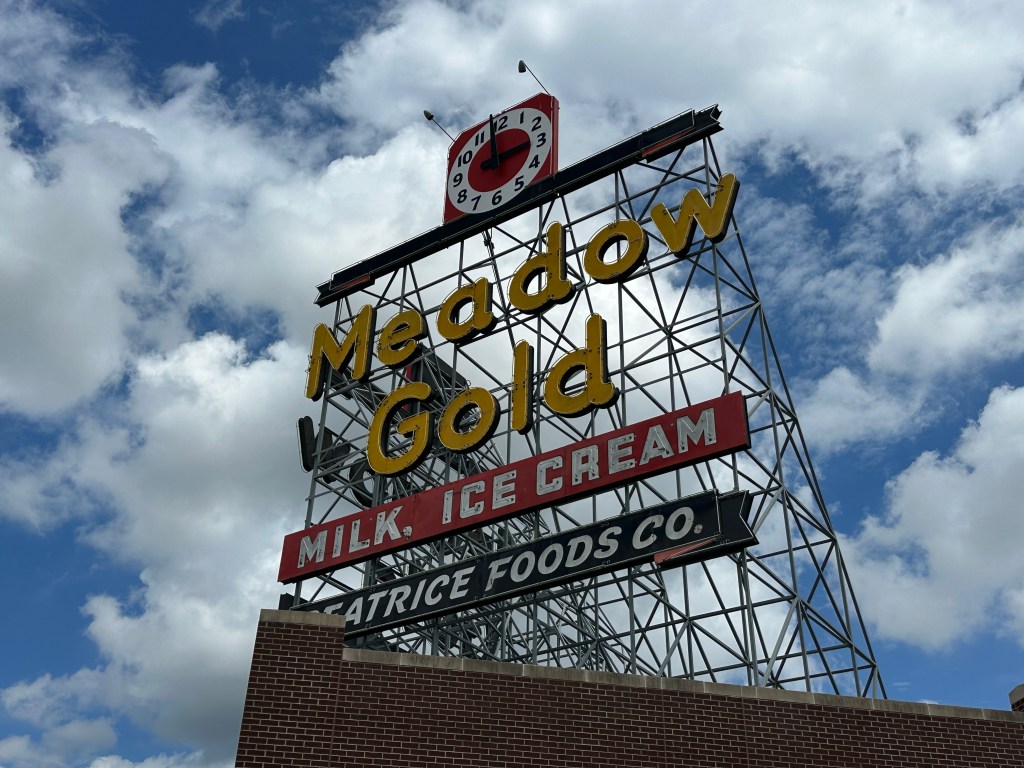
Hey, Friend! Welcome back to another post. Today, I want to show you the historic Meadow Gold neon sign in Tulsa, Oklahoma. Let’s get started!
History
The Historic Meadow Gold sign stands along Route 66 in Tulsa, Oklahoma. This sign was first put up in the 1930s by Meadow Gold Dairy owned by Beatrice Foods.
The sign stopped working in the 1970s and sat dormant on top of a building for the next three decades.
The sign restoration began in 2004 when several agencies came together to save the sign from being demolished with the building it sat on top of.
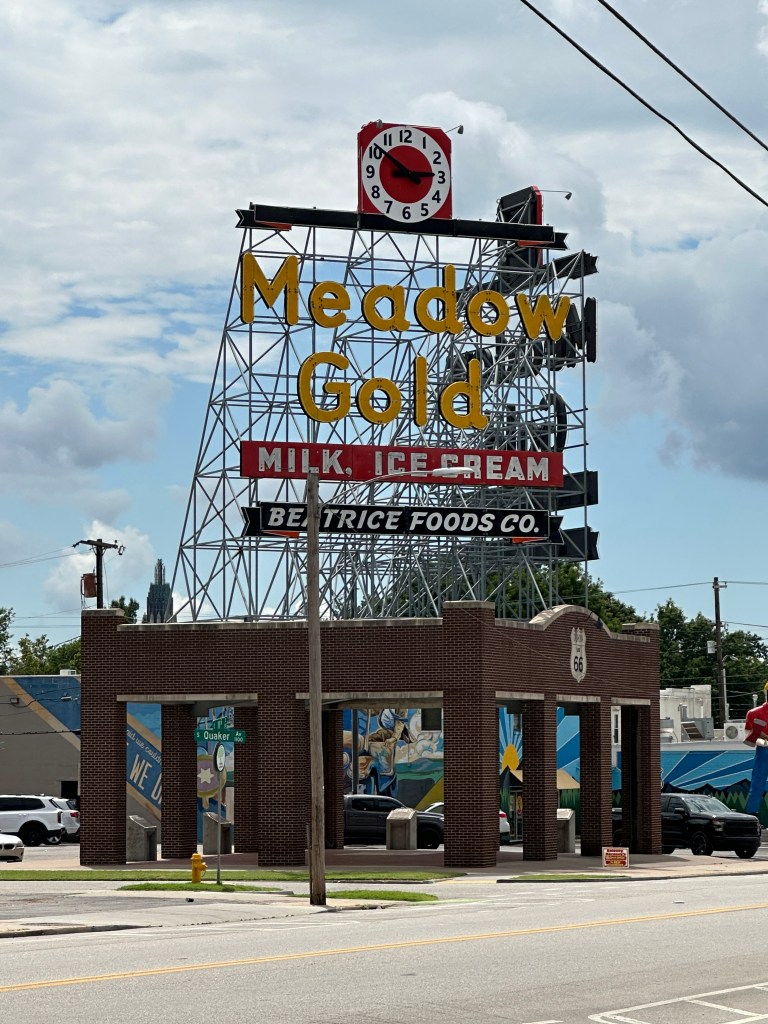
It was carefully removed and fixed by Claude Neon – the original builders of the sign. The sign was reinstalled on top of a brick pavilion on a plot of donated land.
The Meadow Gold sign was re-lit on May 22, 2009 and continues to shine bright today!
Photos
Historic Marker Transcriptions
I have transcribed the historic marker plaques at the site below.
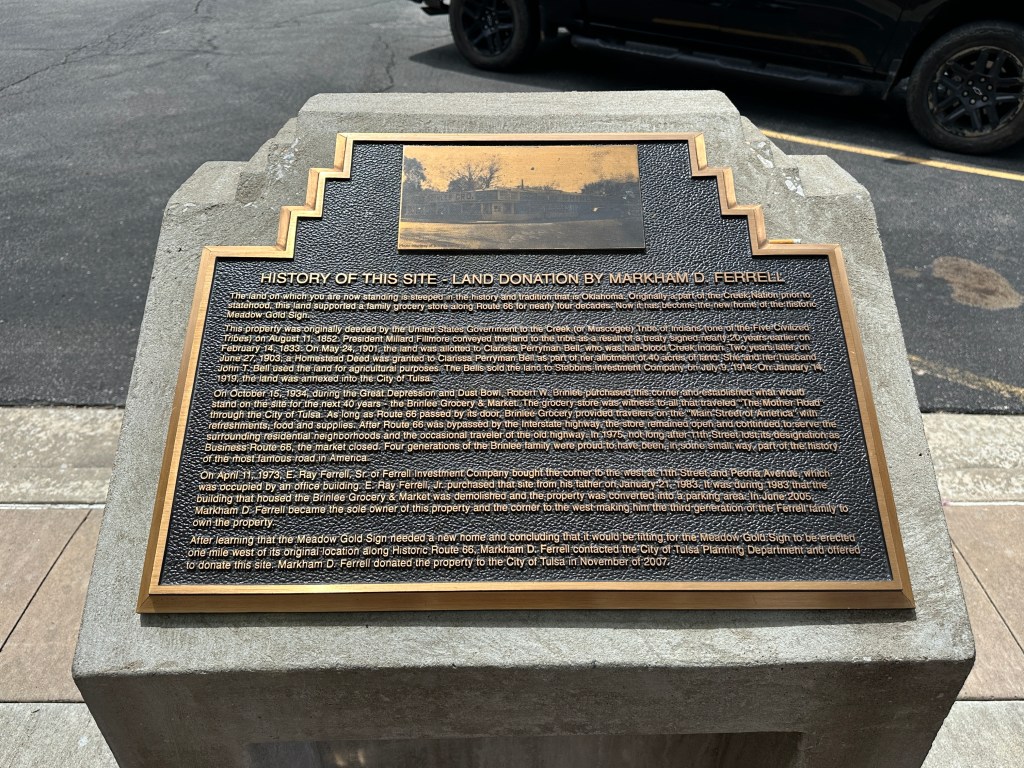
History of This Site – Land Donation by Markham D. Ferrell
“The land on which you are now standing is steeped in the history and tradition that is Oklahoma. Originally a part of the Creek Nation prior to statehood, this land supported a family grocery store along Route 66 for nearly four decades. Now it has become the new home of the historic Meadow Gold Sign.
This property was originally deeded by the United States Government to the Creek (or Muscogee) Tribe of Indians (one of the Five Civilized Tribes) on August 11, 1852. President Millard Fillmore conveyed the land to the tribe as a result of a treaty signed nearly 20 years earlier on February 14, 1833. On May 24, 1901, the land was allotted to Clarissa Perryman Bell, who was half-blood Creek Indian. Two years later on June 27, 1903, a Homestead Deed was granted to Clarissa Perryman Bell as part of her allotment of 40 acres of land. She and her husband John T. Bell used the land for agricultural purposes. The Bells sold the land to Stebbins Investment Company on July 9, 1914. On January 14, 1919, the land was annexed into the City of Tulsa.
On October 15, 1934, during the Great Depression and Dust Bowl, Robert W. Brinlee purchased this corner and established what would stand on the site for the next 40 years – the Brinlee Grocery & Market. The grocery store was witness to all that traveled “The Mother Road” through the City of Tulsa. As long as Route 66 passed by its door, Brinlee Grocery provided travelers on the “Main Street of America” with refreshments, food and supplies. After Route 66 was bypassed by the Interstate highway, the store remained open and continued to serve the surrounding residential neighborhoods and the occasional traveler of the old highway. In 1975, not long after 11th Street lost its designation as Business Route 66, the market closed. Four generations of the Brinlee family were proud to have been in some small way part of the history of the most famous road in America.
On April 11, 1973, E. Ray Ferrell, Sr. of Ferrell Investment Company bought the corner to the west at 11th Street and Peoria Avenue, which was occupied by an office building. E. Ray Ferrell, Jr. purchased that site from his father on January 21, 1983. It was during 1983 that the building that housed the Brinlee Grocery & Market was demolished and the property was converted into a parking area. In June 2005, Markham D. Ferrell became the sole owner of this property and the corner to the west making him the third generation of the Ferrell family to own the property.
After learning that the Meadow Gold Sign needed a new home and concluding that it would be fitting for the Meadow Gold Sign to be erected one mile west of its original location along Historic Route 66, Markham D. Ferrell contacted the City of Tulsa Planning Department and offered to donate this site. Markham D. Ferrell donated the property to the City of Tulsa in November of 2007.”
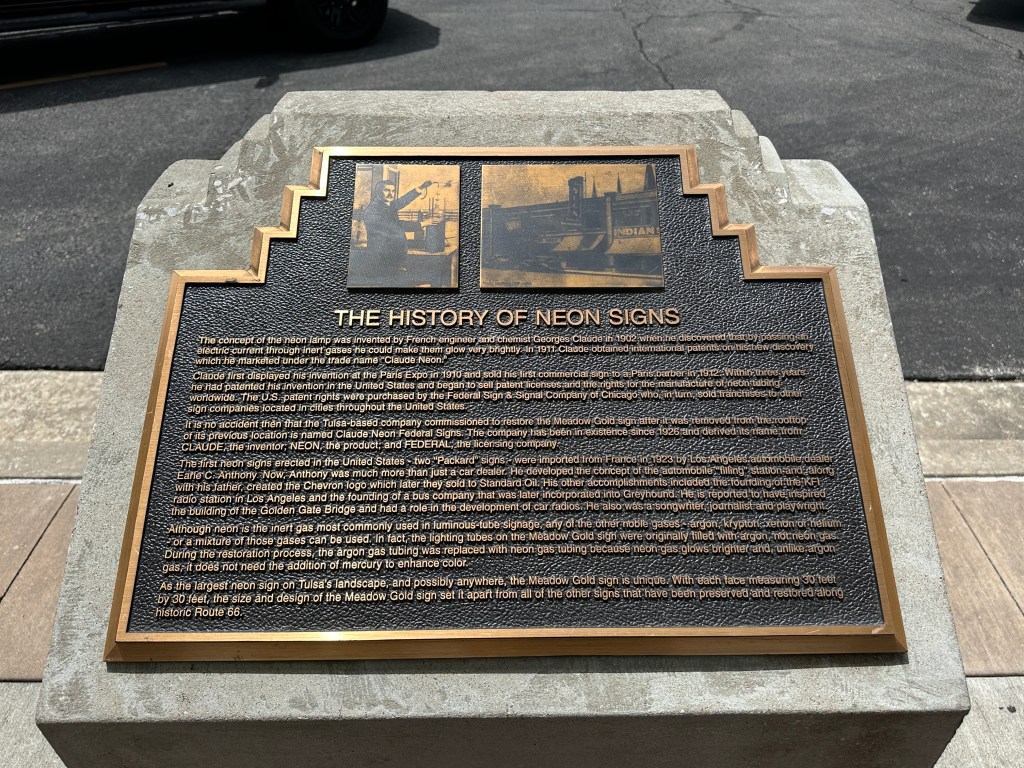
The History of Neon Signs
“The concept of the neon lamp was invented by French engineer and chemist Georges Claude in 1902 when he discovered that by passing an electric current through inert gases he could make them glow very brightly. In 1911 Claude obtained international patents on his new discovery which he marketed under the trade name “Claude Neon.”
Claude first displayed his invention at the Paris Expo in 1910 and sold his first commercial sign to a Paris barber in 1912. Within three years he had patented his invention in the United States and began to sell patent licenses and the rights for the manufacture of neon tubing worldwide. The U.S. patent rights were purchased by the Federal Sign & Signal Company of Chicago who, in turn, sold franchises to other sign companies located in cities throughout the United States.
It is no accident then that the Tulsa-based company commissioned to restore the Meadow Gold sign after it was removed from the rooftop of its previous location is named Claude Neon Federal Signs. The company has been in existence since 1926 and derived its name from CLAUDE, the inventor; NEON, the product; and FEDERAL, the licensing company.
The first neon signs erected in the United States – two “Packard” signs – were imported from France in 1923 by Los Angeles automobile dealer Earle C. Anthony. Now, Anthony was much more than just a car dealer. He developed the concept of the automobile “filling” station and, along with his father, created the Chevron logo which later they sold to Standard Oil. His other accomplishments included the founding of the KFI radio station in Los Angeles and the founding of a bus company that was later incorporated into Greyhound. He is reported to have inspired the building of the Golden Gate Bridge and had a role in the development of car radios. He was also a songwriter, journalist and playwright.
Although neon is the inert gas most commonly used in luminous-tube signage, any of the other noble gases – argon, krypton, xenon or helium-or a mixture of those gases can be used. In fact, the lighting tubes on the Meadow Gold sign were originally filled with argon, not neon gas. During the restoration process, the argon gas tubing was replaced with neon gas tubing because neon gas glows brighter and, unlike argon gas, it does not need the addition of mercury to enhance color.
The first neon signs erected in the United States – two “Packard” signs – were imported from France in 1923 by Los Angeles automobile dealer Earle C. Anthony. Now, Anthony was much more than just a car dealer. He developed the concept of the automobile “filling” station and, along with his father, created the Chevron logo which later they sold to Standard Oil. His other accomplishments included the founding of the KFI radio station in Los Angeles and the founding of a bus company that was later incorporated into Greyhound. He is reported to have inspired the building of the Golden Gate Bridge and had a role in the development of car radios. He was also a songwriter, journalist and playwright.
Although neon is the inert gas most commonly used in luminous-tube signage, any of the other noble gases – argon, krypton, xenon or helium-or a mixture of those gases can be used. In fact, the lighting tubes on the Meadow Gold sign were originally filled with argon, not neon gas. During the restoration process, the argon gas tubing was replaced with neon gas tubing because neon gas glows brighter and, unlike argon gas, it does not need the addition of mercury to enhance color.
As the largest neon sign on Tulsa’s landscape, and possibly anywhere, the Meadow Gold sign is unique. With each face measuring 30 feet by 30 feet, the size and design of the Meadow Gold sign set it apart from all of the other signs that have been preserved and restored along historic Route 66.”
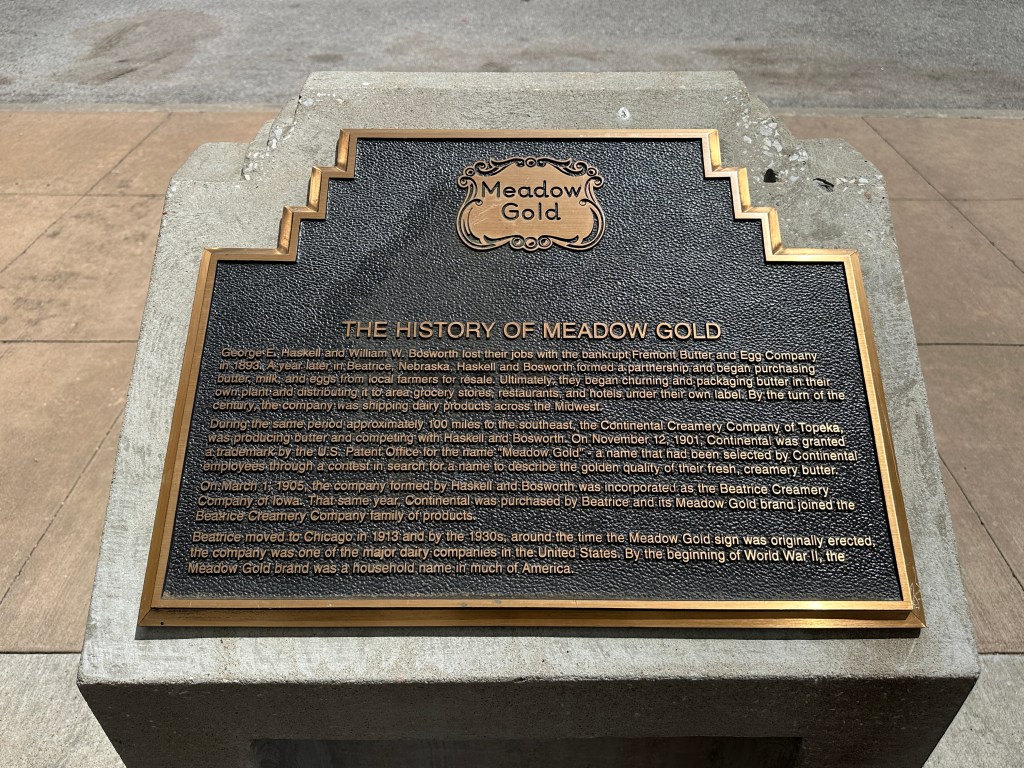
The History of Meadow Gold
“George E. Haskell and William W. Bosworth lost their jobs with the bankrupt Fremont Butter and Egg Company in 1893. A year later in Beatrice, Nebraska, Haskell and Bosworth formed a partnership and began purchasing butter, milk and eggs from local farmers for resale. Ultimately, they began churning and packaging butter in their own plant and distributing it to area grocery stores, restaurants, and hotels under their own label. By the turn of the century, the company was shipping dairy products across the Midwest.
During the same period approximately 100 miles to the southeast, the Continental Creamery Company of Topeka, was producing butter and competing with Haskell and Bosworth. On November 12, 1901, Continental was granted a trademark by the U.S. Patent Office for the name “Meadow Gold” – a name that had been selected by Continental employees through a contest in search for a name to describe the golden quality of their fresh, creamy butter.
On March 1, 1905, the company formed by Haskell and Bosworth was incorporated as the Beatrice Creamery Company of Iowa. That same year, Continental was purchased by Beatrice and its Meadow Gold brand joined the Beatrice Creamery Company family of products.
Beatrice moved to Chicago in 1913 and by the 1930s, around the time the Meadow Gold sign was originally erected, the company was one of the major dairy companies in the United States. By the beginning of World War II, the Meadow Gold brand was a household name in much of America.”
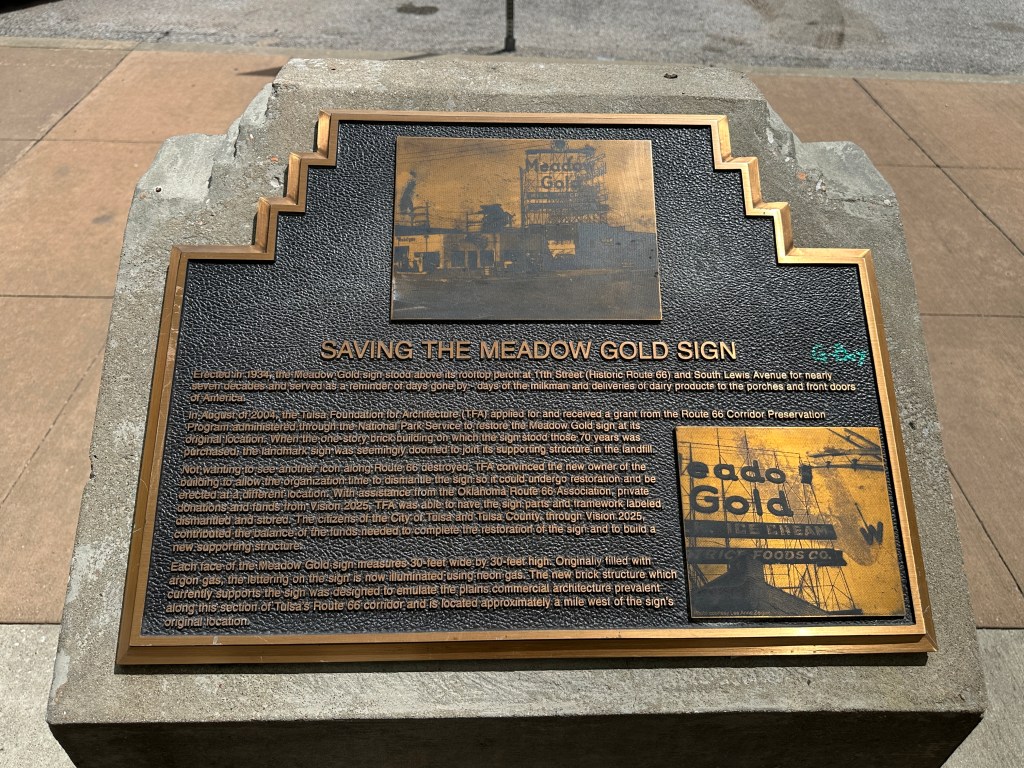
Saving the Meadow Gold Sign
“Erected in 1934, the Meadow Gold sign stood above its rooftop perch at 11th Street (Historic Route 66) and South Lewis Avenue for nearly seven decades and served as a reminder of days gone by – days of the milkman and deliveries of dairy products to the porches and front doors of America.
In August of 2004, the Tulsa Foundation for Architecture (TFA) applied for and received a grant from the Route 66 Corridor Preservation Program administered through the National Park Service to restore the Meadow Gold sign at its original location. When the one-story brick building on which the sign stood those 70 years was purchased, the landmark sign was seemingly doomed to join its supporting structure in the landfill.
Not wanting to see another icon along Route 66 destroyed, TFA convinced the new owner of the building to allow the organization time to dismantle the sign so it could undergo restoration and be erected at a different location. With assistance from the Oklahoma Route 66 Association, private donations and funds from Vision 2025, TFA was able to have the sign parts and framework labeled dismantled and stored. The citizens of the City of Tulsa and Tulsa County , through Vision 2025, contributed the balance of the funds needed to complete the restoration of the sign and to build a new supporting structure.
Each face of the Meadow Gold sign measures 30-feet wide by 30-feet high. Originally filled with argon gas, the lettering on the sign is now illuminated using neon gas. The new brick structure which currently supports the sign was designed to emulate the plains commercial architecture prevalent along this section of Tulsa’s Route 66 corridor and is located approximately a mile west of the sign’s original location.”
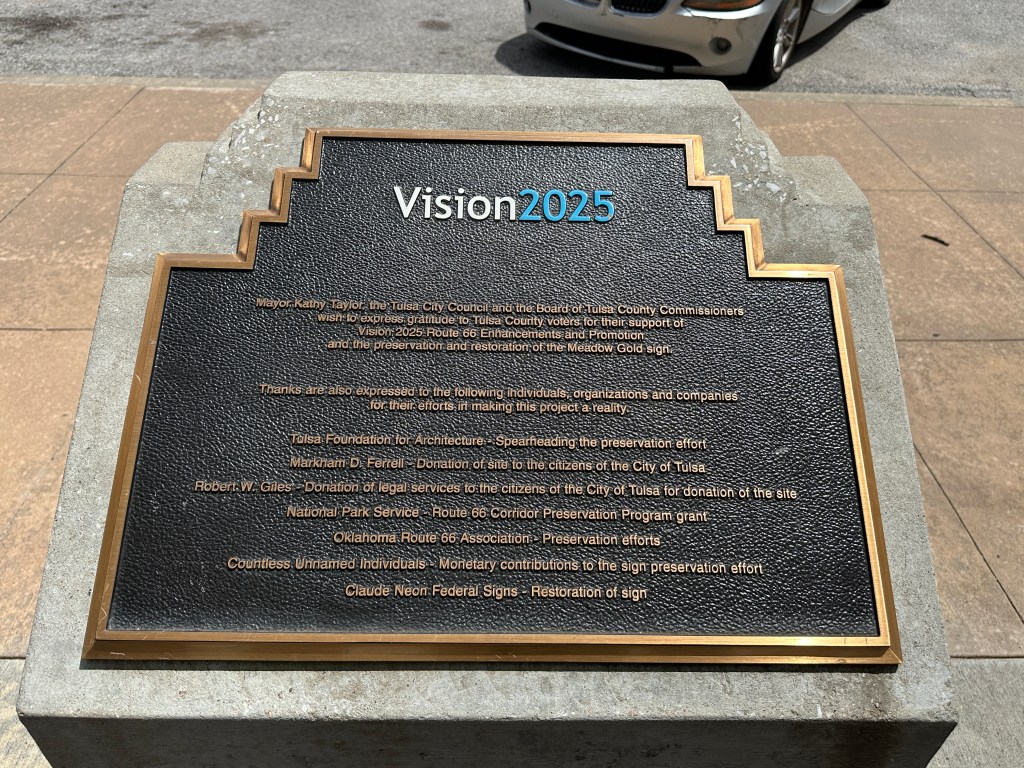
Vision 2025
“Mayor Kathy Taylor, the Tulsa City Council and the Board of Tulsa County Commissioners wish to express gratitude to Tulsa County voters for their support of Vision 2025 Route 66 Enhancements and Promotion and the preservation and restoration of the Meadow Gold sign.
Thanks are also expressed to the following individuals, organizations and companies for their efforts in making this project a reality.
Tulsa Foundation for Architecture – Spearheading the preservation effort
Markham D. Ferrell – Donation of site to the citizens of the City of Tulsa
Robert W. Giles – Donation of legal services to the citizens of the City of Tulsa for donation of the site
National Park Service – Route 66 Corridor Preservation Program grant
Oklahoma Route 66 Association – Preservation efforts
Countless Unnamed Individuals – Monetary contributions to the sign preservation effort
Claude Neon Federal Signs – Restoration of sign”
Visit
1306 E 11th Street
Tulsa, OK 74120
 The Active Historian
Leave a comment