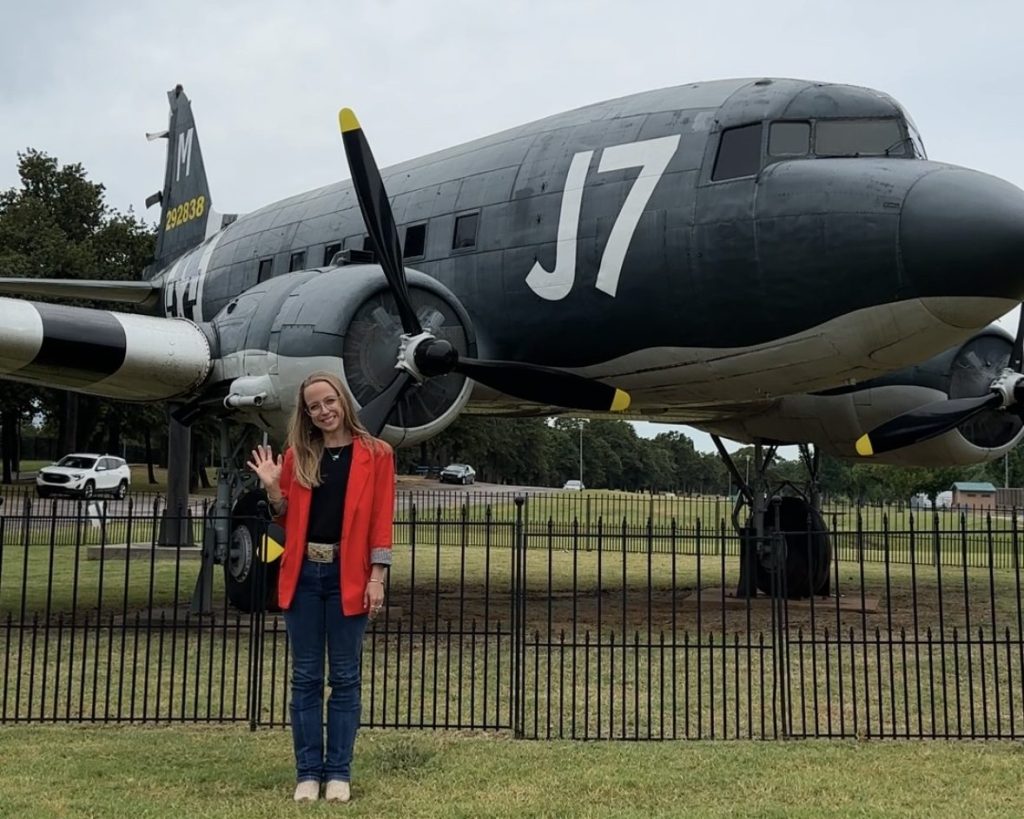
Hey, friend! Welcome back to another post. Today, I want to show you around the Midwest City Veterans Memorial which has a C-47 plane from World War II and signs about Midwest City’s role during WWII. Let’s get started!
Signs with Transcriptions
Each sign has been transcribed below the photo!
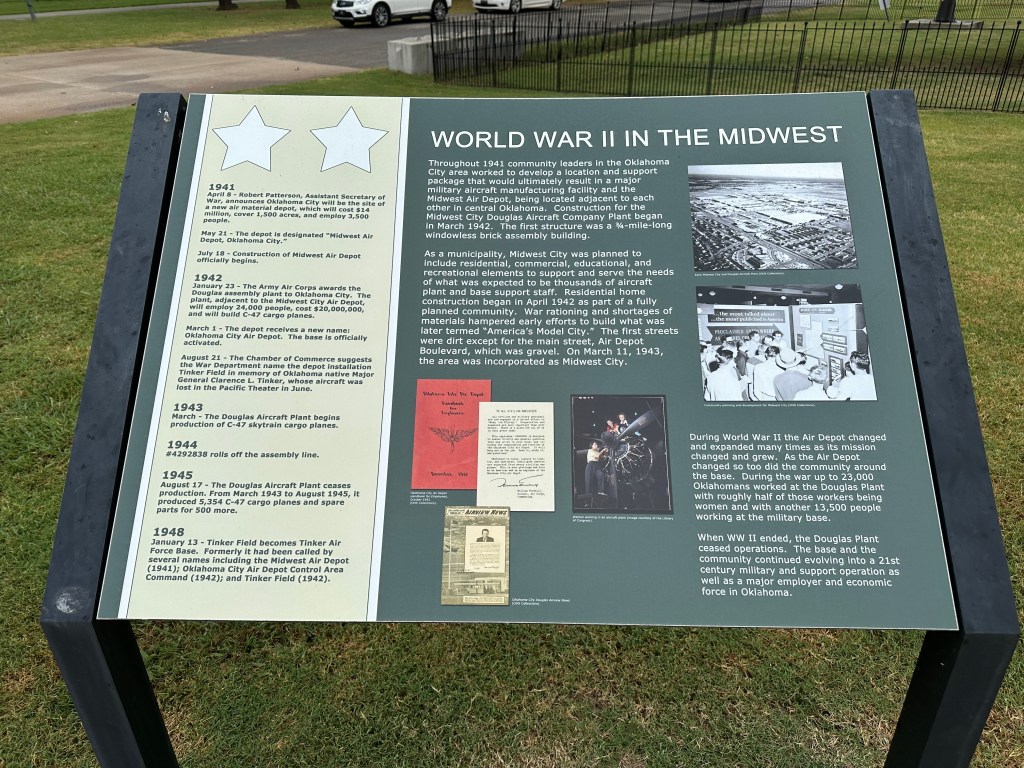
World War II in the Midwest
“Throughout 1941 community leaders in the Oklahoma City area worked to develop a location and support package that would ultimately result in a major military aircraft manufacturing facility and the Midwest Air Depot, being located adjacent to each other in central Oklahoma. Construction for the Midwest City Douglas Aircraft Company Plant began in March 1942. The first structure was a 3/4-mile-long windowless brick assembly building.
As a municipality, Midwest City was planned to include residential, commercial, educational, and recreational elements to support and serve the needs of what was expected to be thousands of aircraft plant and base support staff. Residential home construction began in April 1942 as part of a fully planned community. War rationing and shortages of materials hampered early efforts to build what was later termed “America’s Model City.” The first streets were dirt except for the main street, Air Depot Boulevard, which was gravel. On March 11, 1943, the area was incorporated as Midwest City.
During World War II the Air Depot changed and expanded many times as its mission changed and grew. As the Air Depot changed so too did the community around the base. During the war up to 23,000 Oklahomans worked at the Douglas Plant with roughly half of those workers being women and with another 13,500 people working at the military base.
When WWII ended, the Douglas Plant ceased operations. The base and the community continued evolving into a 21st century military and support operation as well as a major employer and economic force in Oklahoma.
Timeline:
1941
April 8 – Robert Patterson, Assistant Secretary of War, announces Oklahoma City will be the site of a new air material depot, which will cost $14 million, cover 1,500 acres, and employ 3,500 people.
May 21 – The depot is designated “Midwest Air Depot, Oklahoma City.”
July 18 – Construction of Midwest Air Depot officially begins.
1942
January 23 – The Army Air Corps awards the Douglas assembly plant to Oklahoma City. The plant, adjacent to the Midwest City Air Depot, will employ 24,000 people, cost $20,000,000, and will build C-47 cargo planes.
March 1 – The depot receives a new name: Oklahoma City Air Depot. The base is officially activated.
August 21 – The Chamber of Commerce suggests the War Department name the depot installation Tinker Field in memory of Oklahoma native Major General Clarence L. Tinker, whose aircraft was lost in the Pacific Theater in June.
1943
March – The Douglas Aircraft Plant begins production of C-47 skytrain cargo planes.
1944
#4292838 rolls off the assembly line.
1945
August 17 – The Douglas Aircraft Plant ceases production. From March 1943 to August 1945, it produced 5,354 C-47 cargo planes and spare parts for 500 more.
1948
January 13 – Tinker Field becomes Tinker Air Force Base. Formerly it had been called by several names including Midwest Air Depot (1941); Oklahoma City Air Depot Control Area Command (1942); and Tinker Field (1942).
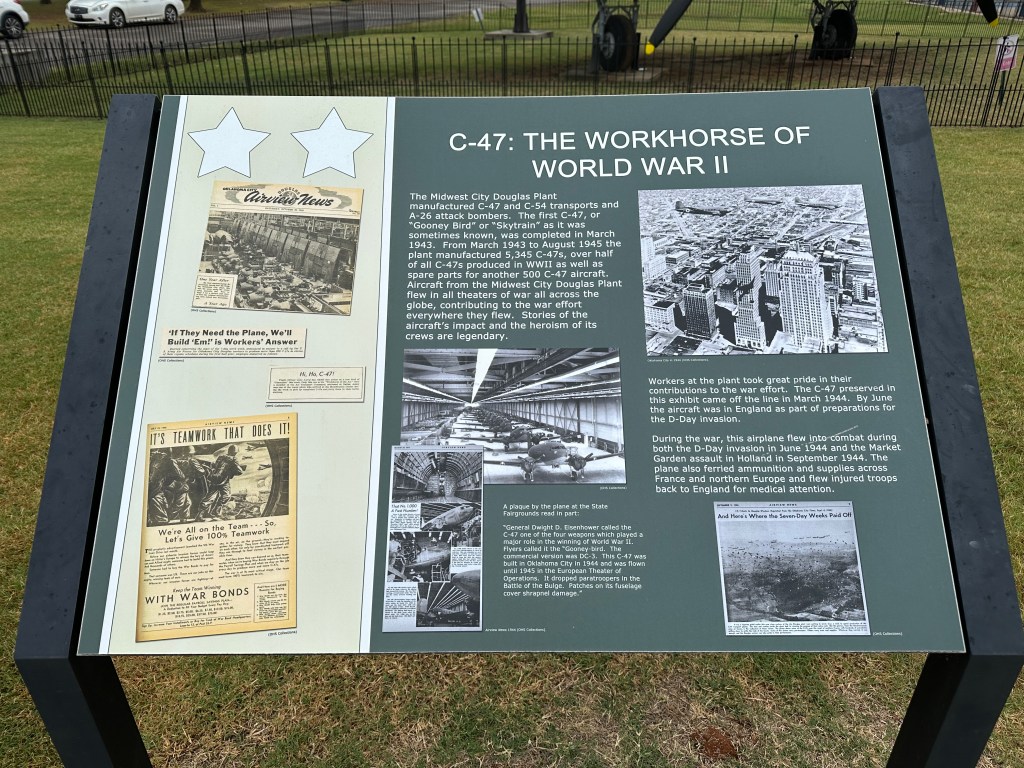
C-47: The Workhorse of World War II
“The Midwest City Douglas Plant manufactured C-47 and C-54 transports and
A-26 attack bombers. The first C-47, or “Gooney Bird” or “Skytrain” as it was sometimes known, was completed in March 1943. From March 1943 to August 1945 the plant manufactured 5,345 C-47s, over half of all C-47s produced in WWII as well as spare parts for another 500 C-47 aircraft. Aircraft from the Midwest City Douglas Plant flew in all theaters of war all across the globe, contributing to the war effort everywhere they flew. Stories of the aircraft’s impact and the heroism of its crews are legendary.
Workers at the plant took great pride in their contributions to the war effort. The C-47 preserved in this exhibit came off the line in March 1944. By June the aircraft was in England as part of preparations for the D-Day invasion.
During the war, this airplane flew into combat during both the D-Day invasion in June 1944 and the Market Garden assault in Holland in September 1944. The plane also ferried ammunition and supplies across France and northern Europe and flew injured troops back to England for medical attention.”
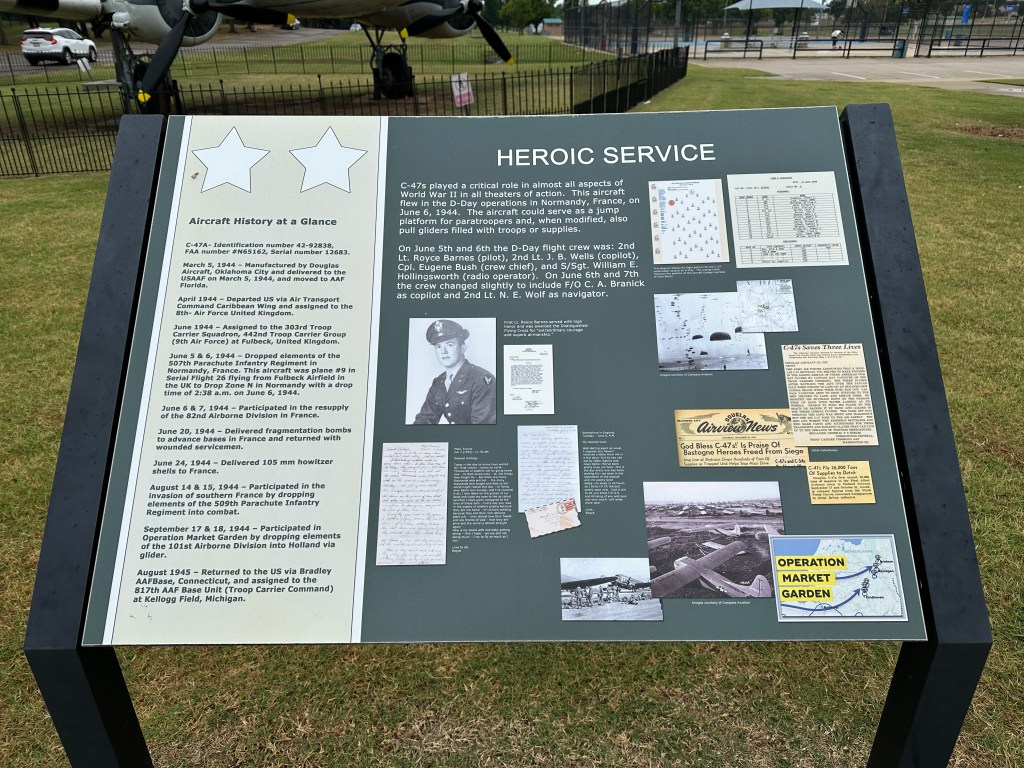
Heroic Service
“C~47 S played a critical role in almost all aspects of World War II in all theaters of action. This aircraft flew in the D-Day operations in Normandy, France, on June 6, 1944. The aircraft could serve as a jump platform for paratroopers and, when modified, also pull gliders filled with troops or supplies.
On June 5th and 6th the D-Day flight crew was: 2nd Lt. Royce Barnes (pilot), 2nd Lt. J. B. Wells (copilot), Col. Eugene Bush (crew chief), and S/Sgt. William E. Hollingsworth (radio operator). On June 6th and 7th the crew changed slightly to include F/O C.A. Branick as copilot and 2nd Lt. N.E. Wolf as navigator.”
Aircraft History at a Glance
C-47A – Identification number 42-92838, FAA number #N65162, Serial number 12683.
March 5, 1944 – Manufactured by Douglas Aircraft, Oklahoma City and delivered to the USAAF on March 5, 1944, and moved to AAF Florida.
April 1944 – Departed US via Air Transport Command Caribbean Wing and assigned to the 8th – Air Force United Kingdom.
June 1944 – Assigned to the 303rd Troop Carrier Squadron, 442nd Troop Carrier Group (9th Air Force) at Fulbeck, United Kingdom.
June 5 & 6, 1944 – Dropped elements of the 507th Parachute Infantry Regiment in Normandy, France. This aircraft was plane #9 in Serial Flight 26 flying from Fulbeck Airfield in the UK to Drop Zone N in Normandy with a drop time of 2:38 a.m. on June 6, 1944.
June 6 & 7, 1944 – Participated in the resupply of the 82nd Airborne Division in France.
June 20, 1944 – Delivered fragmentation bombs to advance bases in France and returned with wounded servicemen.
June 24, 1944 – Delivered 105 mm howitzer shells to France.
August 14 & 15, 1944 – Participated in the invasion of southern France by dropping elements of the 509th Parachute Infantry Regiment into combat.
September 17 & 18, 1944 – Participated in Operation Market Garden by dropping elements of the 101st Airborne Division into Holland via glider.
August 1945 – Returned to the US via Bradley AAFBase, Connecticut, and assigned to the 817th AAF Base Unit (Troop Carrier Command) at Kellogg Field, Michigan.
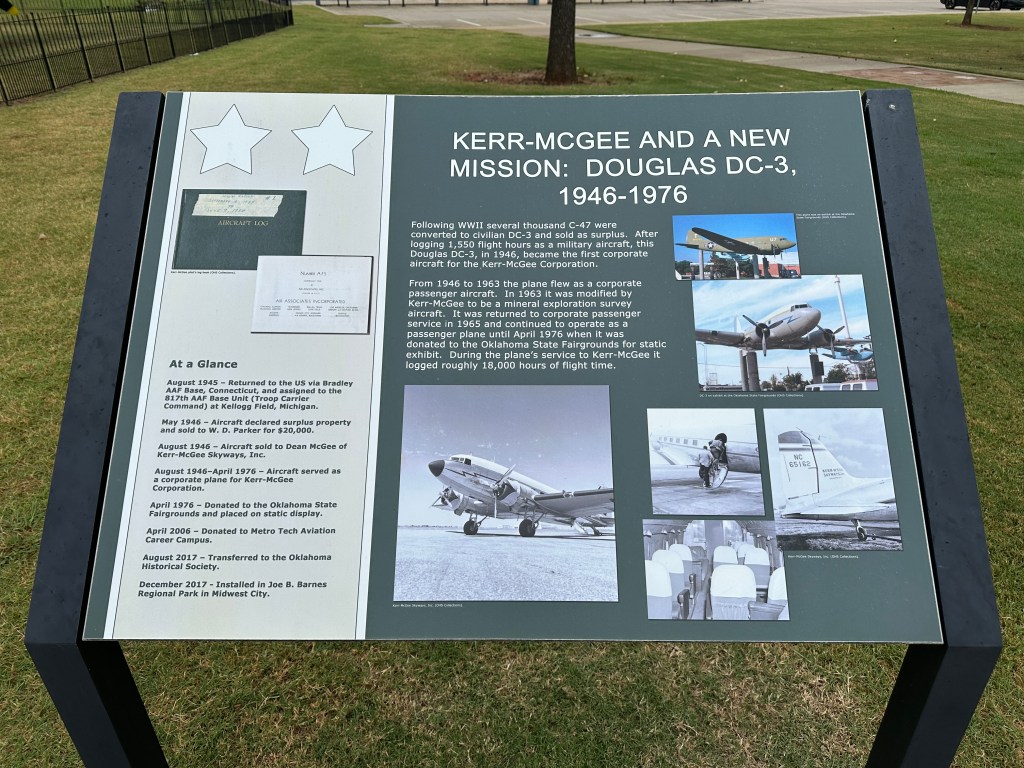
Kerr-McGee and a New Mission: Douglas DC-3, 1946-1976
“Following WWII several thousand C-47 were converted to civilian DC-3 and sold as surplus. After logging 1,550 flight hours as a military aircraft, this Douglas DC-3, in 1946, became the first corporate aircraft for the Kerr-McGee
Corporation.
From 1946 to 1963 the plane flew as a corporate passenger aircraft. In 1963 it was modified by Kerr-McGee to be a mineral exploration survey aircraft.
It was returned to corporate passenger service in 1965 and continued to operate as a passenger plane until April 1976 when it was donated to the Oklahoma state Fairgrounds tor static exhibit. During the plane’s service to Kerr-McGee it logged roughly 18,000 hours of flight time.”
At a Glance
August 1945 – Returned to the US via Bradley AAF Base, Connecticut, and assigned to the 817th AAF Base Unit (Troop Carrier Command) at Kellogg Field, Michigan.
May 1946 – Aircraft declared surplus property and sold to W.D. Parker for $20,000.
August 1946 – Aircraft sold to Dean McGee of Kerr-McGee Skyways, Inc.
August 1946 – April 1976 – Aircraft served as a corporate plane for Kerr-McGee Corporation.
April 1976 – Donated to the Oklahoma State Fairgrounds and placed on static display.
April 2006 – Donated to Metro Tech Aviation Career Campus.
August 2017 – Transferred to the Oklahoma Historical Society.
December 2017 – Installed in Joe. B. Barnes Regional Park in Midwest City.
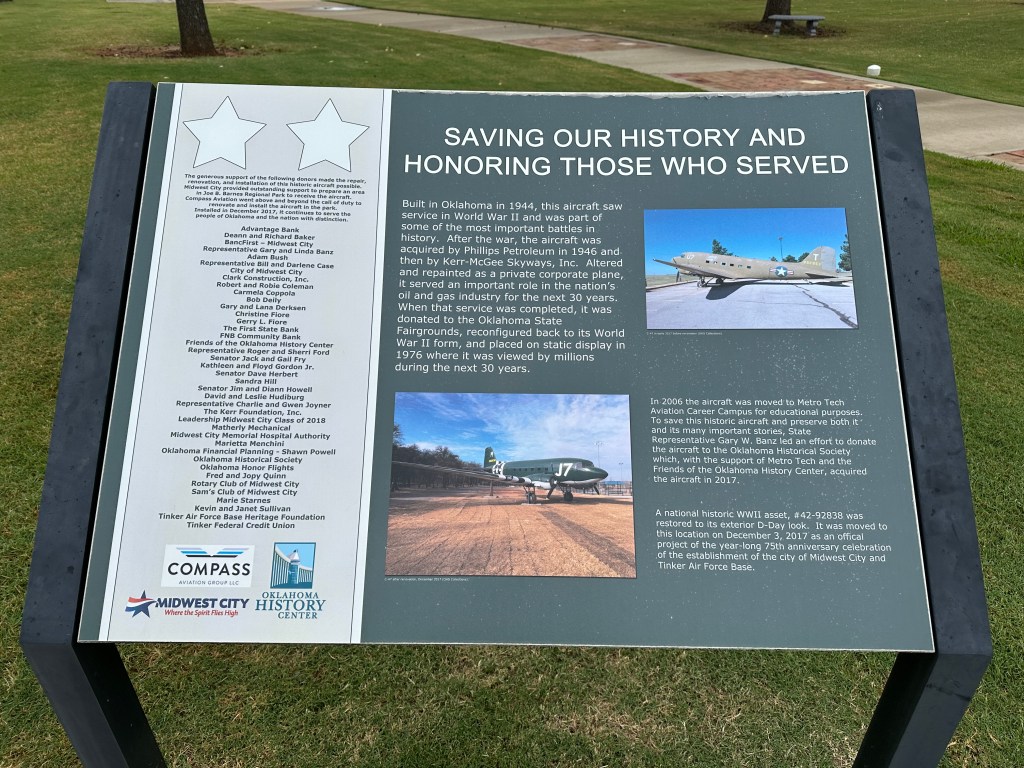
Saving Our History and Honoring Those Who Served
“Built in Oklahoma in 1944, this aircraft saw service in world War Il and was part of some or the most important battles in history. After the war, the aircraft was
acquired by Phillips Petroleum in 1946 and then by Kerr-McGee Skyways, Inc. Altered and repainted as a private corporate plane, it served an important role in the nation’s oil and gas industry for the next 30 years. When that service was completed, it was donated to the Oklahoma State Fairgrounds, reconfigured back to its World war Il form, and placed on static display in 1976 where it was viewed by millions during the next 30 years
In 2006 the aircraft was moved to Metro Tech Aviation Career Campus for educational purposes. To save this historic aircraft and preserve both it and its many important stories, State Representative Gary W. Bank led an effort to donate the aircraft to the Oklahoma Historical Society which, with the support of Metro Tech and the Friends of the Oklahoma History Center, acquired the aircraft in 2017.
A national historic WWII asset, #42-92838 was restored to its exterior D-Day look. It was moved to this location on December 3, 2017 as an official project of the year-long 75th anniversary celebration of the establishment of the city of Midwest City and Tinker Air Force Base.”
C-47
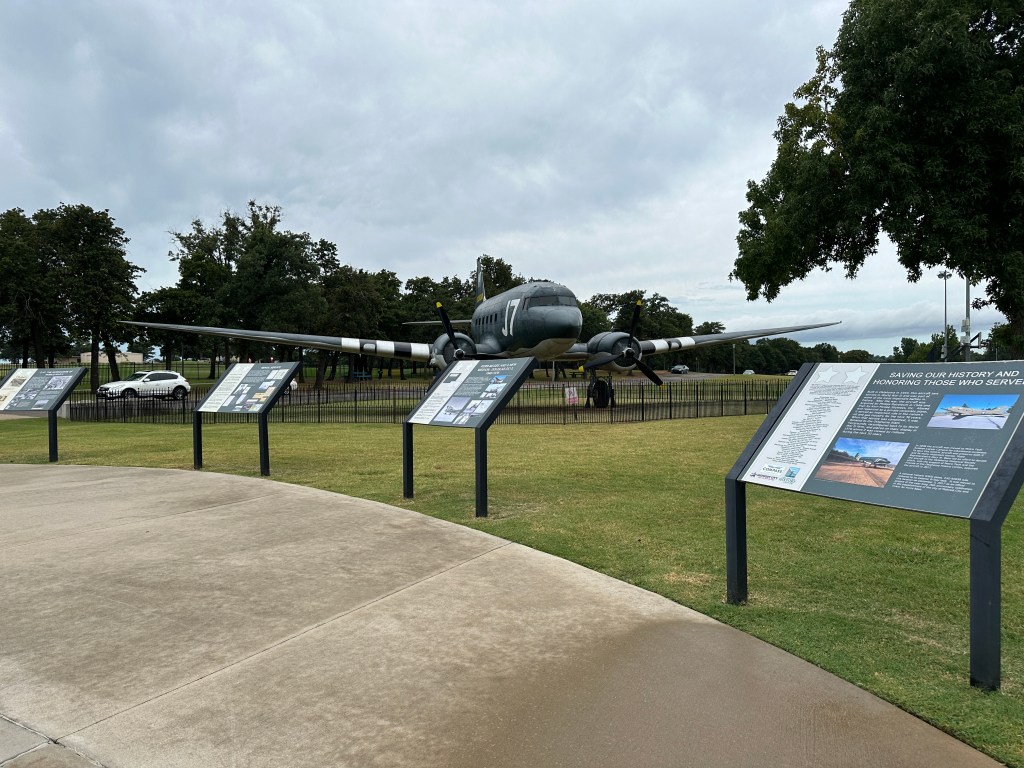
Midwest City Veterans Memorial

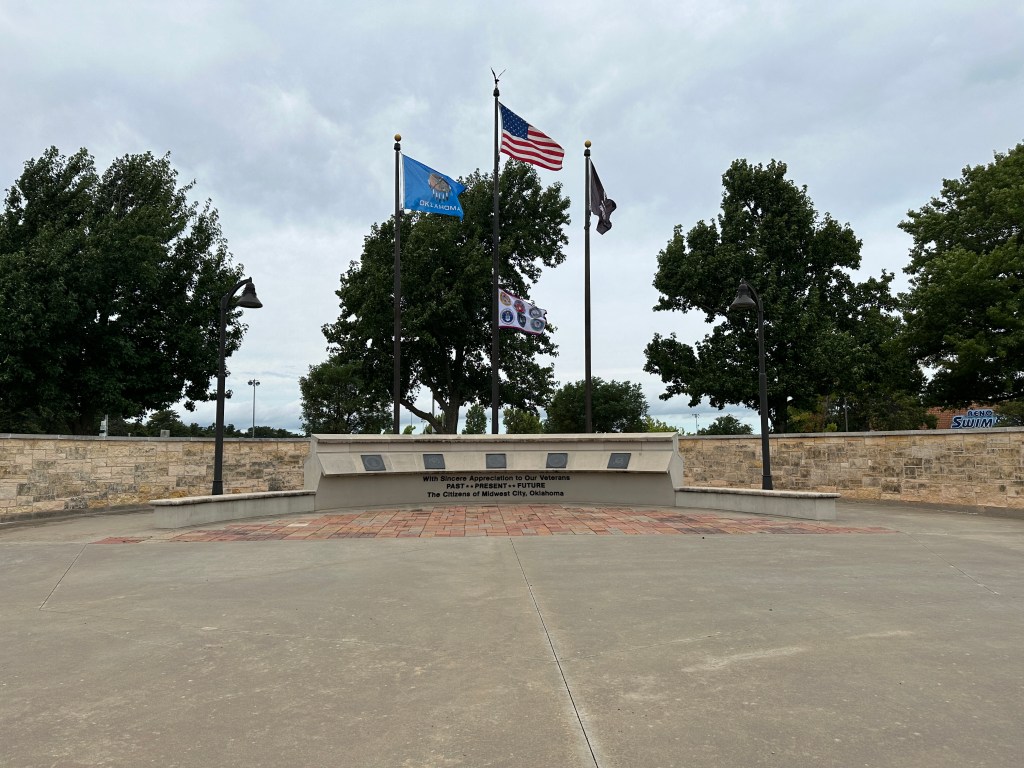
Concluding Thoughts
I had driven by this plane and Memorial many times, but never made the time to stop and take a look. I’m glad I decided to make the stop when I was in the area again. The history of Midwest City’s role in WWII was so fascinating. I hope you’ll stop by and check it out!
If you are a fan of aviation history and military history, make sure to drive a few miles over to the Major Charles B. Hall Airpark off of 29th and Air Depot. There are a lot more planes over there!
Happy Traveling, friend! I’ll talk to ya soon 🙂
Visit
8700 E Reno Ave.
Midwest City, OK 73130
TRAVEL TIP: On the East side of the Joe B. Barnes Park. It is North of the golf course and south of Reno Swim and Slide.
Sources
Historic Markers & Plaques.
 The Active Historian
Leave a comment