
Hey, friend! Welcome back to another post – today, I want to show you the Centennial Land Run Monument in Oklahoma City, Oklahoma. This massive sculpture was designed by Paul Moore and commissioned by the Oklahoma Centennial Committee.
Keep scrolling to see transcriptions of the plaques with more information about Paul Moore, the statues, and the Land Run.
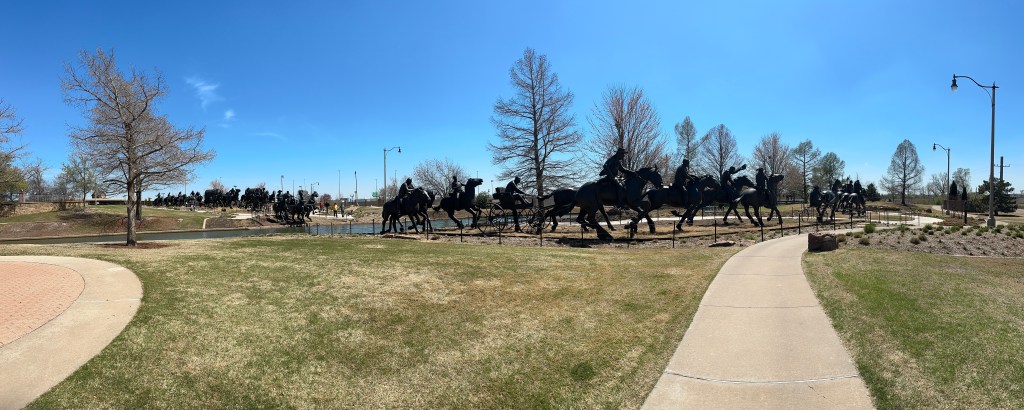


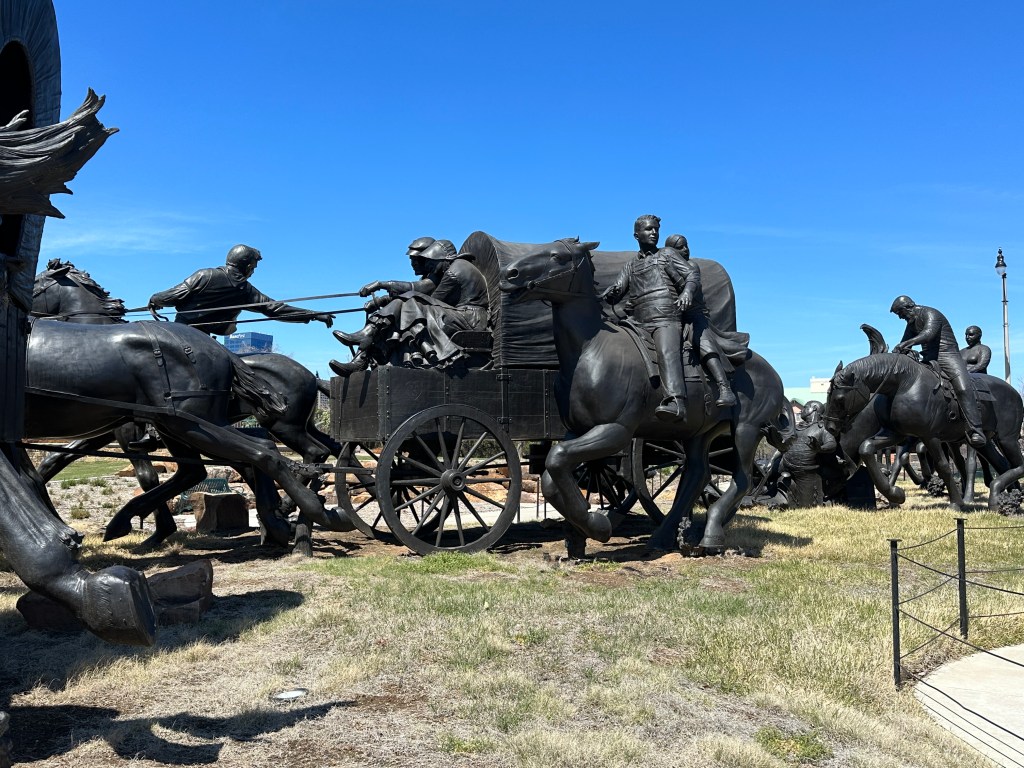


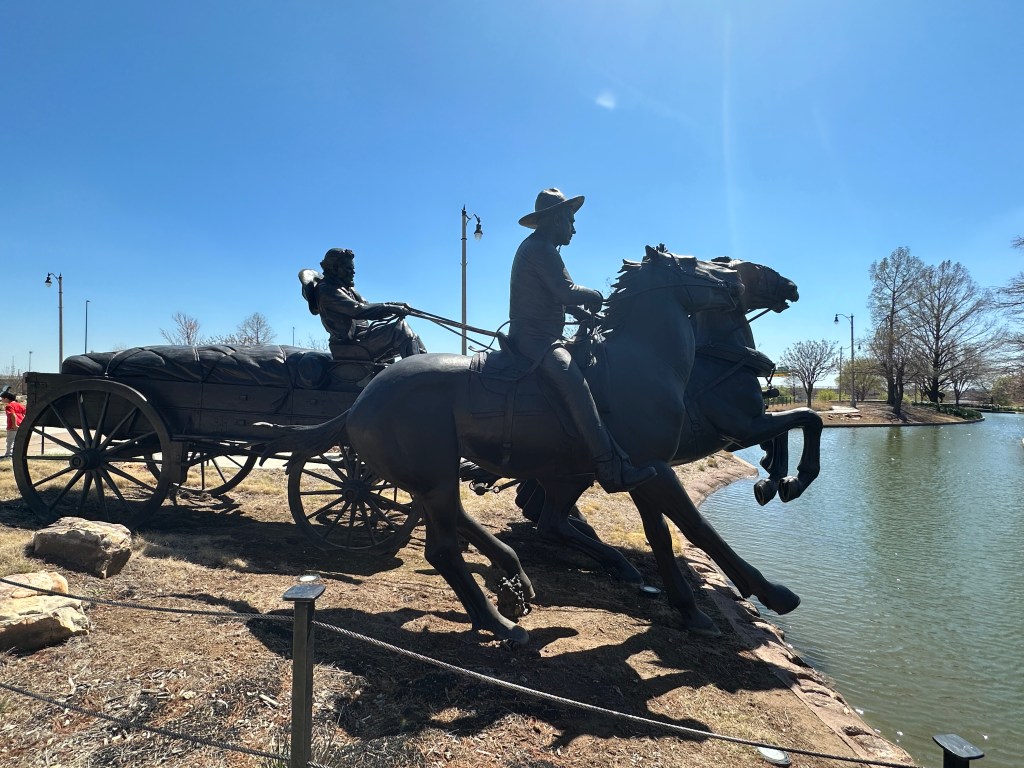
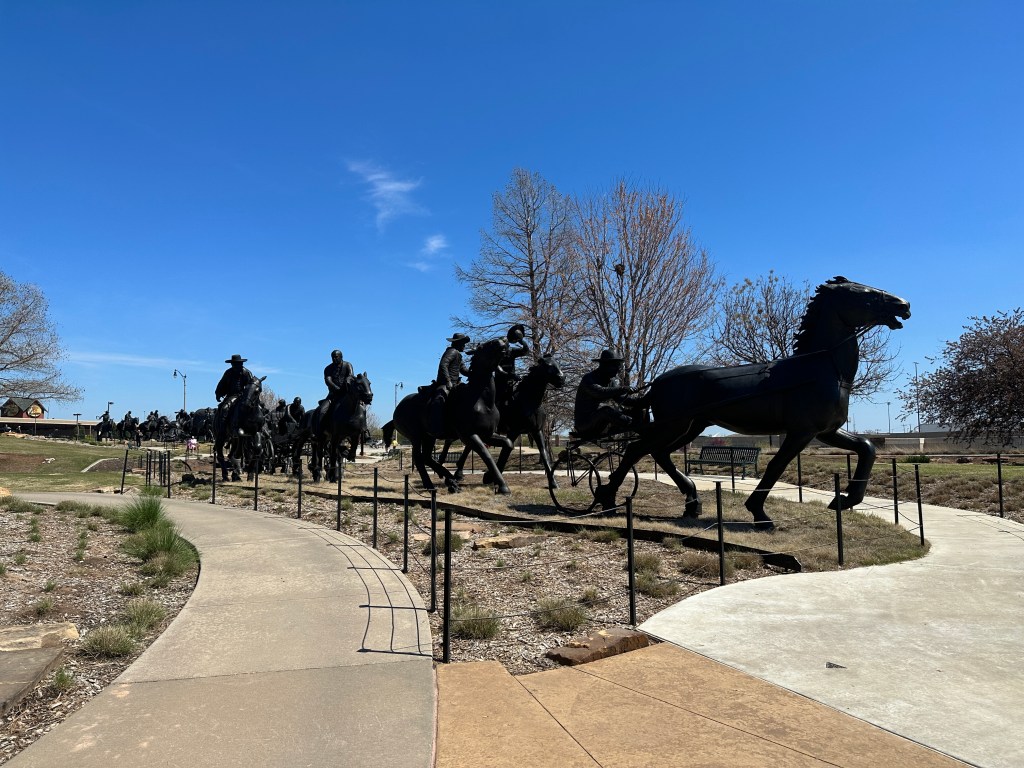

“The Centennial Land Run Monument commemorates the opening of the Unassigned Lands in Oklahoma Territory with the Land Run of 1889. It is on of the world’s largest bronze sculptures featuring 45 life-and-one-half sized figures of Land Run participants. The frenzied energy and emption are captured in one frozen instant by artist Paul Moore. Mr. Moore is an internationally acclaimed sculptor and artist who also served as the Artist in Residence and Professor of Figurative Sculpture at the University of Oklahoma. The monument is over 100 yards long, over 30 yards wide, and over 16 feet high. It was twenty years in the making and became a multi-generational work with Moore’s sons Todd and Ryan working with their dad to produce and complete the sculptures.
About the Artist
Paul Moore is a fifth generation Oklahoman who gained national and international recognition with his sculpture. He was born in Oklahoma City in 1957 and is a citizen of the (Creek) Muscogee Nation, Sweet Potato Clan. Moore is a Fellow and previous Board Member of the National Sculpture Society and an Emeritus Member and previous Board Member of the Cowboy Artists of America. He is in constant demand for portrait and monumental commissions.
Moore left Santa Fe, New Mexico where he raised for 13 years to open his own private studio in Norman, Oklahoma in 1997. He was hired to revive and develop the University of Oklahoma’s Figurative Sculpture Program, which had been non-existent since 1969, and to the University’s first Artist in Residence. He is the second figurative sculpting instructor in the University’s history. In the past 40 years he has sculpted more than 160 commissions.
Awards and Honors
Moore has received numerous awards and accolades for his sculpture. The National Sculpture Society presented Moore with the nation’s highest award for sculpture, the Special Medal of Honor, at its annual conference in 2021. In the society’s 129-year history only 29 artists have received this prestigious award. He has also received numerous awards from the Prix de West, an annual world-renowned show at the National Cowboy and Western Heritage Museum. His portrait and figurative sculptures are represented in prominent institutions nationally and internationally. To learn more about the artist and his work and for a complete list of awards and honors: crownartsinc.com”
History of the Land Run
*Each plaque is transcribed below. The numbers in the photo captions correspond with each heading.


The Unassigned Lands (1)
“On April 22, 1889, one of the significant events of American history swept across this location and some 2,000,000 surrounding acres. On that day, more than 50,000 men and women rushed to stake their claims in the Land Run of 1889. That one day changed the face and land and the course of its future and led to the creation of the nation’s 46th state – Oklahoma.
The present state of Oklahoma was once Indian Territory, except for the Panhandle and Old Greer County, a disputed area with Texas. Part of the Louisiana Purchase, Indian Territory was created in 1825 as a refuge for tribes relocated from the Northeast and South. Through treaties in 1866, the Five Civilized Tribes ceded approximately half their lands to the government for the relocation of other tribes – but some 2,000,000 acres in the center of the area were left unassigned.
Farmers, businessmen and railroad officials argued that these Unassigned Lands were now public domain, and they pressured the government to open the area to non-Indian settlement. Their cause was furthered by the ‘Boomers,’ who made attempts to settle the area, only to be removed by the U.S. Army including Cheyenne Scouts and Buffalo Soldiers, African-Ameircan troopers from nearby Fort Reno. Public demand forced Congress to yield. On March 23, 1889, President Benjamin Harrison proclaimed the Unassigned Lands would be opened for settlement at high noon on April 22, 1889.”

The Land Run of 1889 (2)
“Obtaining 160 acres in the Unassigned Lands quickly became a national passion, fueled by the desire of countless Americans to have their own piece of land. By 1889, the Great American Frontier – long the source of homesteads – was rapidly disappearing. The opening of the Unassigned District was an opportunity to own land and to begin a new life.
Soon after Harrison’s proclamation, floods of prospective settlers began making their way toward Indian Territory. Many were farmers and unemployed men from Kansas, Missouri, Texas and Midwestern states stricken by drought, but others came from throughout the nation.
The President’s announcement had not said how the Unassigned Lands would be opened, but government officials had declared claims would be made on a first some basis through a land run. U.S. citizens – men and unmarried women 21 years of age or older – could compete for a quarter section of land. Those who then lived on a claim for five years would received title. A great rush or ‘run’ of land seekers resulted, with farmers, cowboys, former soldiers and Black Freedmen among the hopefuls.
Lawyers, doctors, realtors, merchants, and others sought town lots. The Santa Fe Railroad had constructed a North South line through Indian Territory in 1887, and now rail stations at Alfred (Mulhall), Guthrie, Edmond, Oklahoma (City), Verbeck (Moore), and Norman became potential townsites. Kingfisher stagecoach station was also a favored destination.
The rule against trespassing on Indian Territory was lifted three days prior to the run, allowing contestants to gather along the four boundaries of the Unassigned Lands. Troops patrolled some points of entry, at others, the crowds were left to monitor themselves. By Easter Sunday, April 21, the Unassigned Lands lay surrounded.
April 22, 1889, dawned bright and clear. In camps cluttering the borders of the Unassigned Lands, throngs of eager citizens – African Americans, American Indians, and Whites; men and women, the prosperous and the poor – prepared for ‘Harrison’s Hoss Race.’
As noon neared, rivals astride horses, in wagons or carriages, on foot – or even on bicycles – jostled for position along the lines. Huge crowds of determined hopefuls at stations in Arkansas City, Kansas, to the North, and Purcell, Chickasaw Nation, to the South, packed the cars, platforms and roods of trains in order to make the run by rail.
Cavalry men with bugles, flags and rifles positioned themselves on the highest elevations and prepared to give the signal. At Fort Reno, a cannoneer made ready. At the stroke of noon, bugles sounded, flags dropped, rifles fired and the cannon boomed. In that one instant, wagons, horses, trains and settlers surged forward together. The first great land run in history had begun.
Families cheered, men whooped, and whips cracked as contestants dashed pell-mell across the prairie, seeking the right site to halt and drive claim stakes into the soil. Along the Santa Fe line, some excited passengers jumped off the trains without waiting for them to stop.
Some individuals were unlucky. Horses tumbled or threw their riders, wagons overturned or cracked up in the gullies, carriage axles split or wheels flew apart. A jubilant claim seeker would rush upon a choice site only to find if already taken. In some instances, participants had entered the region early and staked claims. They became known as ‘sooners.’
Congress had made no plans for mapping townsites. As a result, competing groups had mapped out towns at various railroad depots and elsewhere, which led to some people purchasing overlapping lots.
Despite the sudden influx of tens of thousands of people into a vast, unorganized area, there was relatively little violence or crime. By dusk April 22, 1889, tent cities teemed with crowds of new citizens, and the expansive prairie sparkled with the solitary campfires of triumphant claimants. The Run of 1889 had ended and the march to statehood had begun.”

“Brand New State!” (3)
“In the summer of 1889, buildings were replacing tents, disputed claims were being resolved, and residents of the Unassigned Lands were meeting to organize a Territorial Government and to petition Congress on the issue. Congress responded on May 2, 1890, by establishing a new territory known as ‘Oklahoma,’ which in the Choctaw language means ‘Land of the Red Man.’
The Oklahoma Organic Act created the territory. It also attached No-Man’s Land, today’s Panhandle, and declared that as lands in Western Indian Territory were opened to homesteading, they, too, would become part of Oklahoma Territory. Lands were opened through runs, lotteries and allotments. In 1896, Old Greer County also became a part of the new territory. As a result, ‘Twin Territories’ came to exist, Oklahoma Territory to the West and Indian Territory to the East.
In 1898, the Curtis Act phased out tribal governments in Indian Territory, granted U.S. citizenship to their members, and established private land ownership.
A constitutional convention that brought the two territories together to create one state government was authorized by the Oklahoma Enabling Act of 1906. Delegates eventually resolved social, legal and political issues to submit a constitution to a vote of the people. It passed by a wide margin on September 17, 1907.
Finally, on November 16, 1907, President Theodore Roosevelt declared a 46th ‘Brand New State” – Oklahoma!”
Concluding Thoughts
I enjoyed stopping by to take pictures of this monument! I remember first seeing it almost ten years ago when I was a senior in high school… It was cool back then, but seeing the magnitude of the complete sculpture is impressive now. I hope you’ll go check it out while you’re in Oklahoma City!
Happy Traveling, friend! I’ll talk to ya soon 🙂
Visit
200 Centennial Ave
Oklahoma City, OK 73102
TRAVEL TIP: The easiest way to access this monument is to go through the Bass Pro parking lot in Bricktown (OKC). After you pass through the Bass Pro parking lot, you’ll see a small lot next to a set of steps. Go up the steps and it’ll be right there!
TRAVEL TIP: You can also see the monument from the Bricktown Water Taxi! One of the boats went by while I was taking pictures of the statues.

 The Active Historian
Leave a reply to Things To Do In Oklahoma City – The Active Historian Cancel reply