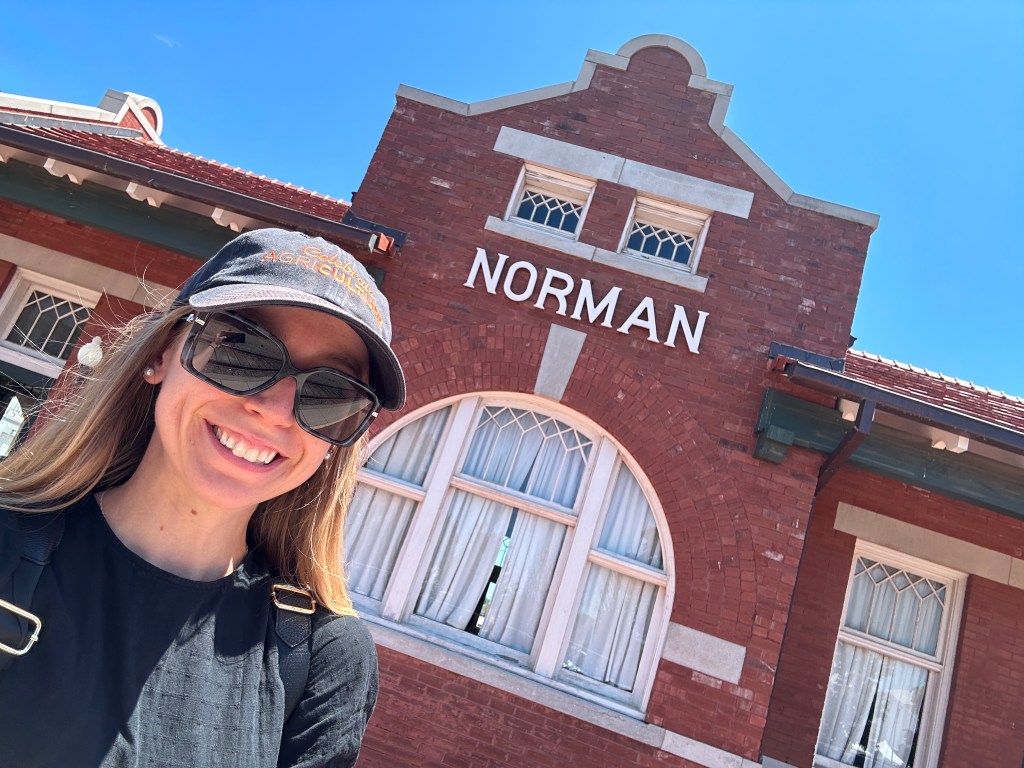
Hey, friend! Welcome back to another post. Today, we’re exploring the Legacy Trail in Norman, Oklahoma which is located inside the Edwards Park. This mile-long trail in the heart of Norman explores the history of the town from colonization to the present. Lace up your walking shoes and let’s get going!
Edwards Park
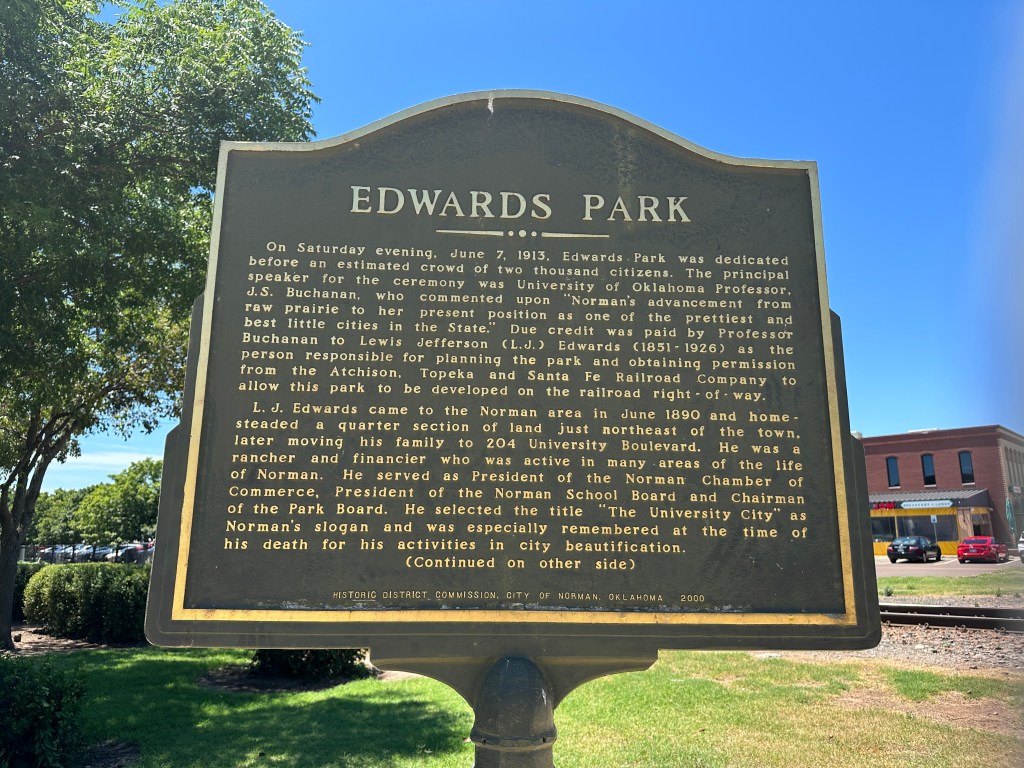
“On Saturday evening, June 7, 1913, Edwards Park was dedicated before an estimated crowd of two thousand citizens. The principal speaker for the ceremony was University of Oklahoma Professor, J.S. Buchanan, who commented upon “Norman’s advancement from raw prairie to her present position as one of the prettiest and best little cities in the State.” Due credit was paid by Professor Buchanan to Lewis Jefferson (L.J.) Edwards (1851-1926) as the person responsible for planning the park and obtaining permission from the Atchison, Topeka and Santa Fe Company to allow this park to be developed on the railroad right-of-way.
L.J. Edwards came to the Norman area in June 1890 and homesteaded a quarter section of land just northeast of the town, later moving his family to 204 University Boulevard. He was a rancher and financier who was active in many areas of the life of Norman. He served as President of the Norman Chamber of Commerce, President of the Norman School Board and Chairman of the Park Board. He selected the title “The University City” as Norman’s slogan and was especially remembered at the time of his death for his activities in city beatification.
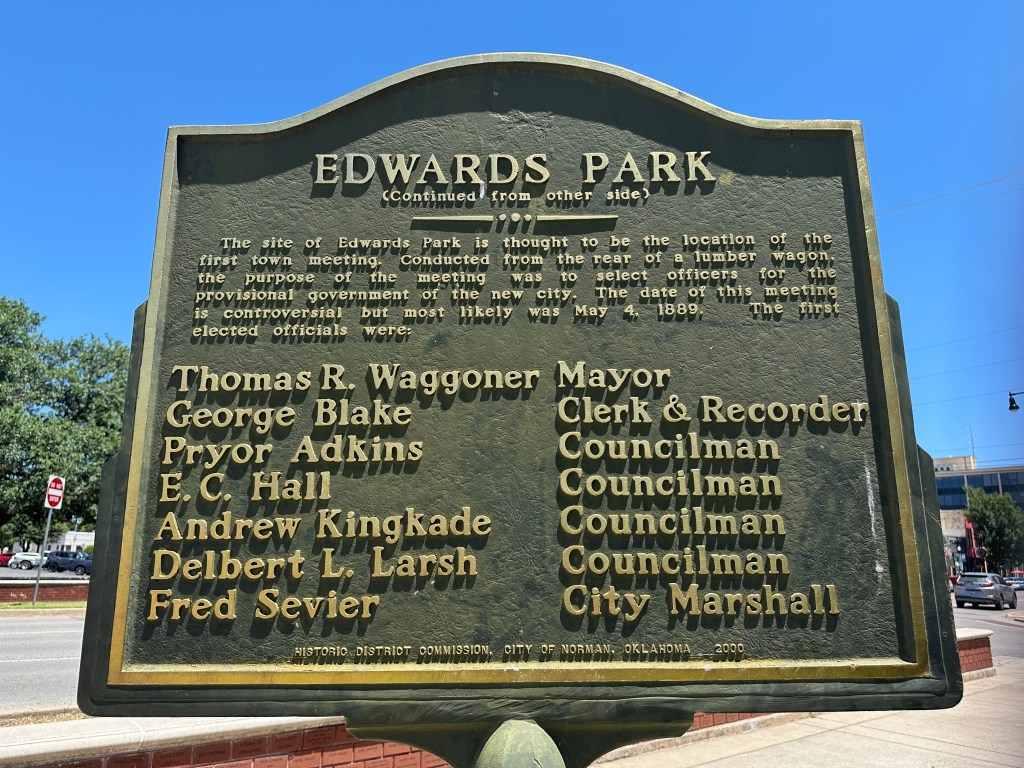
The site of Edwards Park is thought to be the location of the first town meeting. Conducted from the rear of a lumber wagon, the purpose of the meeting was to select officers for the provisional government of the new city. The date of this meeting is controversial but most likely was May 4, 1889. The first elected officials were:
Thomas R. Waggoner (Mayor), George Blake (Clerk & Recorder), Pryor Adkins (Councilman), E.C. Hall (Councilman), Andrew Kingkade (Councilman), Delbert L. Larsh (Councilman), Fred Sevier (City Marshall)
*Historic Marker is located near the James Garner Statue on the Legacy Trail.
Santa Fe Depot
The Santa Fe Depot is a fun place to look around! Read more about this historic building in my blog post, “Santa Fe Depot: Norman, OK.”


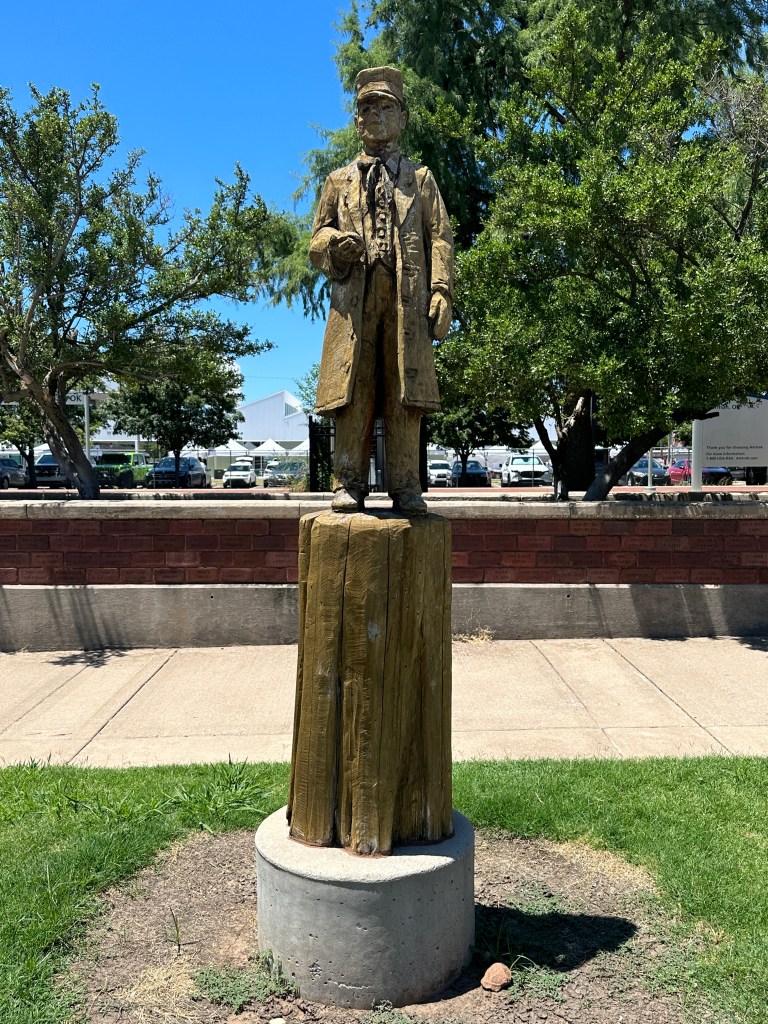
Pioneers & Educators Statue
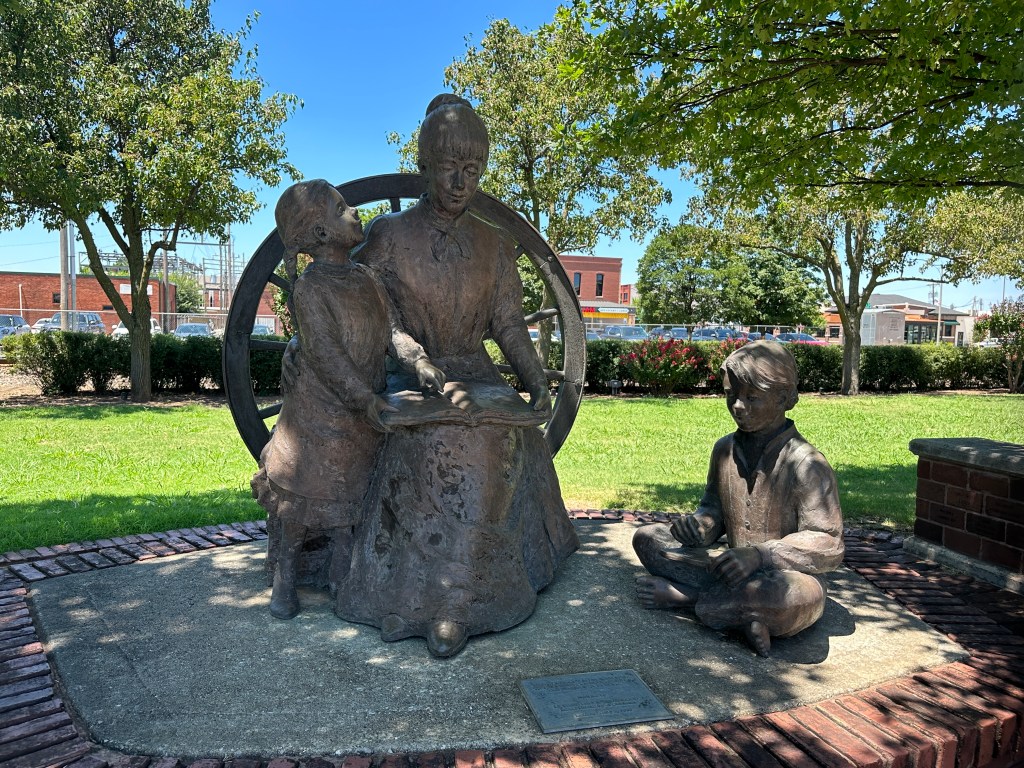
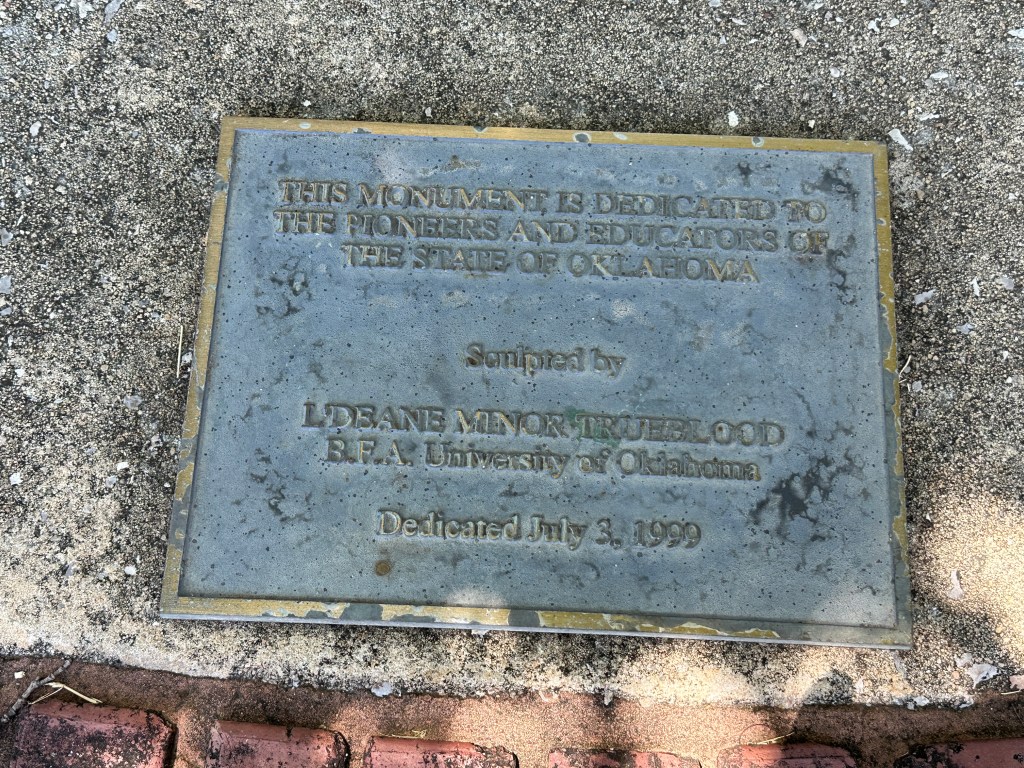
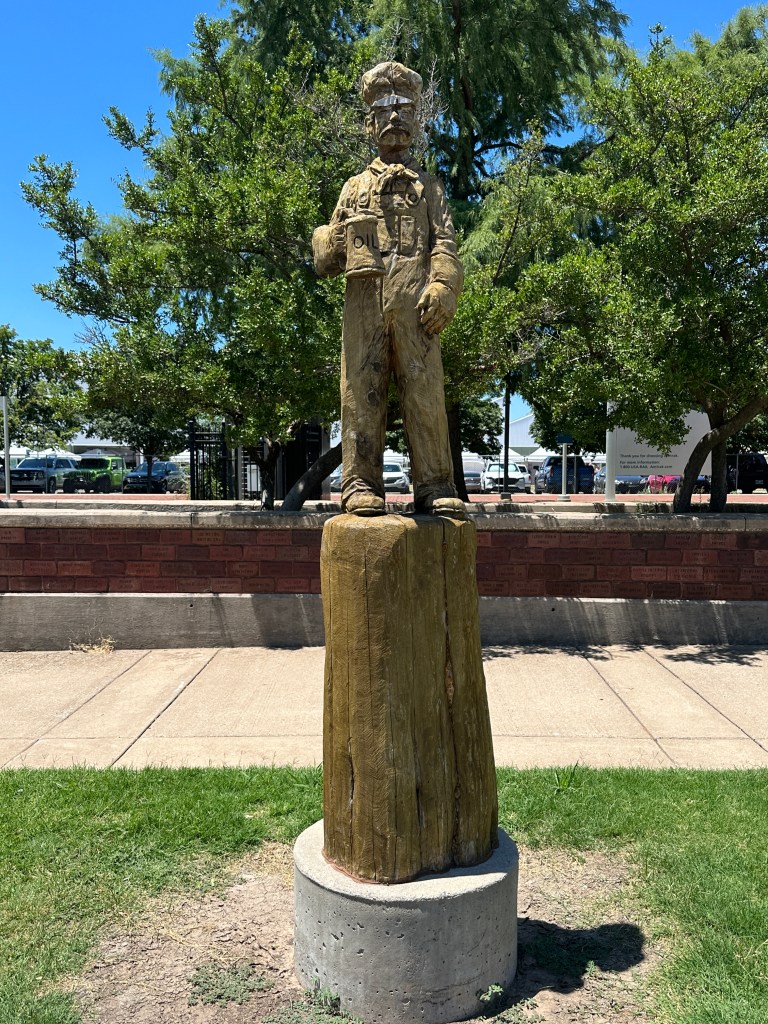
“This monument is dedicated to the pioneers and educators of the state of Oklahoma.” It was sculpted by L’Deane Minor Trueblood who received a B.F.A. from the University of Oklahoma. The statue was dedicated on July 3, 1999.
James Garner Statue
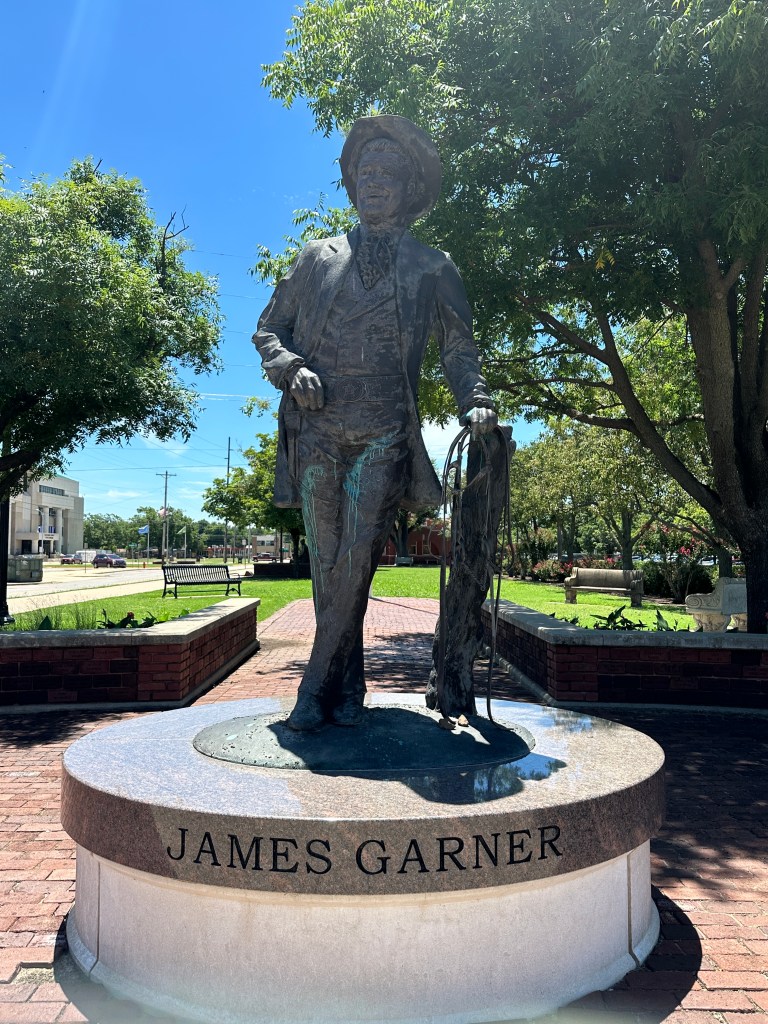
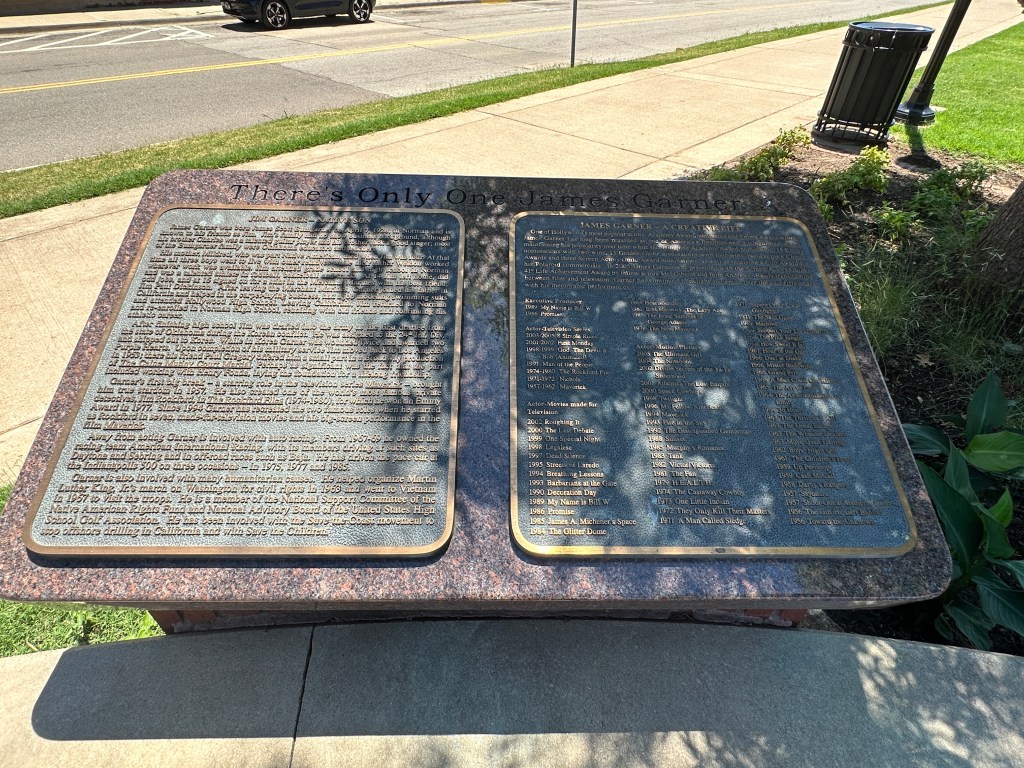
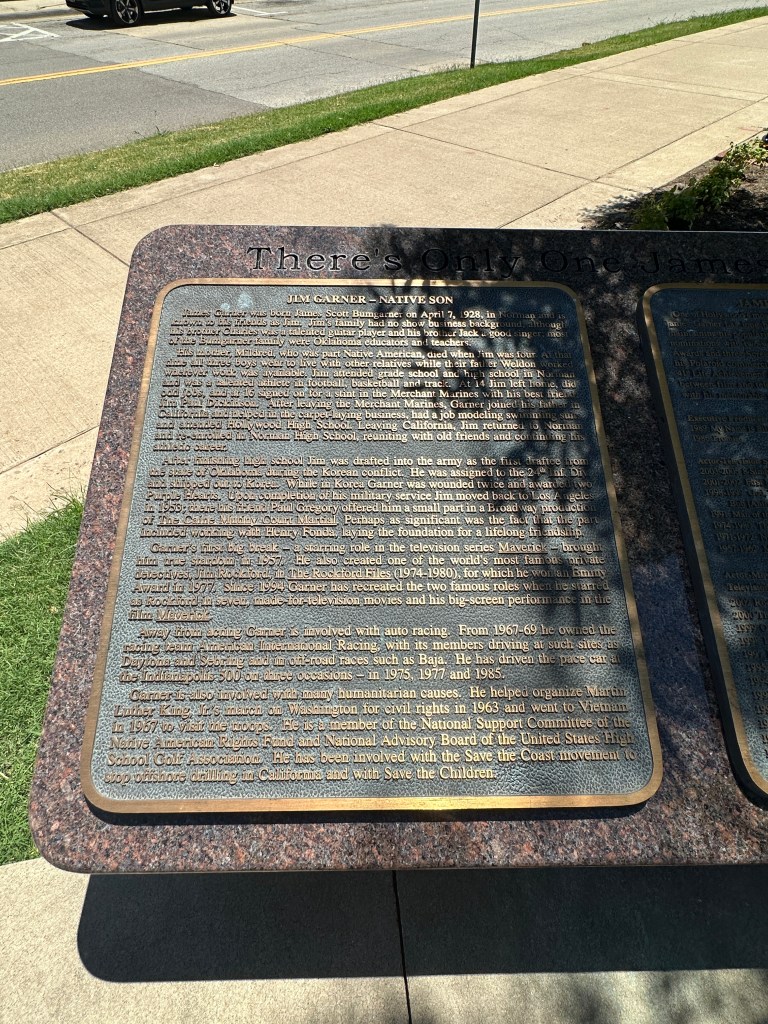
“James Garner was born James Scott Bumgarner on April 7, 1928, in Norman and is known to his friends as Jim. Jim’s family had no show business background although his brother Charles was a talented guitar player and his brother Jack a good singer; most of the Bumgarner family were Oklahoma educators and teachers.
His brother Mildred, who was part Native American, died when Jim was four. At that time all three boys went to live with other relatives while their father Weldon worked whatever work was available. Jim attended grade school and high school in Norman and was talented in football, basketball and track. At 14 Jim left home, did odd jobs, and at 16 signed on for a stint in the Merchant Marines with his best friend Jim Paul Dickinson. After leaving the Merchant Marines, Garner joined his father in California and helped in the carpet-laying business, had a job modeling swimming suits and attended Hollywood High School. Leaving California, Jim returned to Norman and re-enrolled in Norman High School, reuniting with old friends and continuing his athletic career.
After finishing high school Jim was drafted into the army as the first draftee from the state of Oklahoma during the Korean conflict. He was assigned to the 24th Inf. Div. and shipped out to Korea. While in Korea Garner was wounded twice and awarded two Purple Hearts. Upon completion of his military service Jim moved back to Los Angeles in 1953; there his friend Paul Gregory offered him a small part in a Broadway production of The Caine Mutiny Court Martial. Perhaps as significant was the fact that the part included working with Henry Fonda, laying the foundation for a lifelong friendship.
Garner’s first big break – a starring role in the television series Maverick – brought him true stardom in 1957. He also created one of the world’s most famous private detectives, Jim Rockford, in The Rockford Files (1974-1980), for which he won an Emmy Award in 1977. Since 1994 Garner recreated the two famous roles when starred as Rockford in seven made-for-television movies and his big-screen performance in the film Maverick.
Away from acting Garner is involved with auto racing. From 1967-69 he owned the racing team American International Racing, with its members driving at such sites as Daytona and Sebring and in off-road races such as Baja. He has driven the pac car at the Indianapolis 500 on three occasions – in 1975, 1977 and 1985.
Garner is also involved with many humanitarian causes. He helped orangish Martin Luther King, Jr.’s march on Washington for civil rights in 1963 and went to Vietnam in 1967 to visit the troops. He is a member of the National Support Committee of the Native American Rights Fund and National Advisory Board of the United States High School Golf Association. He has been involved with the Save the Coast movement to stop offshore drilling in California and with Save the Children.”
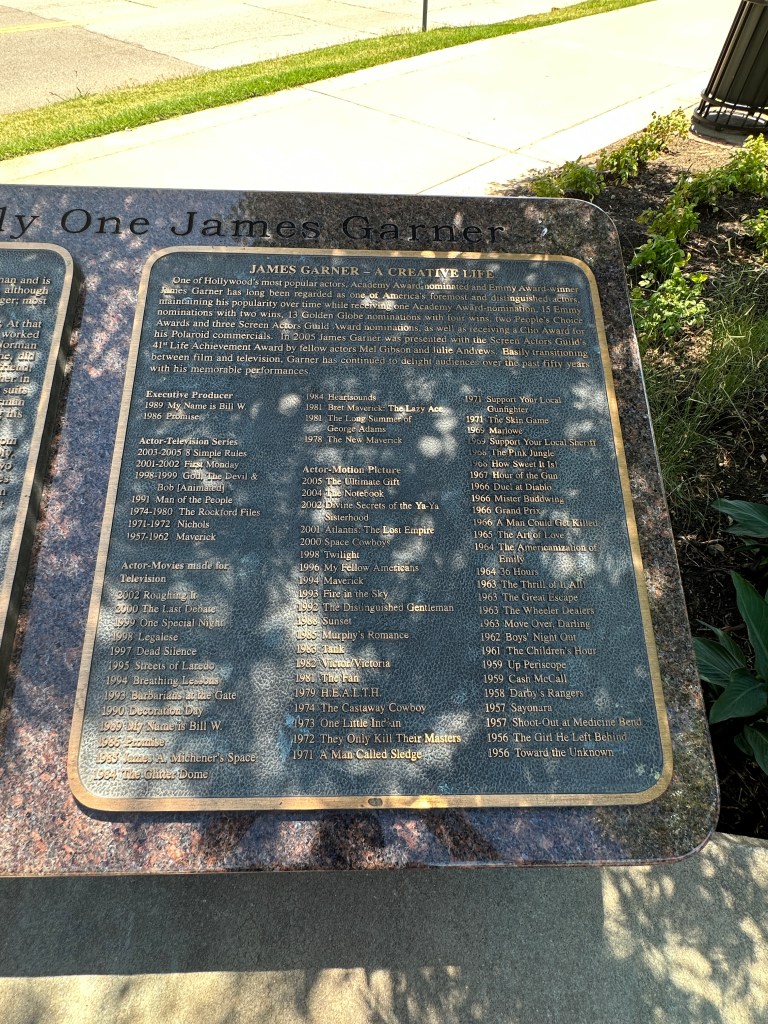
“One of Hollywood’s most popular actors, Academy Award-nominated and Emmy Award-winner James Garner has long been regarded as one of America’s foremost and distinguished actors, maintaining his popularity over time while receiving one Academy Award-nomination, 15 Emmy nominations with two wins, 13 Golden Globe nominations with four wins, two People’s Choice Awards and three Screen Actors Guild Award nominations, as well as receiving a Clio Award for his Polaroid commercials. In 2005 James Garner was presented with the Screen Actors Guild’s 41st Lifetime Achievement Award by fellow actors Mel Gibson and Julie Andrews. Easily transitioning between film and television, Garner has continued to delight audiences over the past fifty years with his memorable performances.”
Concluding Thoughts
This post does not contain photos of all the statues or markers located along this trail. I walked a small portion of this trail and need to go back and finish walking the entirety of it when I can convince a friend to go with me!
In the mean time, I hope you enjoyed seeing a few markers and will check it out next time you visit Norman.
Happy Traveling! I’ll talk to ya soon 🙂


Leave a Reply